The devlog opens, and the game gets research, a vault and a new cockpit
The devlog opens. Ships are now made of parts, there is a lab, a vault and prices that move, and the game has a new interface with a map of the system and research as a tree.
This is the first day of the Supergalactic devlog. From now on there is one entry a day, and it describes what changed in the game, its engine and this site, with pictures of what it looks like.
Where it stands
Supergalactic runs on an engine that generates a whole universe from a single number. Every galaxy, star, planet, moon and rock is generated when you look at it, always in the same way, and placed on its real orbit. Since October 3rd the game itself has been built on top of it. The first thing we built is mining. You fly out, mine, fly home and sell. A pilot starts docked at Galuromus d’s station with 2 000 credits and the start kit, flies to the Trojan rocks of the neighboring giant, mines the fuel for the way home and sells the rest.
Everything runs on the server’s clock, which runs a thousand times faster than ours and is the same for every pilot. A flight to the moon takes a minute and the trip to the rocks most of an hour. The ship keeps flying while your phone is in your pocket.
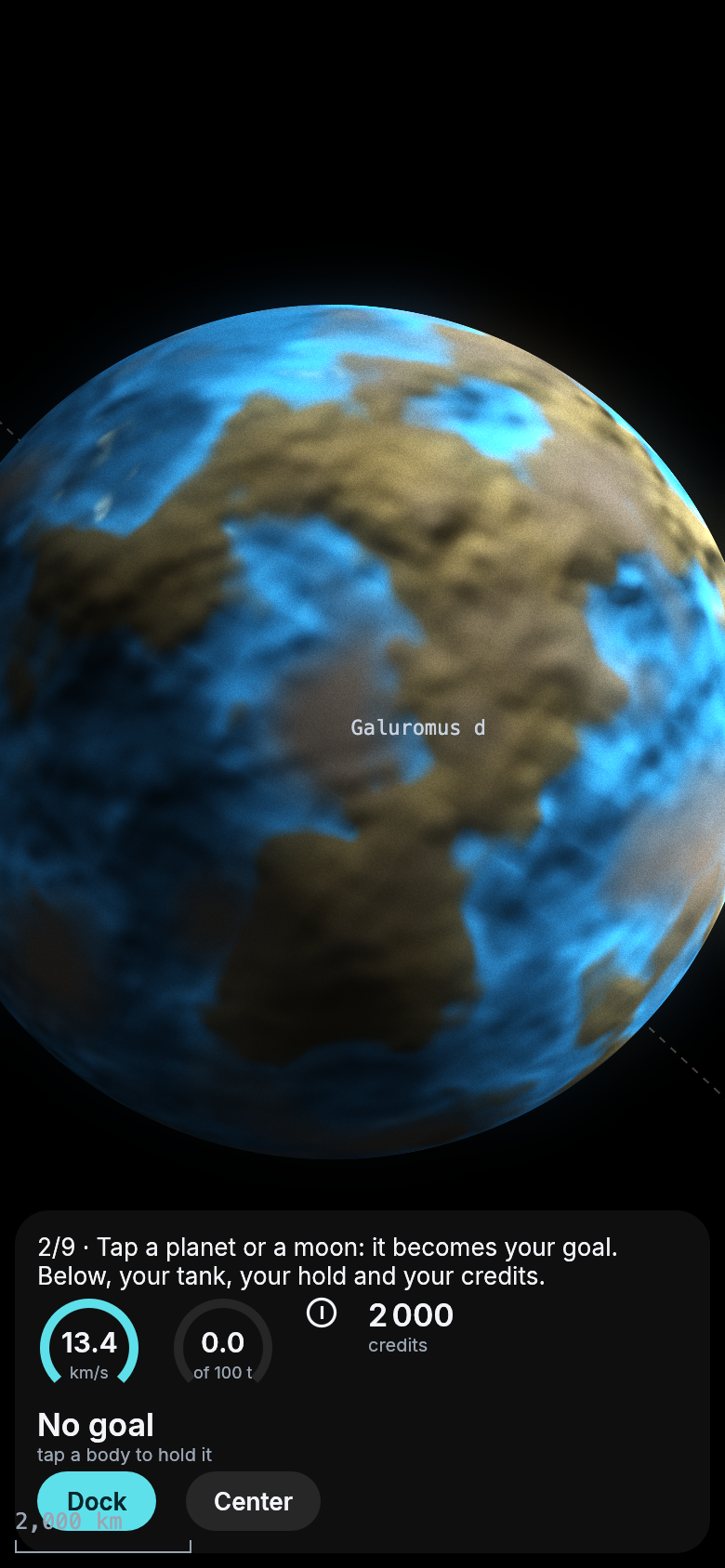
Galuromus d, where every pilot starts. It is an ocean world in the Galuromus system.
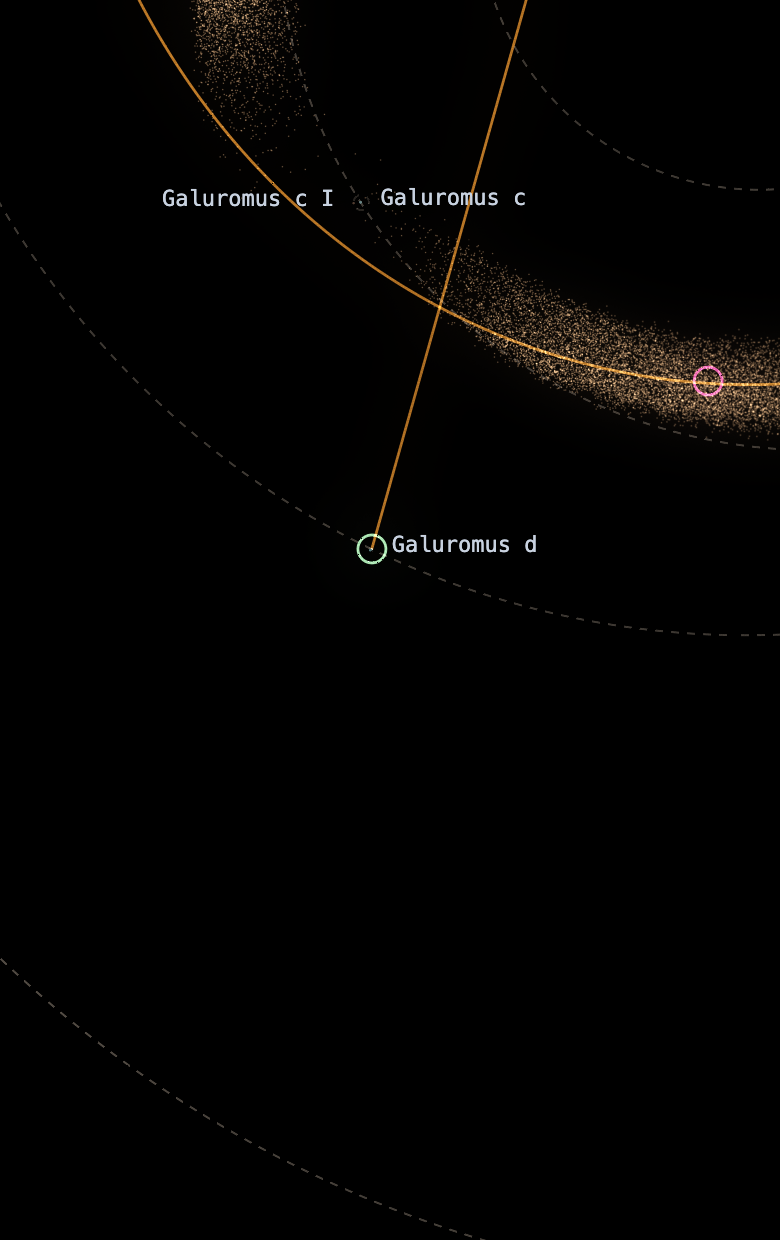
Underway to the Trojans. The course is drawn in amber and the target rock is ringed in magenta.
Parts, a lab, a vault and moving prices
With mining working, the next step is what the credits and the rock are for.
- Ships are made of parts. A ship is now a hull with parts in its slots, such as a drive, a tank, a hold, a mining head and an extractor, and what it can do is the sum of its parts. The start kit flies as before, and later updates can build better parts and fit them.
- The lab. A research costs credits, materials and time on the universe’s clock. The first one takes two minutes, tier 1 takes ten and tier 2 an hour. Only one runs at a time, and it keeps going while you are away.
- The vault. Vault I is the lab’s first research and a step of the tutorial. It opens a store that belongs to you and to no station. Whatever you put in is there at every station, and losing the ship does not lose it. The vault also pays for research when the hold runs short. Construction I makes it 500 tonnes and Construction II 2 000.
- Prices that move. Every station keeps a stock of what it trades, and the fuller the stock, the less the station pays. A trip’s 30 tonnes of silicate move the price by one credit, and a thousand tonnes take it from 50 to 35. Left alone, a stock recovers within a day. A sale is always paid at the price the station showed you.
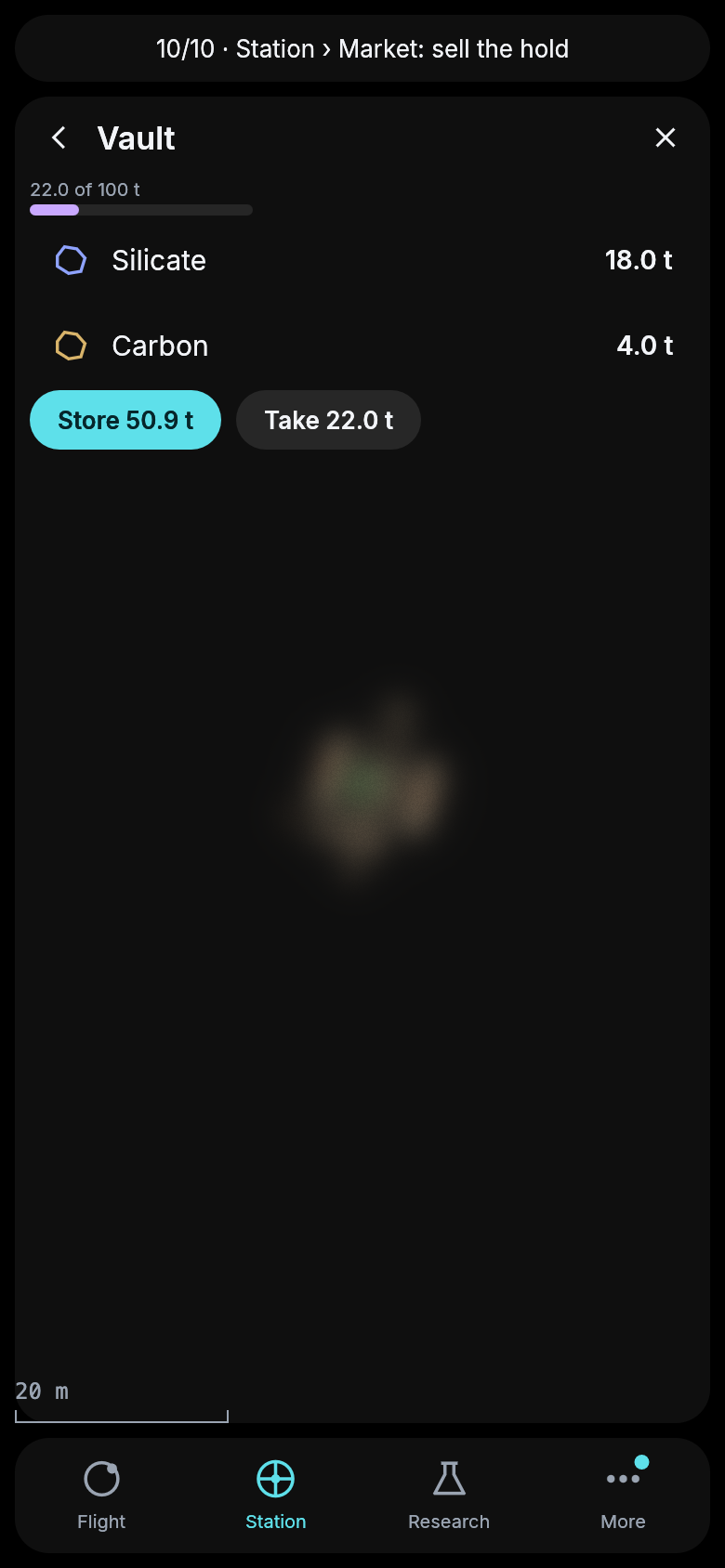
The vault at Galuromus d’s station.
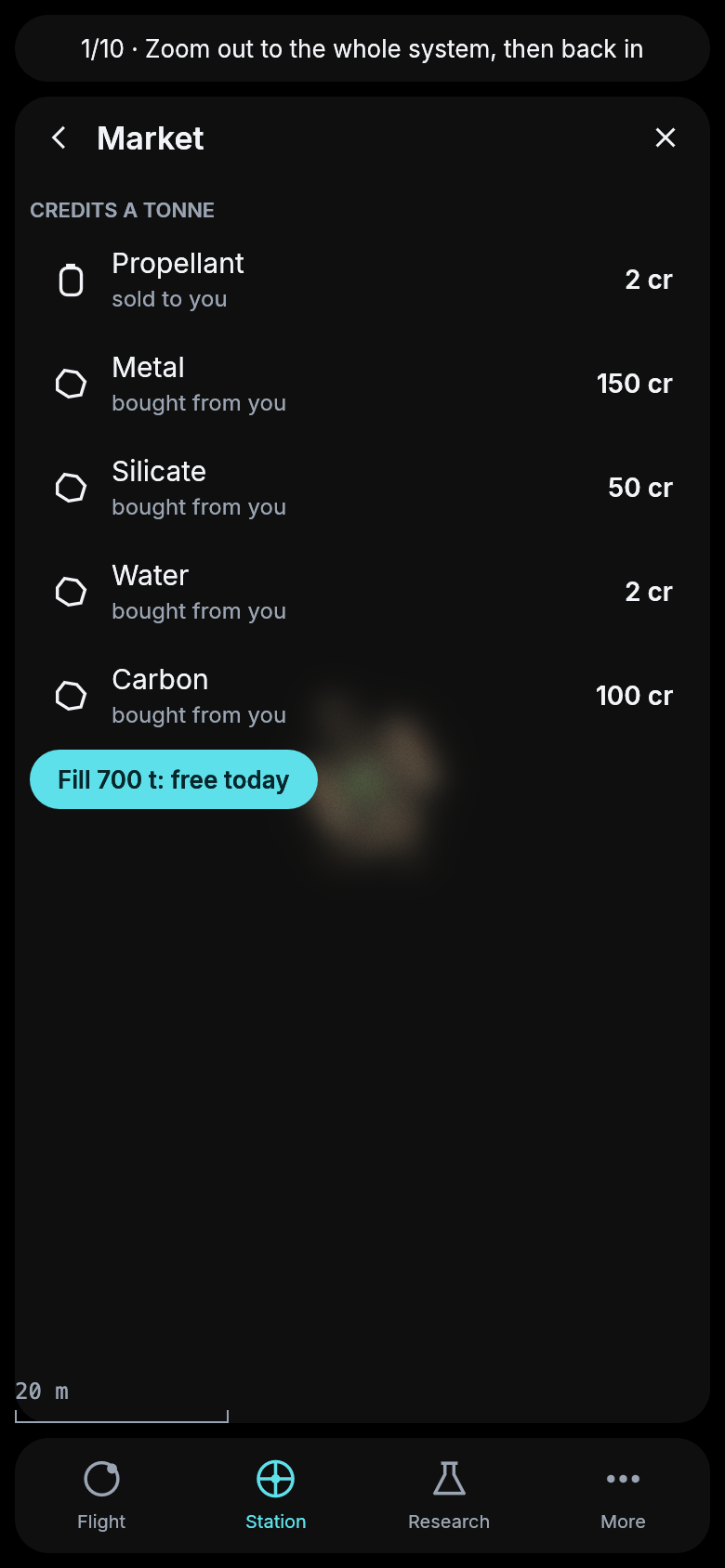
Galuromus d’s market at rest. Silicate pays 50, carbon 100 and metal 150 credits a tonne.
A new cockpit
Until today the cockpit was a single strip along the bottom of the screen that held everything, and a sheet rose over the map with the market, the vault and the lab stacked in one long column. It was too cramped, and the feedback on the station sheet was blunt. It is now replaced by the interface concept decided this morning, built on new parts of the engine.
- The line at the top shows the tutorial’s current step. Tap it to open what the step is about.
- The card at the bottom shows what you are doing right now. It has two thin bars for the tank and the hold, your credits, your goal or where you are, and the one action to press, with at most one other action beside it.
- The bar holds the sections Flight, Navigation, Station while you are docked, Research and More. Each section is a list whose rows open a detail page.
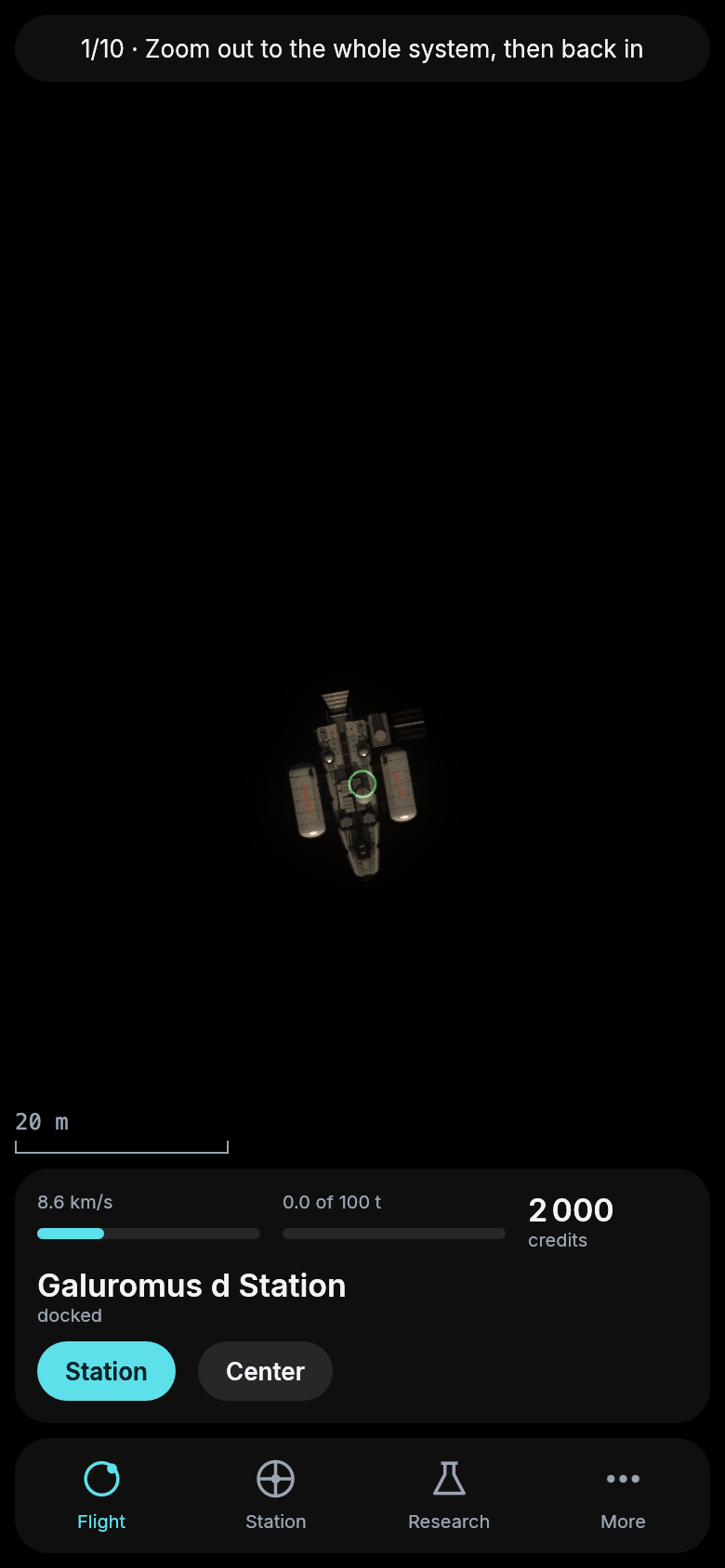
Docked at Galuromus d. Everything on the screen has its own place.
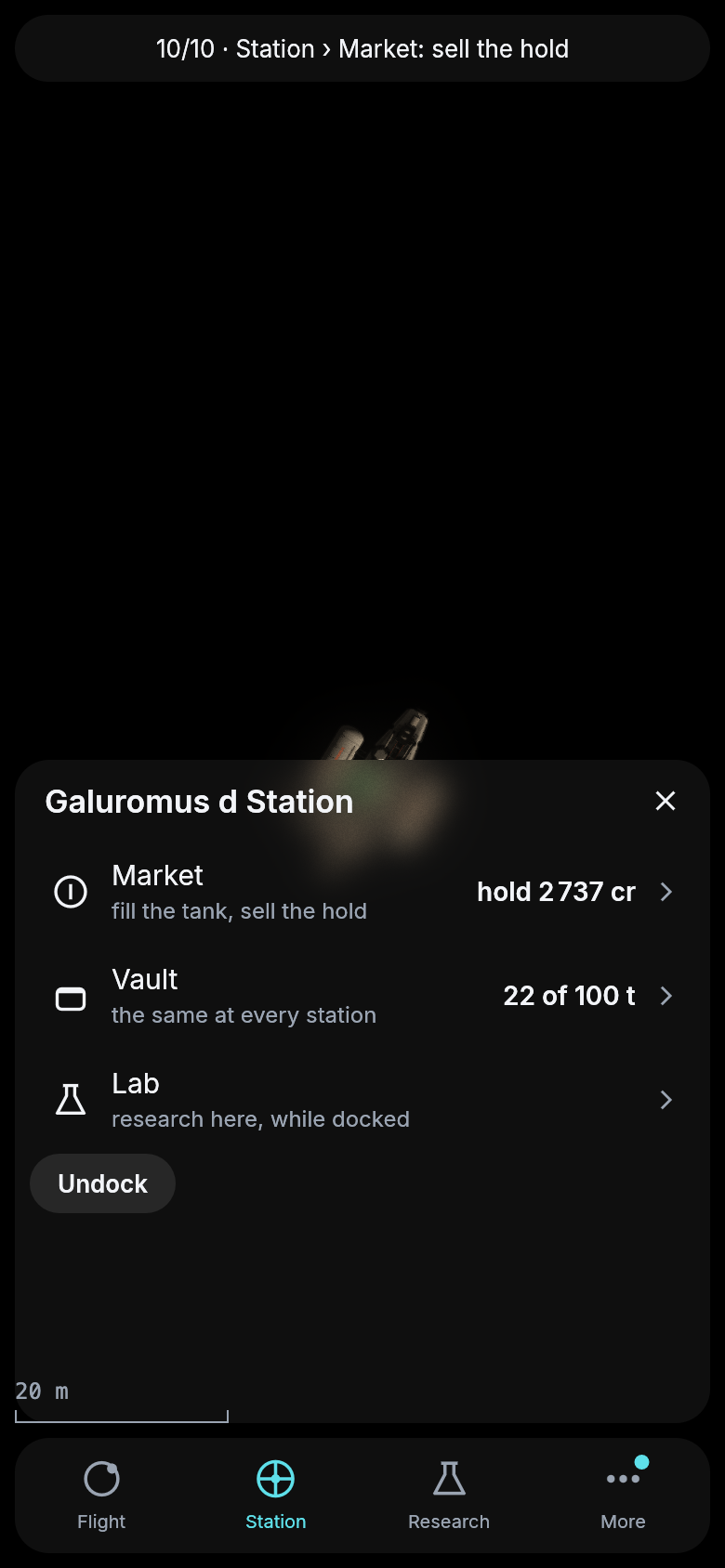
The station is now three rows instead of one column holding everything.
On a tablet or a computer the sections sit in a rail on the left and open as a panel beside it, so the map stays in view.
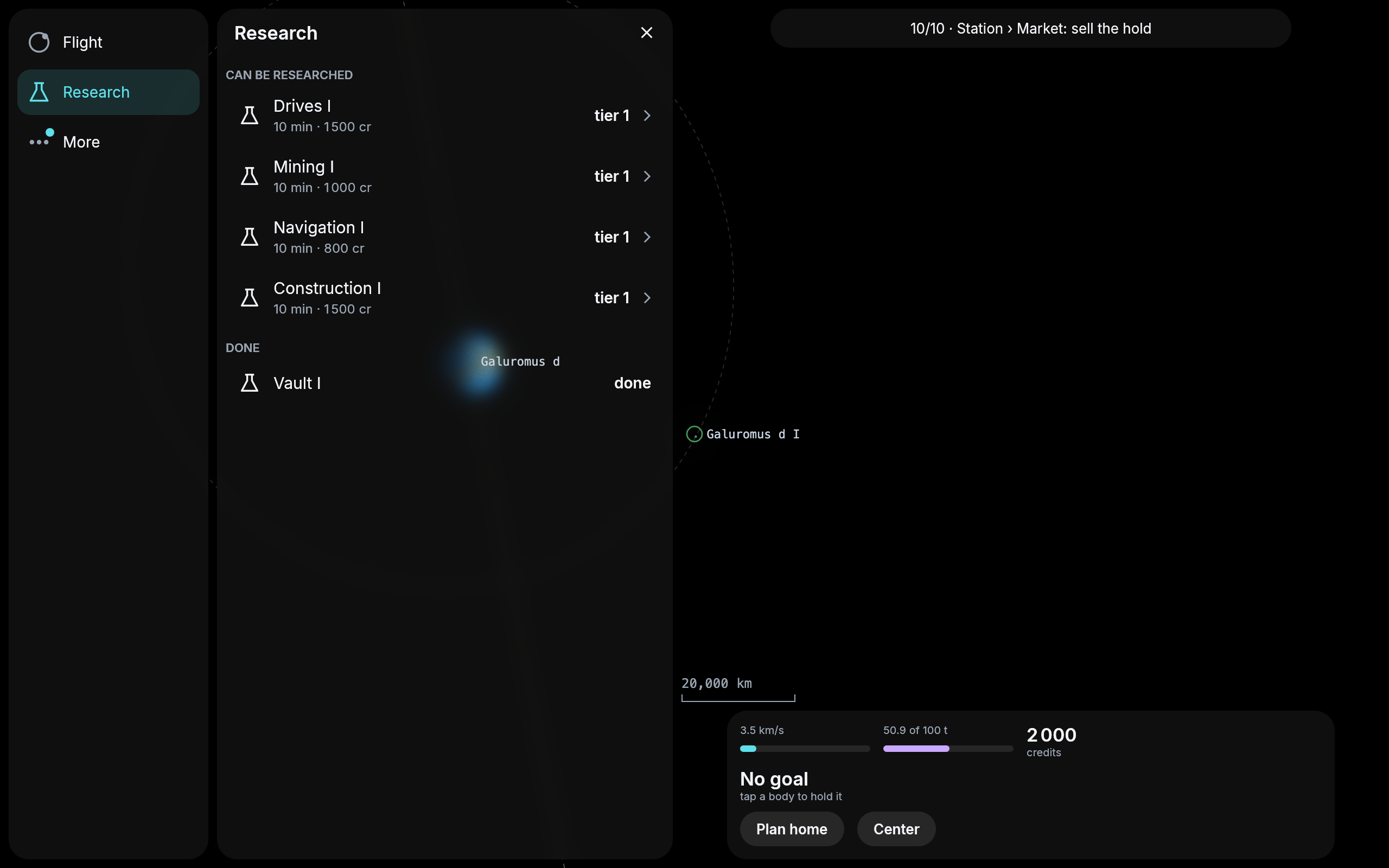
The same cockpit at 1 280 pixels wide.
Navigation
The new Navigation section shows the whole system as a map, with the star, every orbit, the planets where they are right now, the station and your ship. Under the map is everything near you, nearest first, with a search field. Tap a body to see what it is and how far away it is. Center moves the view there, Goal makes it your goal, and Plan makes it your goal and asks for the way there.
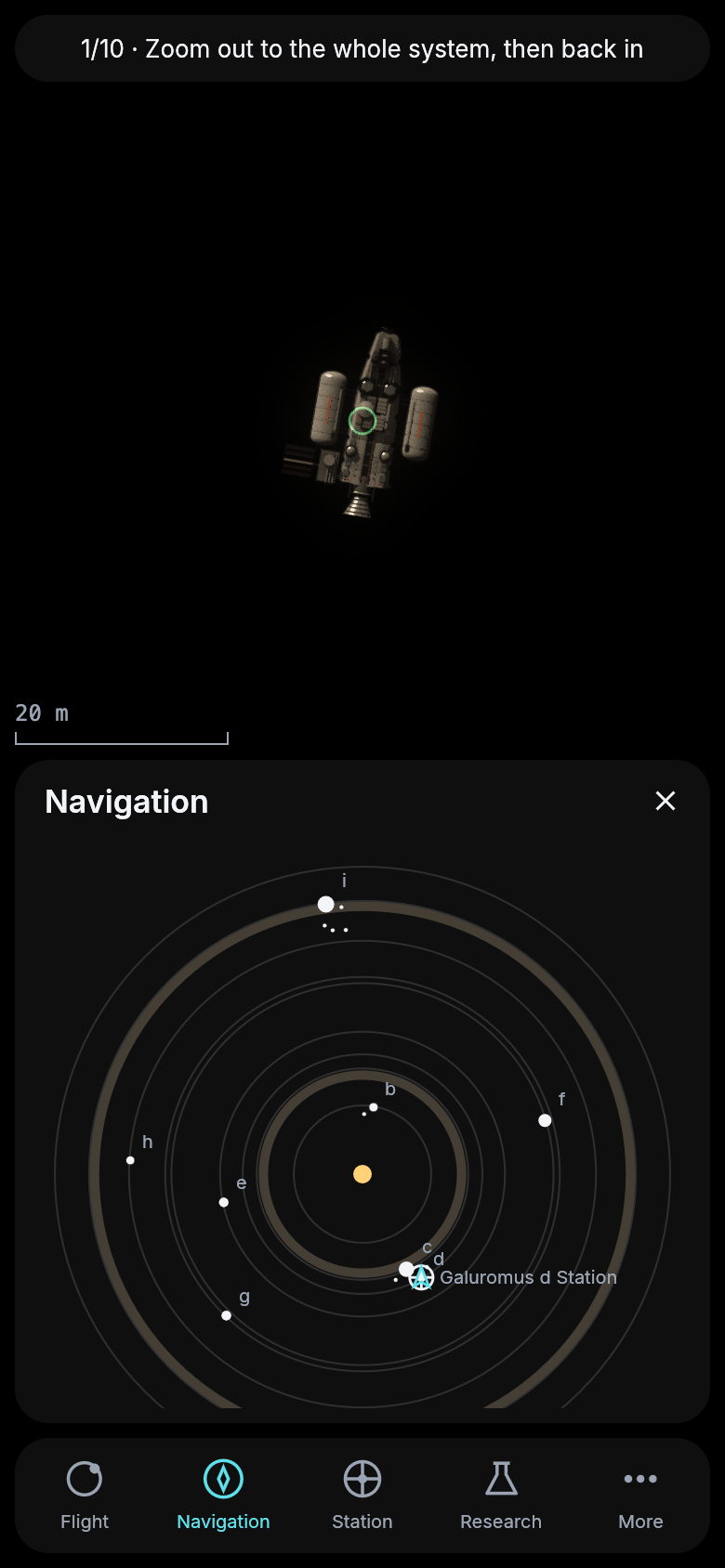
The orbits are drawn at the logarithm of their size, so the inner planets and the far giant fit on one screen.
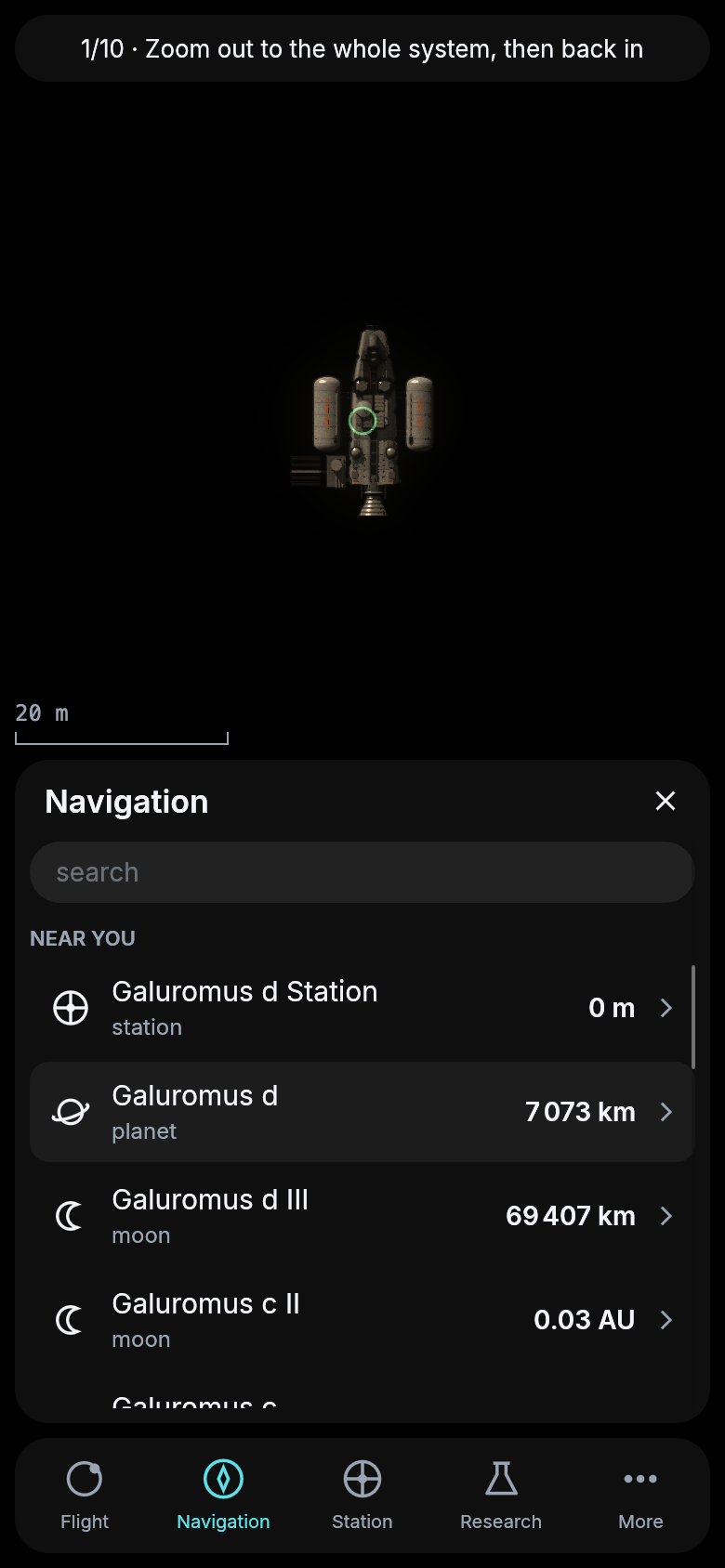
Everything near you, nearest first.
On a computer your goal gets a card right next to it on the map, and resting the mouse on any body shows its name and how far it is from your ship.
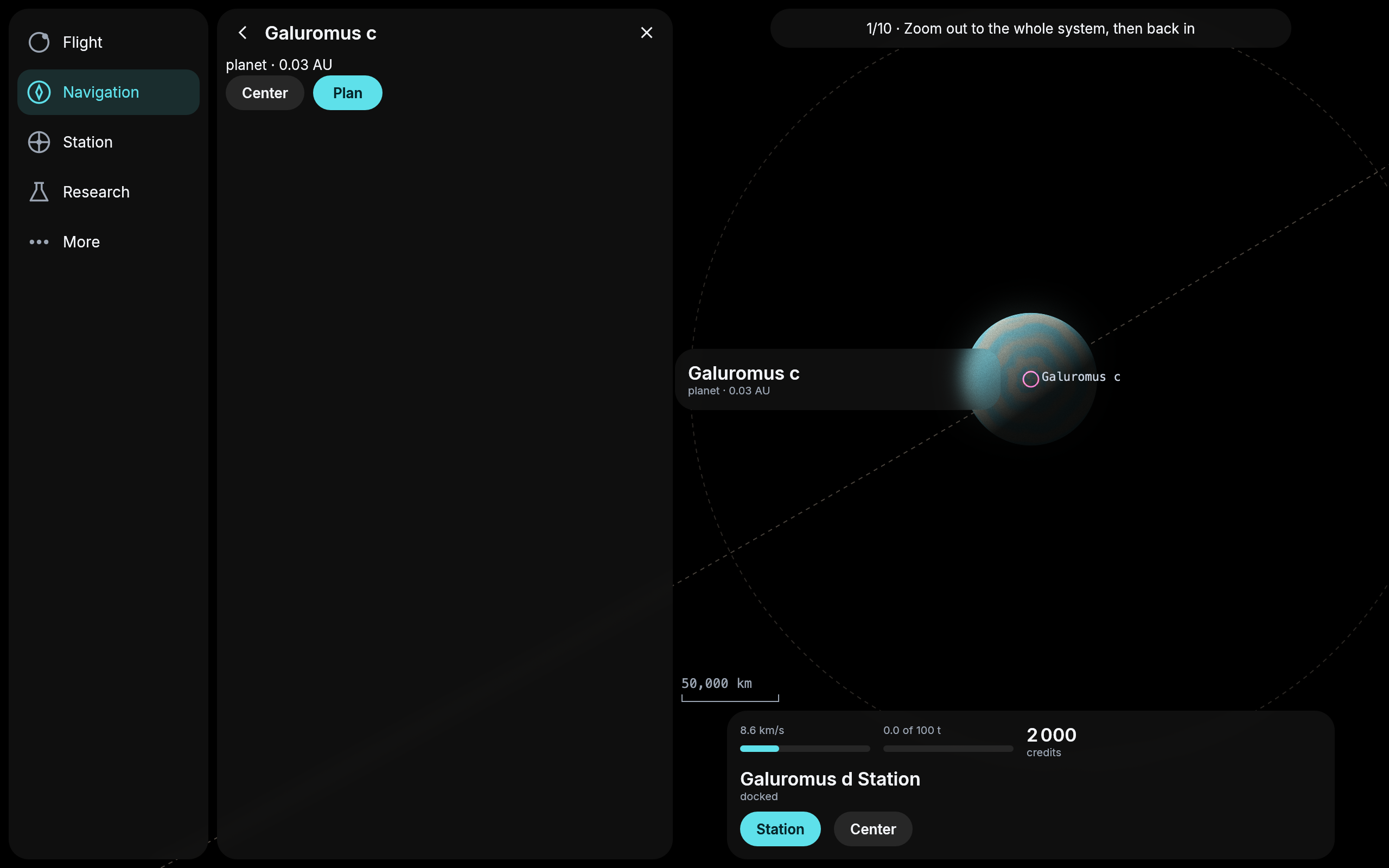
Galuromus c centered from Navigation, with its card beside it.
Research as a tree
The Research section is now a tree. Each research is a node that is done, running with a ring that fills up, open with its time and credits, or locked with a small padlock, and lines show what comes before what. Each row is a branch and each column a tier, so a branch reads from left to right, for example Mining I and then Mining II.
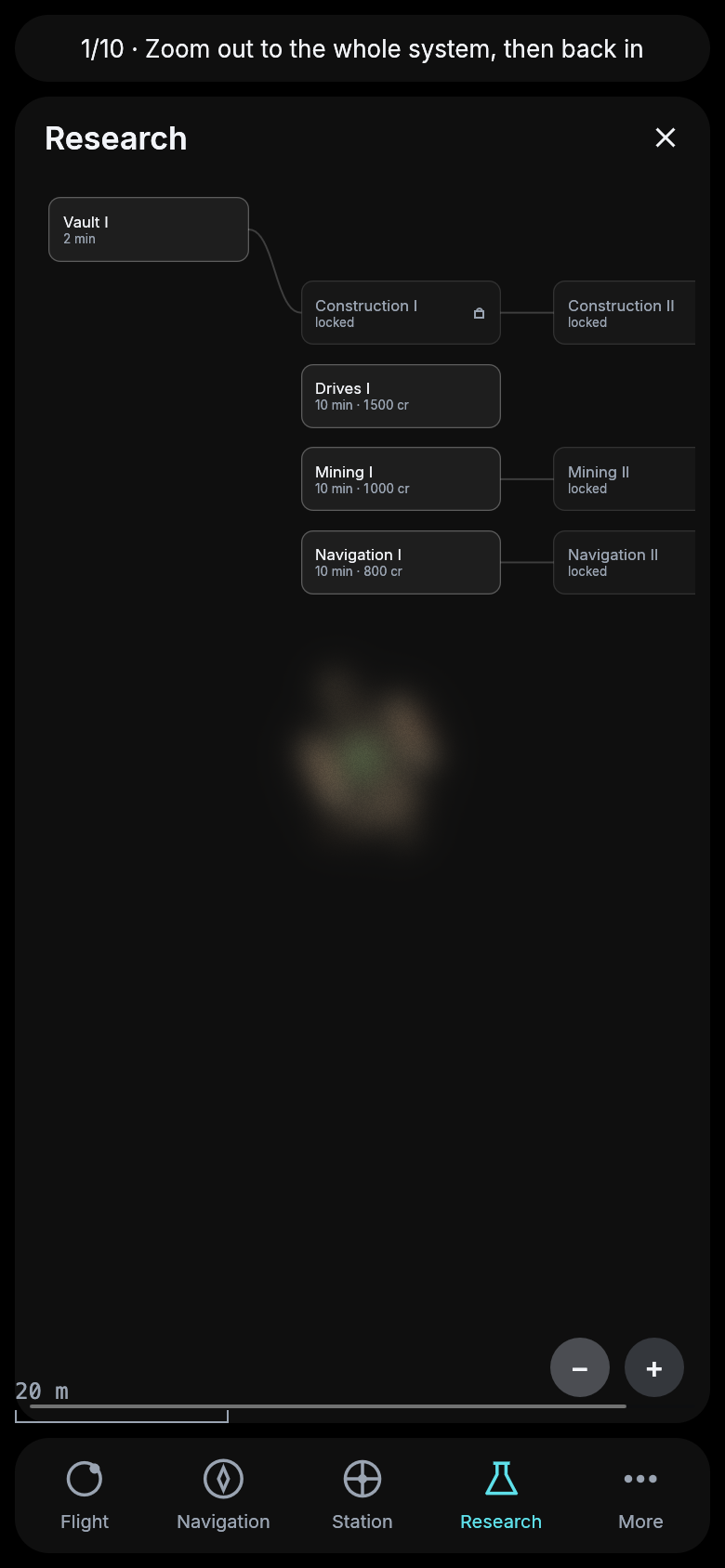
The tree at the start of the game.
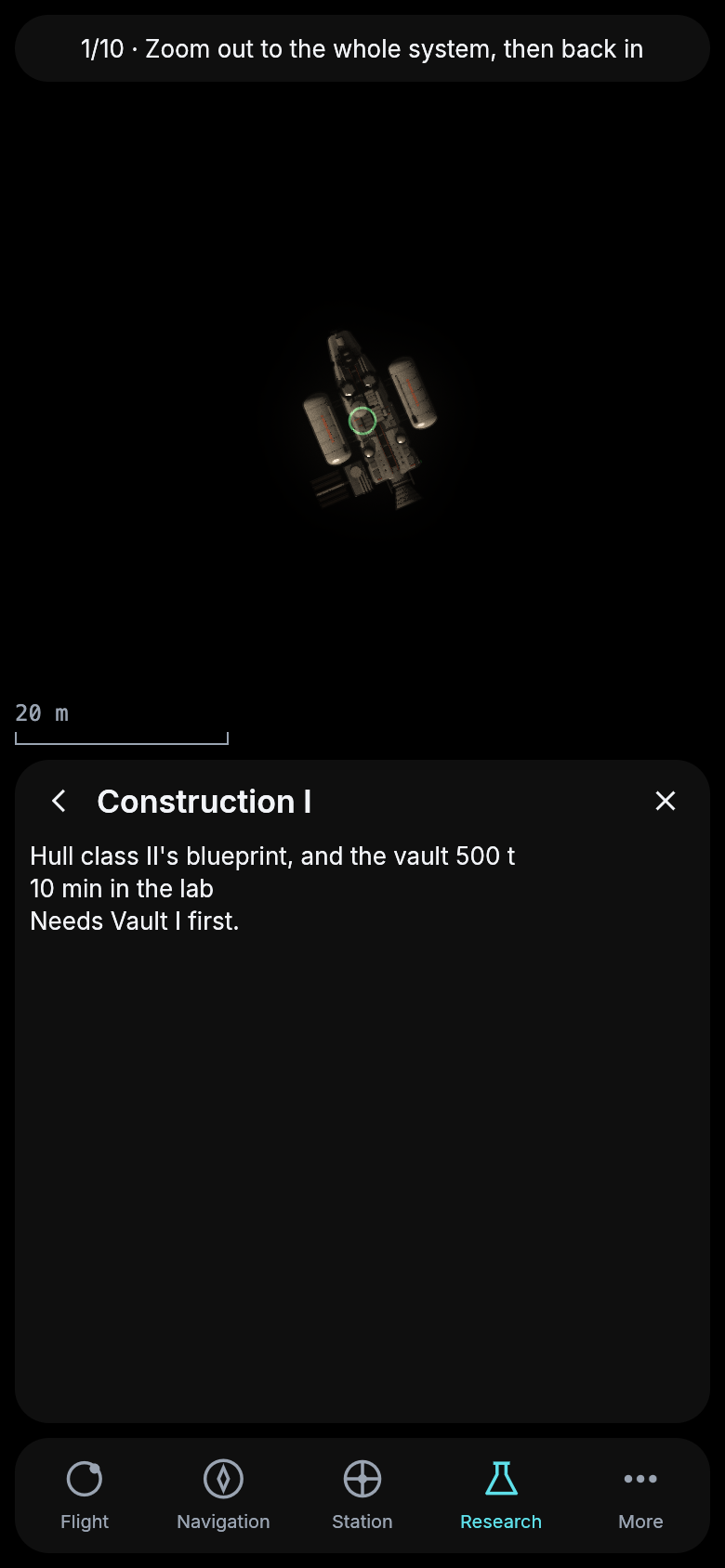
A locked research shows what it unlocks, how long it takes and what it needs first.
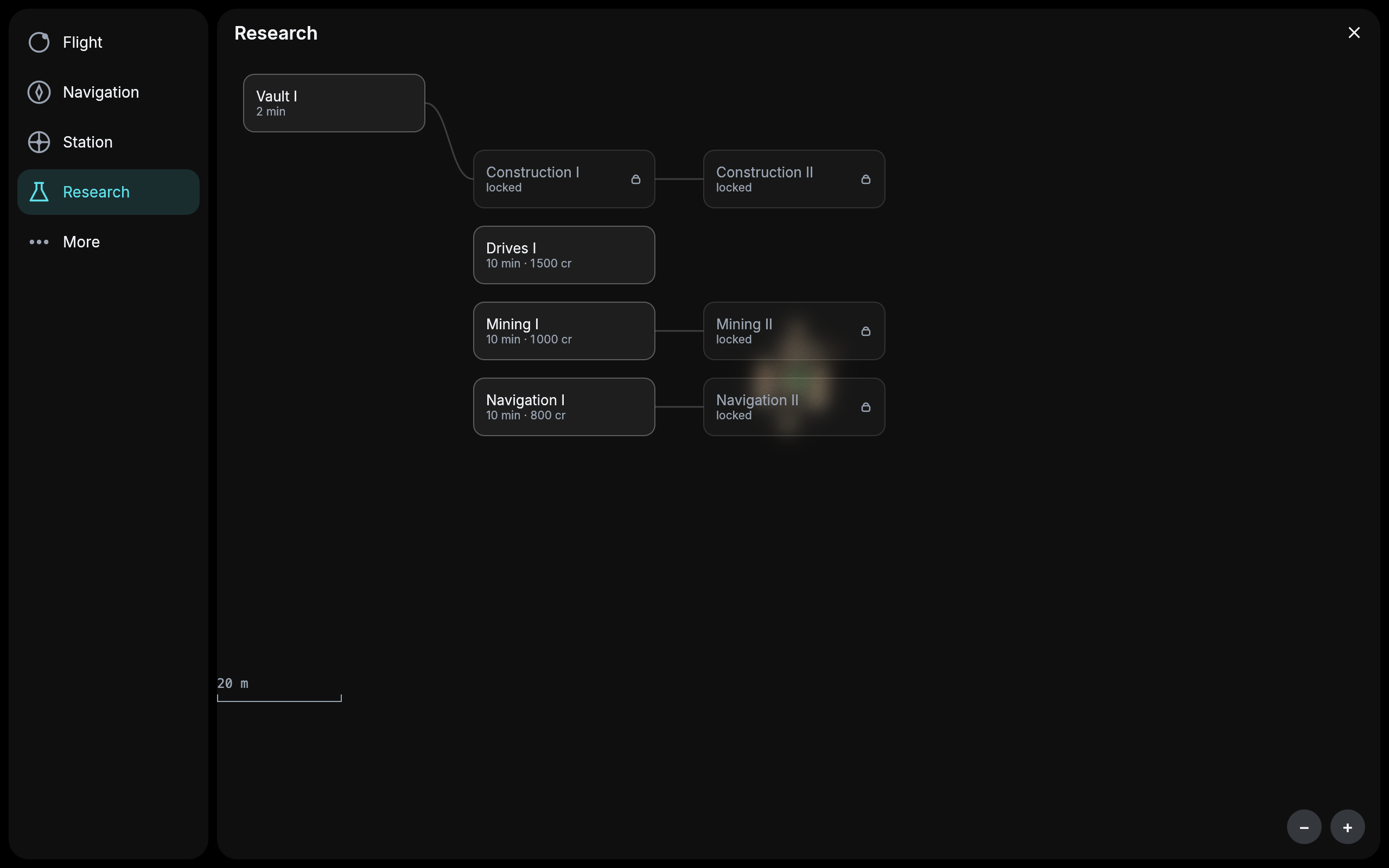
On a tablet or a computer the tree takes all the space the map normally has.
The tree shows everything there is to research, including what you cannot start yet.
Your ship in one place
The new Ship section shows your ship’s figures, what it is built of and what it carries. At the top are how much speed your tank can still give you, what a full tank would give, the ship’s mass, and how full the tank and the hold are. Below that is every part of the ship with its stage, and at the bottom what the hold carries, each material with what the station would pay for it right now, and how full your vault is.
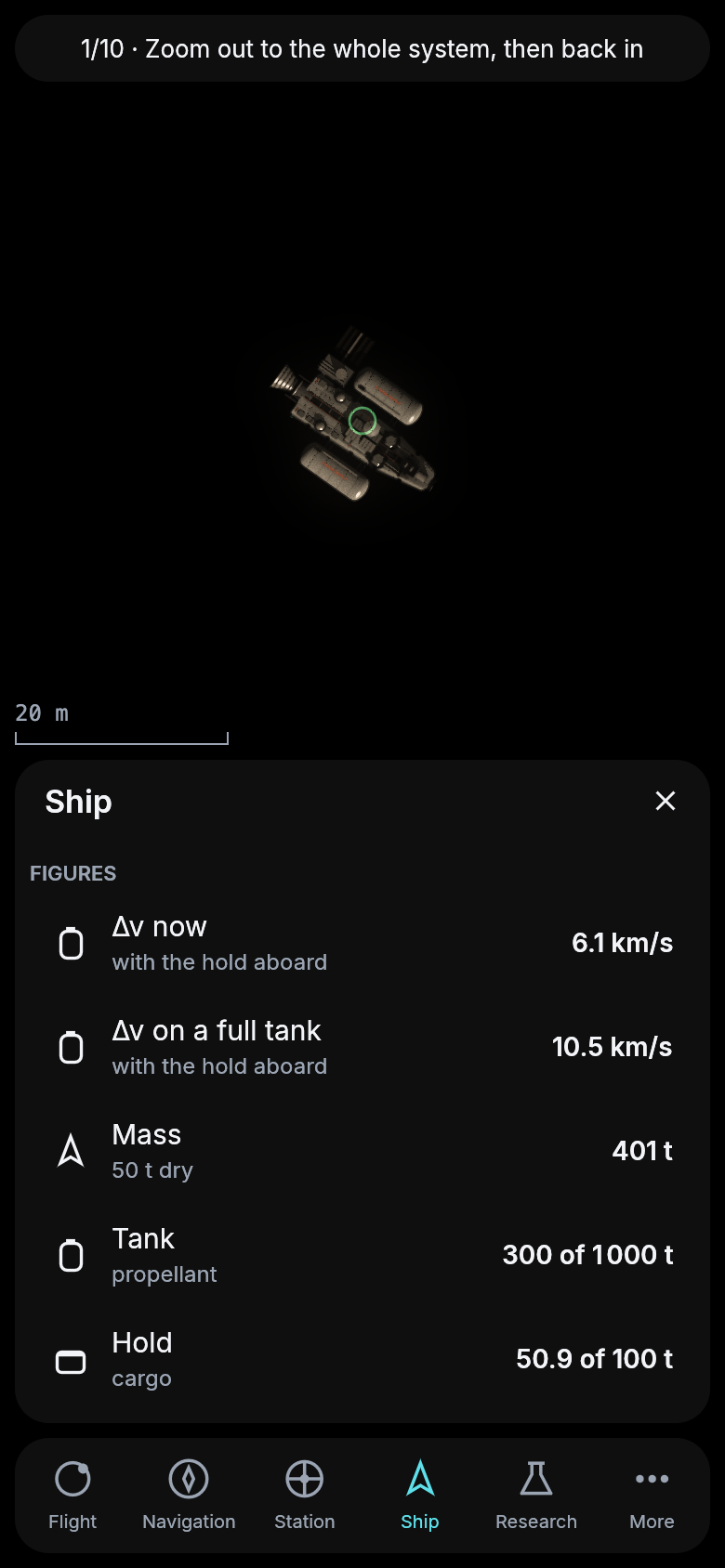
The start kit with 300 tonnes of propellant and a hold of 50.9 tonnes.
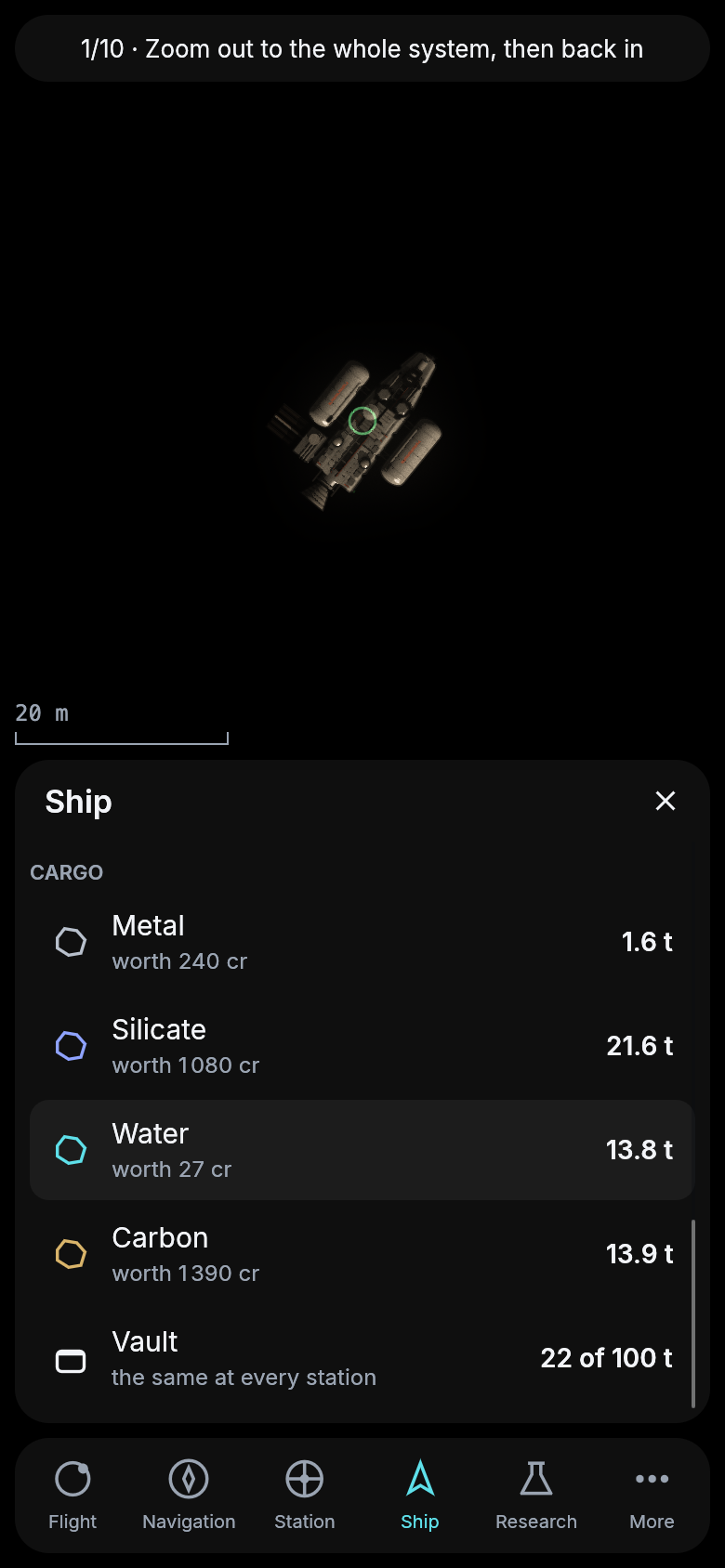
What a trip to the Trojan rocks brings home, and what the station would pay for it.
Next up is the yard, where blueprints become parts.