A fusion drive for every ship
Every ship now starts with a fusion drive, and the tutorial's trip brings you home sooner. The ship's computer answers from anywhere on the way, the rocks near Galuromus c swing in families so the next one is a short hop, and propellant is worth paying for.
Free fills through the tutorial, and a goal you can drop
The tutorial asks you to fill your tank before you plan the way to the rock, and that used up the day’s free fill. The flight to the rock then needed a second fill that cost credits. Now every fill is free until the tutorial is done. After that, the first fill of each day stays free as before.
On the card, a goal you hold now has a small × beside its name that drops it. Center, which brings the view back to your ship, is on the card again whenever nothing else needs that place. The list of blueprints now says that a part takes its minutes aboard your ship, and a ship, a mine or a station its minutes at the station.
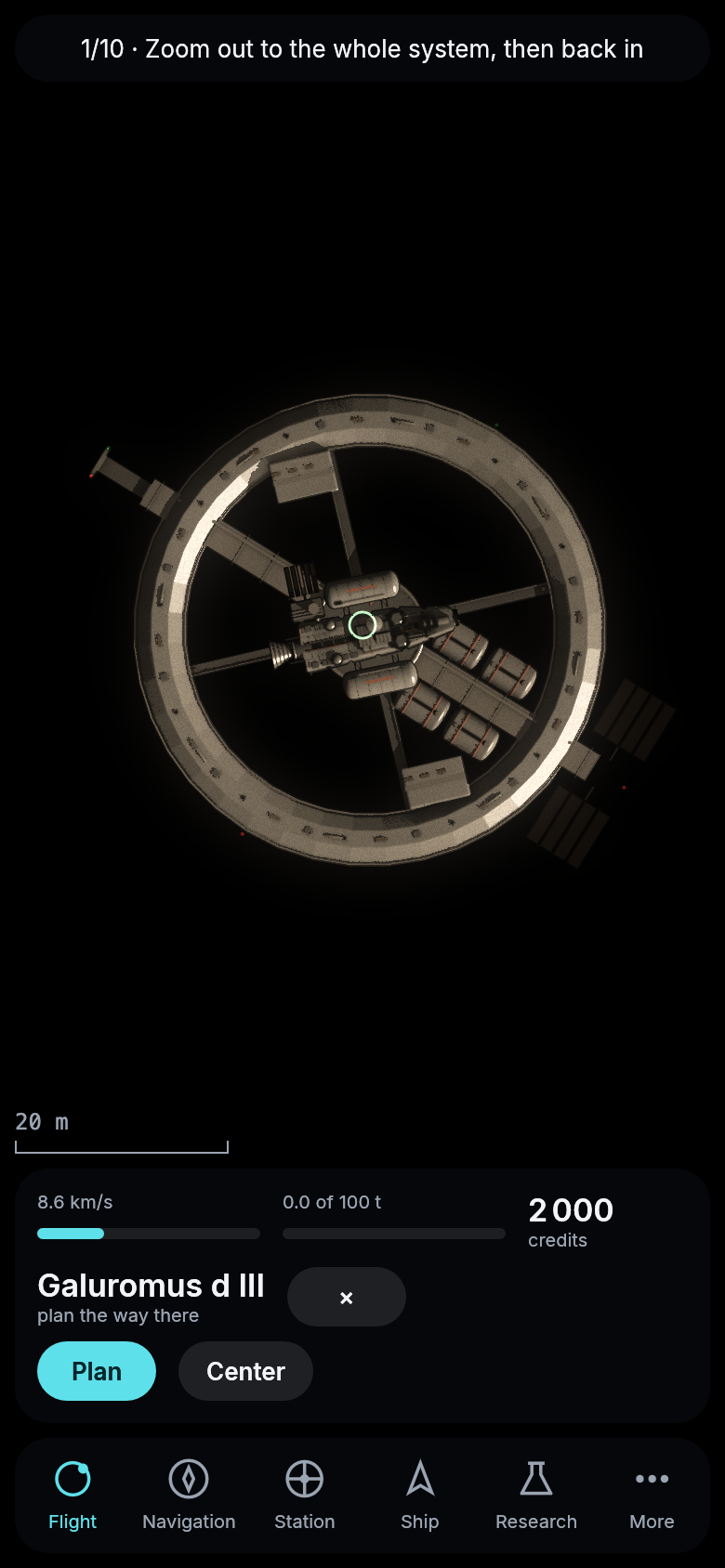
Docked at Galuromus d’s station with its moon as the goal.
A way home from the rock, whenever you ask
Sometimes the navigation computer told a pilot beside the rock that there was no way home, even with a full tank. Ask again an hour later and it found one that cost far less than the tank held. The computer looks for the way home over one full round of the two worlds, the time until the rock and your home planet stand the same way again. It worked that round out from where the two were at the moment you asked. Your home planet’s orbit is an oval, so on some days that guess came out a fifth too short, and the cheap way home fell in the part it never looked at.
Now it times the round by how the rock and the planet really move. Asked from beside the rock at any of 36 moments spread over two years, it finds a way home every time on a full tank, and twice a way a good deal cheaper than before.
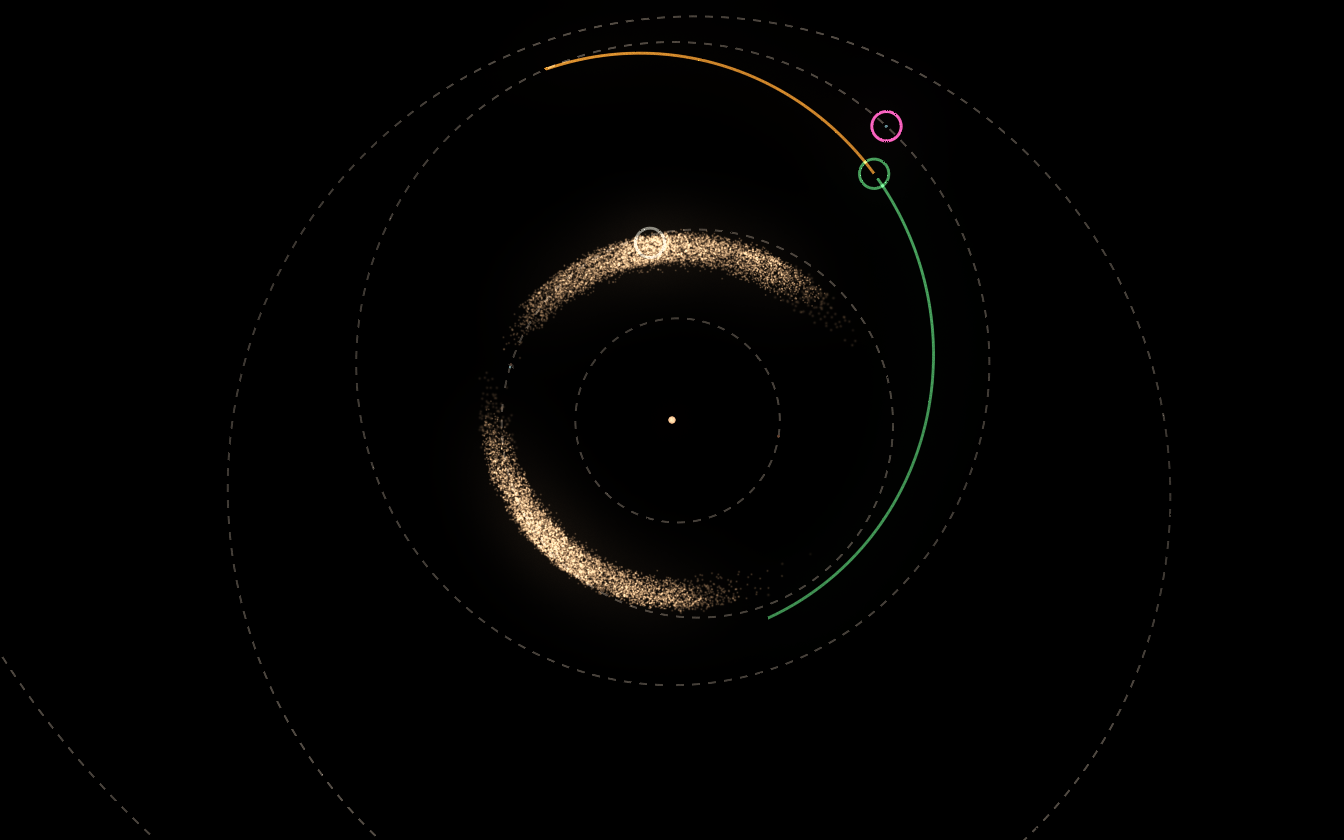
Halfway home from B-178 in Galuromus c’s Trojan clouds. Green is the way flown since leaving the rock, which is the white ring on the clouds. Orange is the course still ahead, and the pink ring is Galuromus d.
Turn back, or pick a new goal, on the way
Once a ship was on its way, the navigation computer had nothing more to say. Ask it for a new course halfway to the moon or halfway to Galuromus c and it answered with no way at all, so a pilot who changed their mind had to fly the whole trip first.
The computer can now plan from wherever the ship is. Halfway to d III it finds a way back to Galuromus d, on to the moon, to the station, or even out to c or the rock B-178. Halfway to c it still finds the way home. It works out where your ship will really drift if you do nothing, with every planet and moon pulling on it, and plans the new course from there. A turn that would only come after you have swung past c is planned with c’s pull in it, so it does not promise a cheap way back that the flyby would ruin.
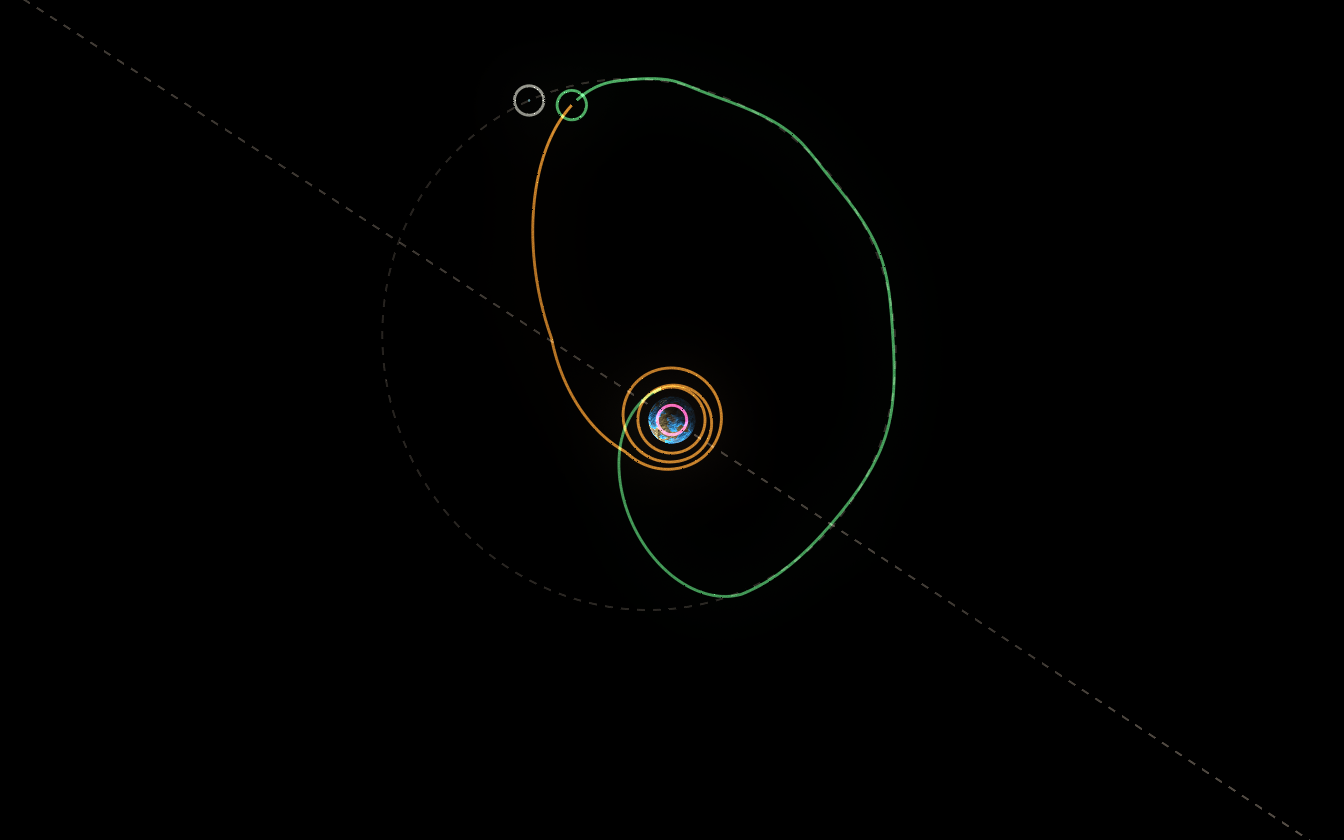
Halfway to the moon Galuromus d III and turned back. Green is the way flown, past the halfway point and round to the turn beside the moon, which is the white ring. Orange is the way home to Galuromus d, the pink ring, ending in loops around the planet while the ship settles into its orbit.
From a moon to the rocks in one plan
Some trips have to leave one planet’s pull and enter another’s. Parked over the moon d III, the navigation computer could not plan a way to the rocks at all, and from the rock to the station it took two separate plans that the game had to string together.
Now such a trip is one plan in two legs. The first takes you to an orbit around Galuromus d, half way out to the moon when the moon is one end, or just inside the station’s orbit when the station is. The second leg starts from there. That stop in between was the cheapest of the ones measured, and on the starter ship’s full tank every one of these trips fits, from 10 to 13 km/s depending on when you leave. From the open space between the planets you can now also head straight for a moon or a station.
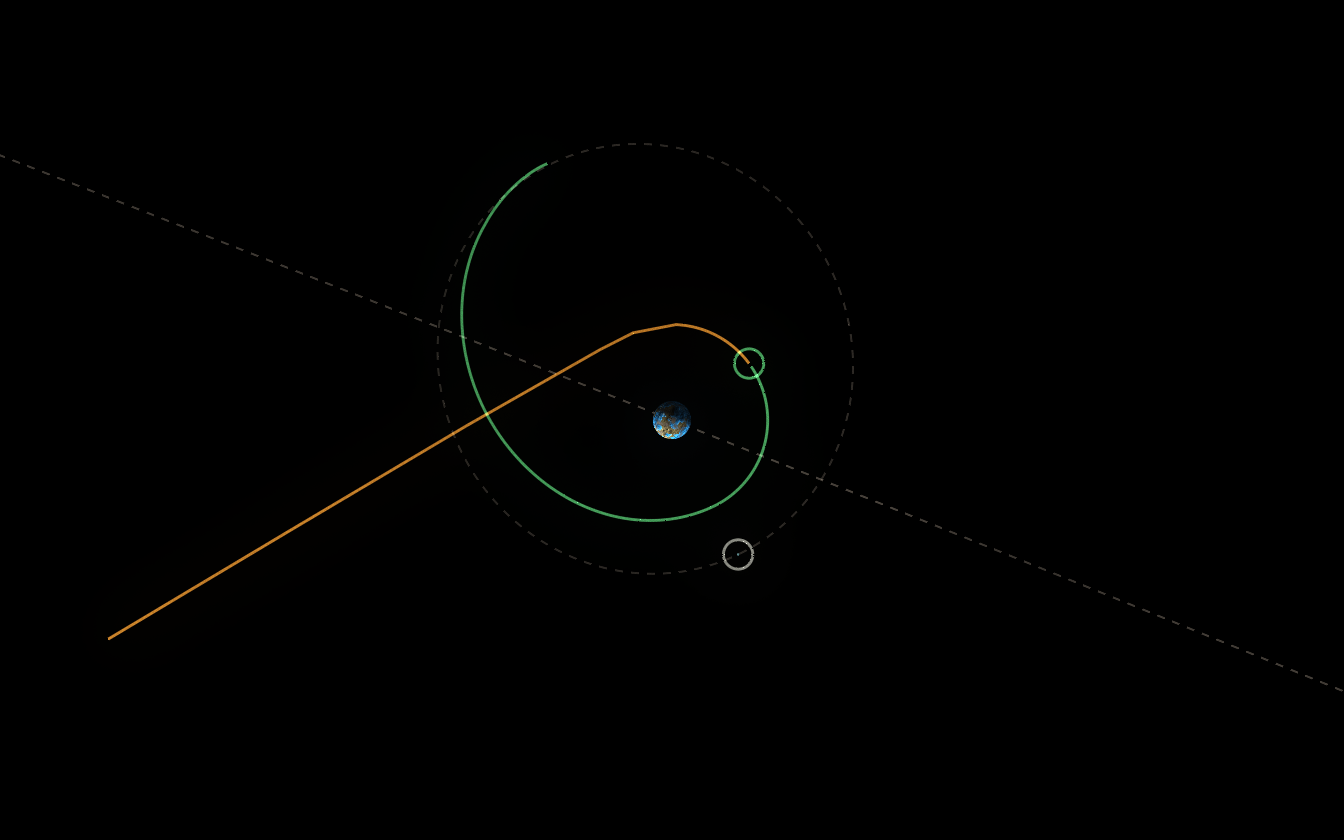
Leaving d III for the rock B-178. Green is the first leg, dropping from the moon’s orbit to an orbit half way in. Orange is the second leg climbing out of Galuromus d’s pull toward the rock. The white ring is the moon.
Arriving at the moon when you get there
Flying to the moon d III, a pilot saw the ship settle into orbit and then circle two or three more times while the plan still said it was on its way, with a dozen tiny burns along the way. The orbit 300 km above d III is a long way out for such a small moon, and Galuromus d pulls on it so hard that it never stays a perfect circle. The computer kept trying to make it one.
Now it stops at a circle as round as d’s pull lets it be. The trip ends with the one braking burn that puts you in orbit, and it costs a little less.
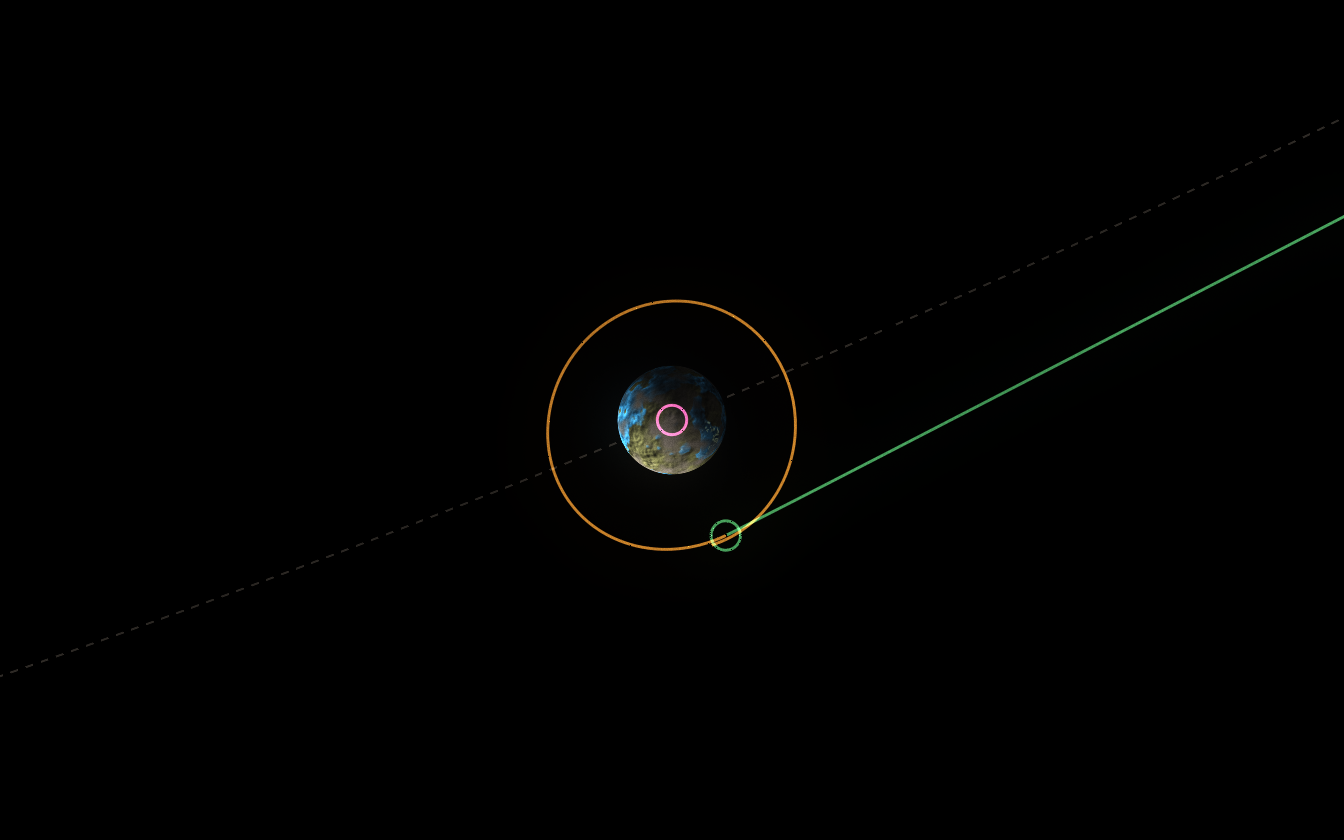
Arriving at Galuromus d III. Green is the way in, orange the orbit the ship keeps for a turn after its one braking burn, with no further burns.
Change course in the cockpit
The cockpit now lets you use that. While your ship is on its way, hold any goal and press Plan, and the card offers a new route from where the ship is right now. Fly it replaces the route you were on, and what the old route had not burned yet stays in your tank. The station and every planet and moon in Navigation offer Plan on the way as well. Before, the card only said when the flight would arrive. A station asked for from far away, beside a rock for instance, is now one route that ends right beside it, where you dock.
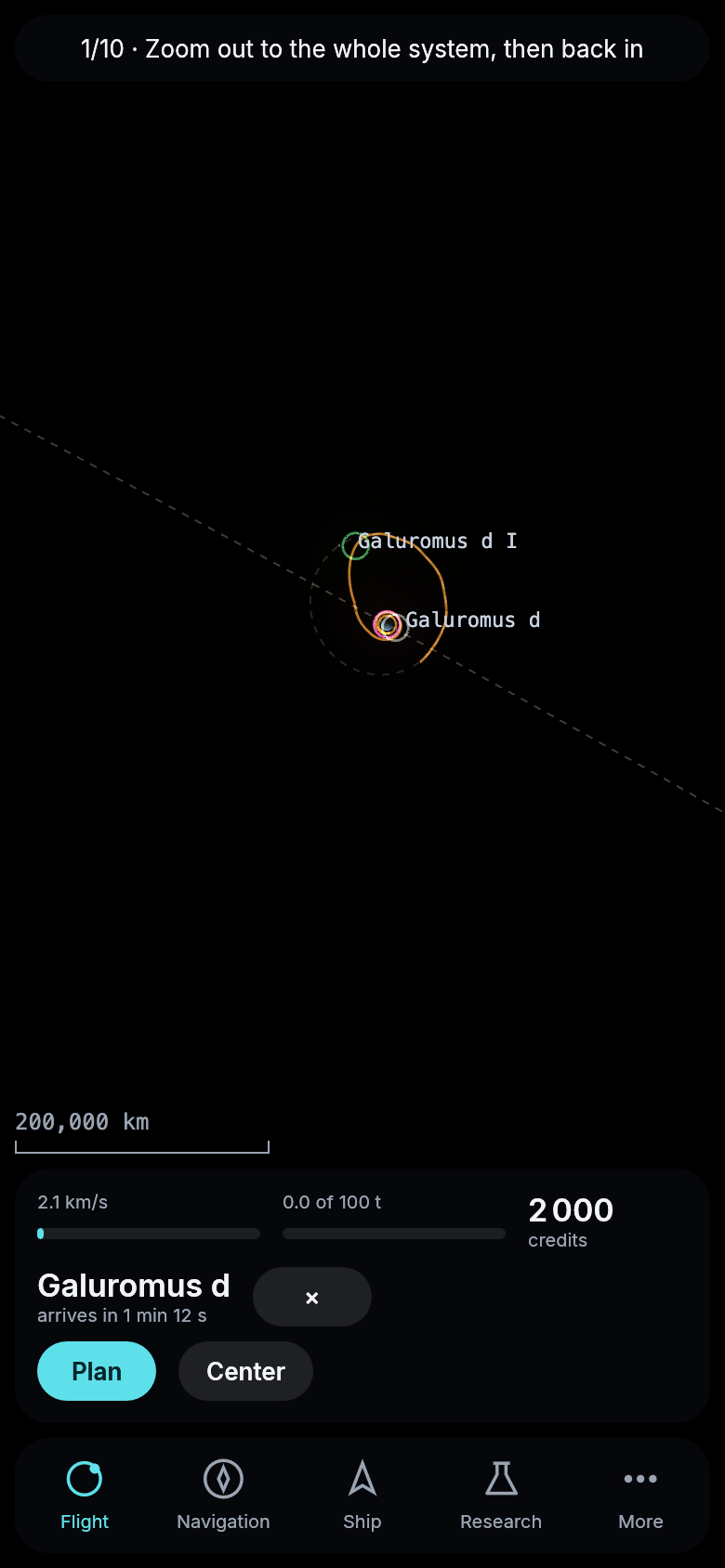
Halfway to the moon and turned back. The orange course runs back to Galuromus d.
Seconds when it gets close
Every time the cockpit shows now counts its seconds once it is under five minutes, “2 min 30 s” rather than “3 min”. Flights did so already; now the lab’s research, the yard’s builds, a station core being assembled and the log’s “ago” do too, so a countdown visibly moves in its last minutes.
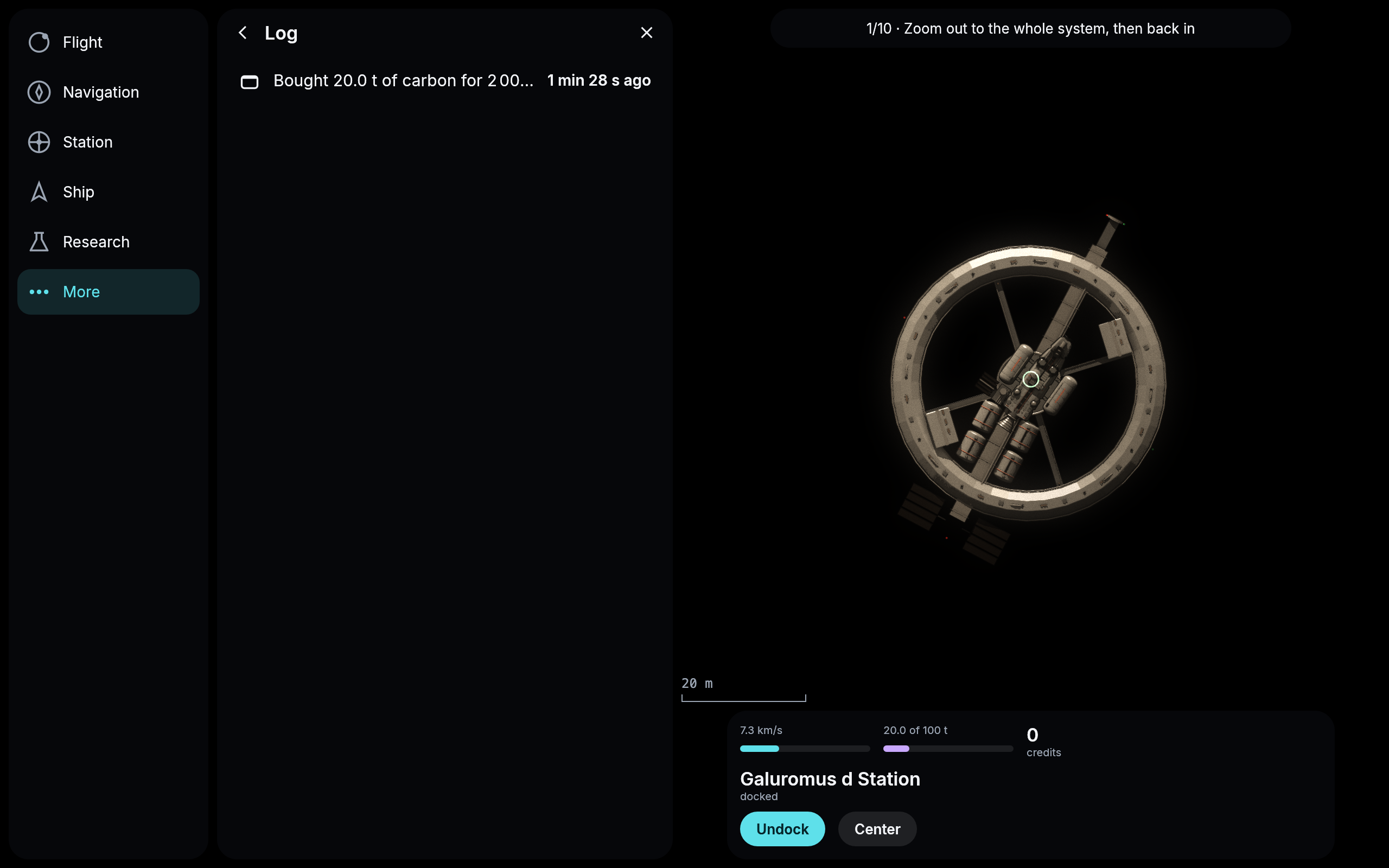
The log, the purchase told in minutes and seconds.
Buying at the station
The station’s market only bought from you and sold propellant. Now it sells what is in its stock as well, metal, silicate, water and carbon, and that includes what you sold there yourself. Each material has a Buy button that takes as much as your hold has room for and your credits pay. You pay the price the stock has after your purchase, a little above the one shown, so selling a hold and buying it straight back never earns anything.
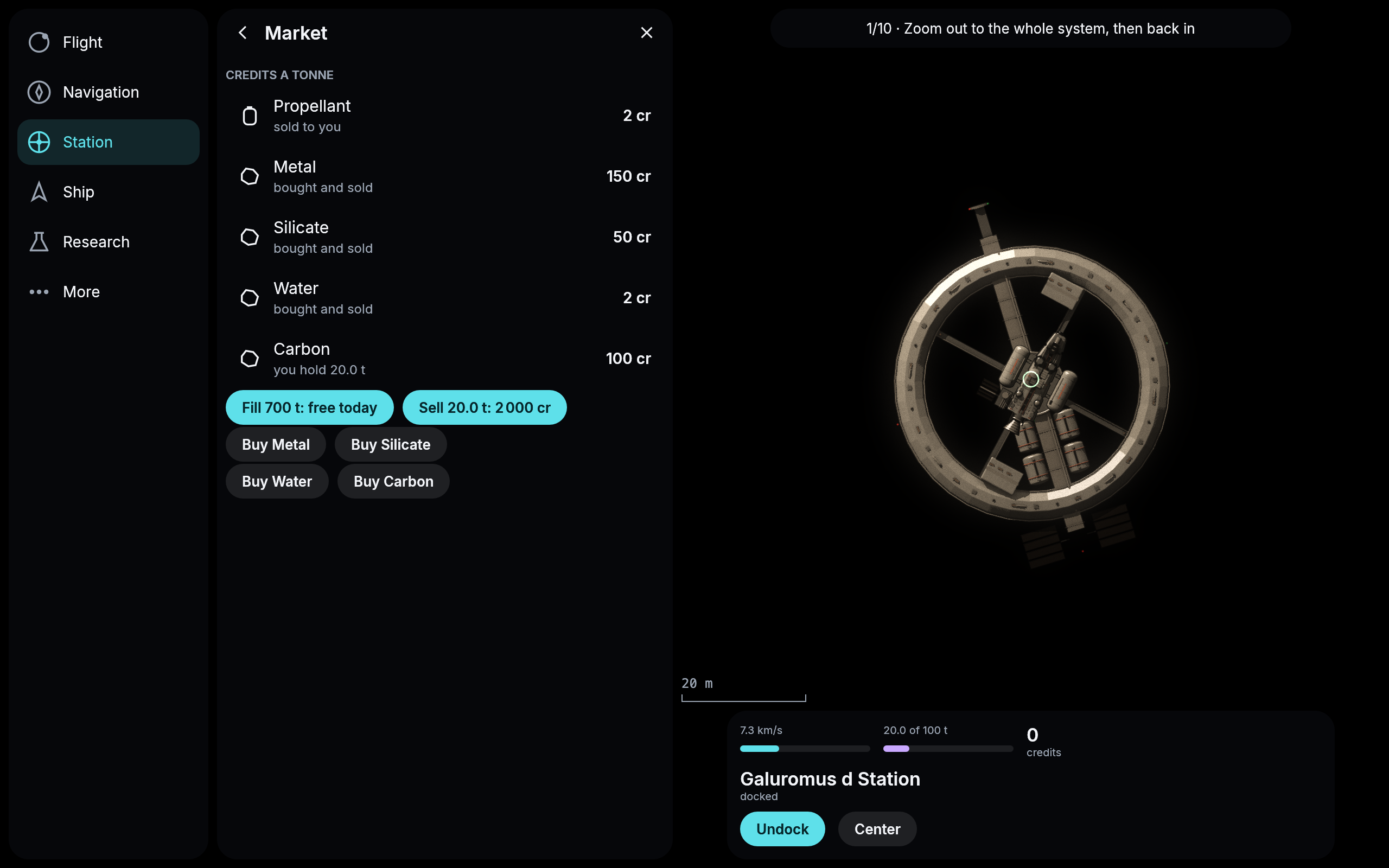
Galuromus d’s market, with a Buy for each material under Fill and Sell.
Never stranded after the tutorial
The start kit’s chemical drive is a teacher. Every route costs km/s from the tank, and a tank that runs dry leaves a ship where it is. That is the lesson, and it should not be the game. The tutorial now has three more steps that end it with the drive you keep. You research Drives I, build the nuclear-thermal drive and fit it at the station, each free and two minutes long while the tutorial runs. The drive’s scoop gathers hydrogen from the star’s wind and fills the tank while the ship drifts, so from then on an empty tank means a wait, not a rescue. Pilots who finished the old ten steps meet the three new ones the next time they play, and whatever they did on their own already counts.
The tutorial’s third step now also says what the km/s on an offer means, the price your tank pays.
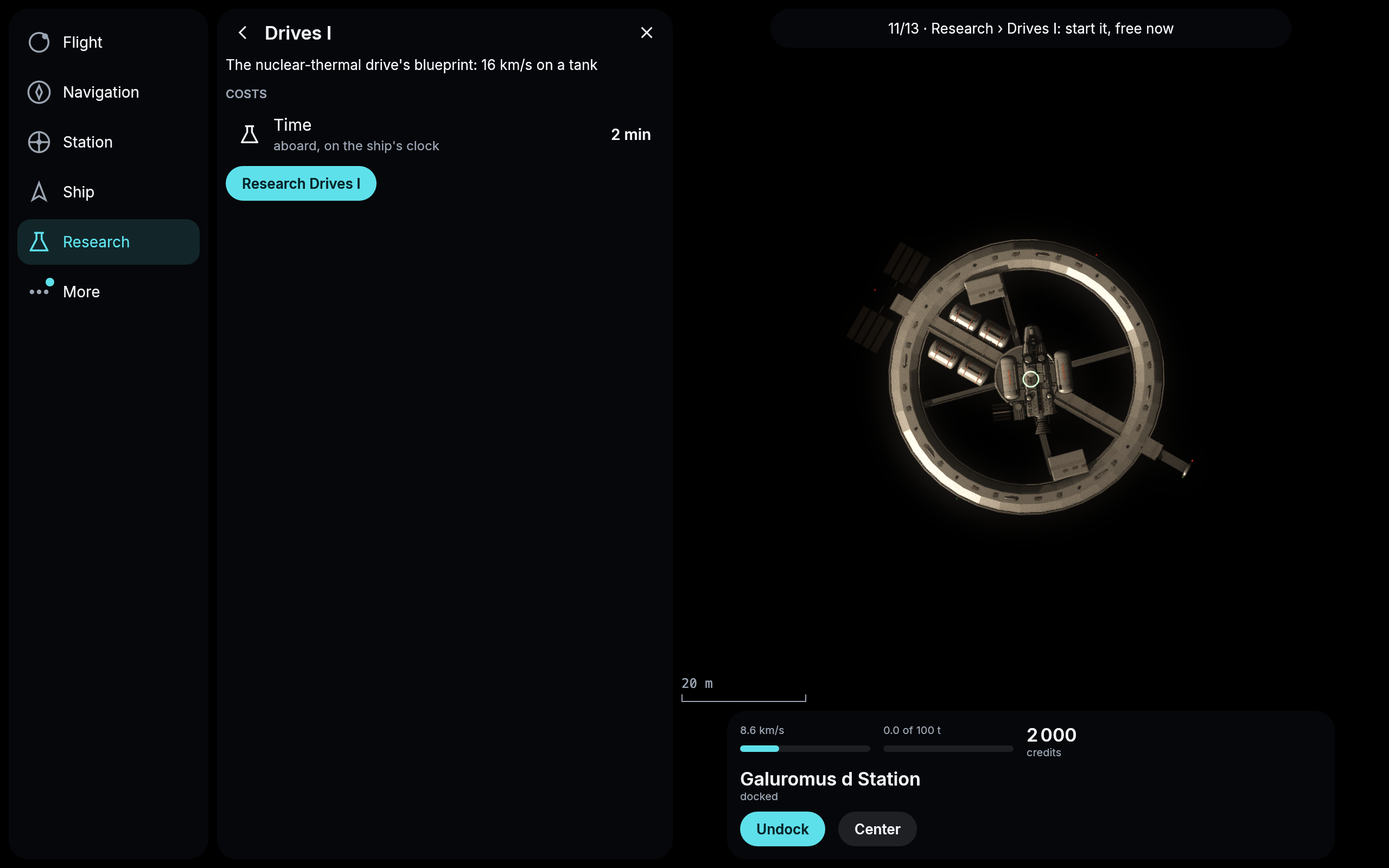
Step 11 of 13, Drives I in the lab at no cost.
Station names that fit on a phone
On a phone the system map in Navigation wrote “Galuromus e Station” across planet b’s letter and the A belt, and “Galuromus d Station” over f’s letter. A station sits right beside its planet, whose letter is already on the map, so the map now just says Station there. The list under the map keeps the whole name.
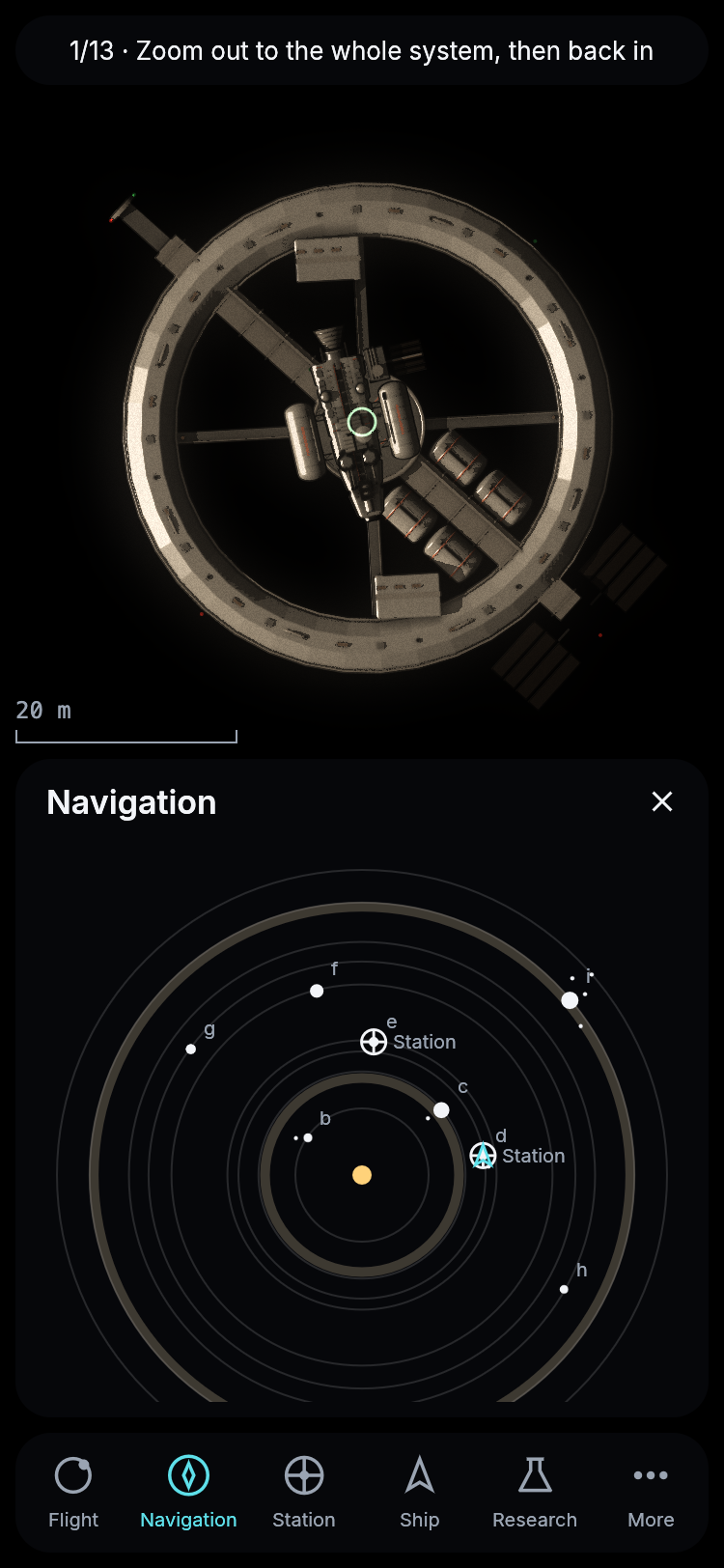
Galuromus on a phone, both stations labeled beside their planets.
The Trojans swing about their points
Every giant planet carries two clouds of rocks on its orbit, sixty degrees ahead of it and sixty behind. Until today each rock sat still in its cloud, going round at exactly its giant’s pace on an ellipse of its own size. That looked right in a picture, but it was not how a rock can move: one on a slightly wider ellipse went faster than gravity allows, up to kilometers a second. Every burn off a rock was reckoned against a speed no real rock has.
Now each rock does what Jupiter’s Trojans do: it swings slowly about its point, along a tadpole-shaped path, drifting away from the giant and back over a dozen or more of the giant’s turns, its orbit a little wider while it falls behind and a little tighter while it catches up. The shape of a cloud is now what those swings add up to, not a curve fitted to it: steep on the side toward the giant, long on the side away, as the real clouds are measured. And every rock is a free body, within the few meters a second its giant’s own pull adds.
A rock you knew by name may have moved: the rocks of every cloud were dealt anew, so Galuromus B-178 now sits at the far end of c’s trailing cloud. Galuromus A-53, at c’s leading point, is a rock in the middle of things.
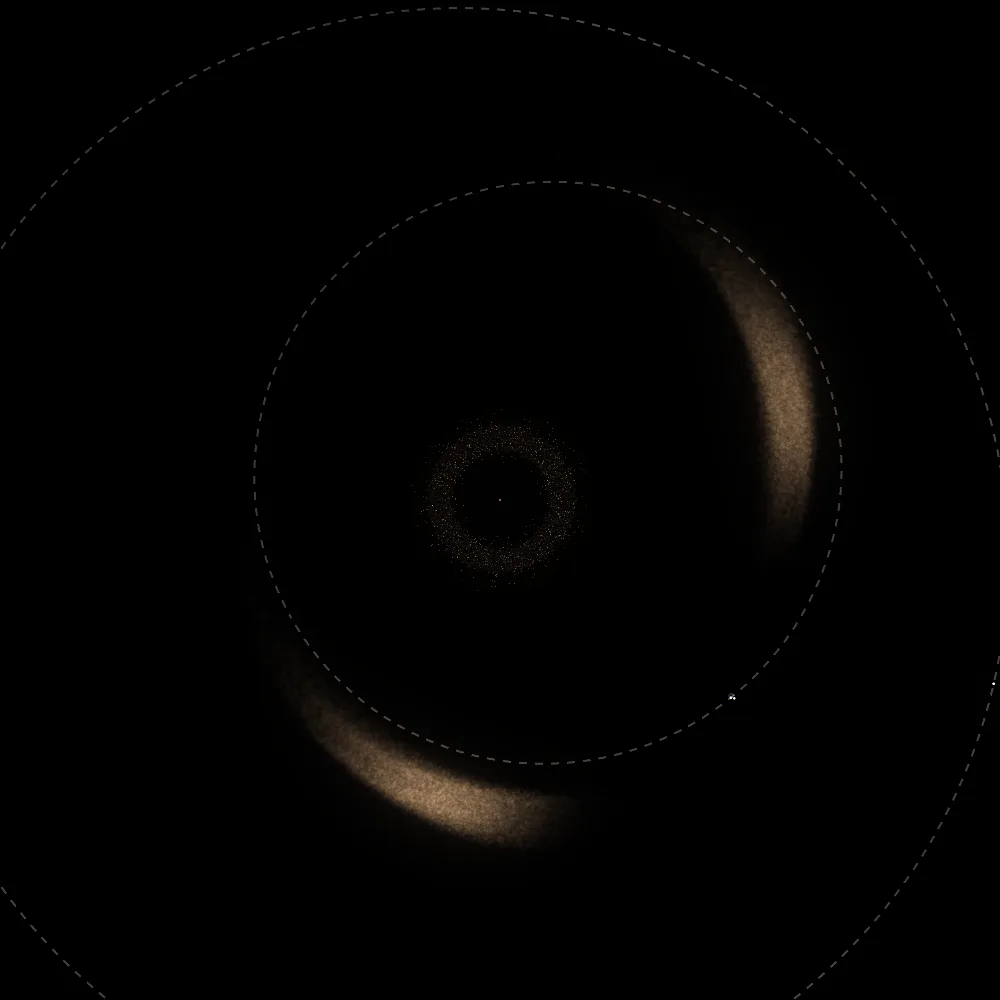
A giant’s two clouds as the swings make them, drawn by the engine: each a tadpole, its tail running away from the giant.
Rock families: the next rock is a short hop
Mining one rock and then the next used to mean a long, dear trip, even to a rock you could almost see: two rocks side by side in a cloud were on different orbits and passed each other at three or four kilometers a second, and matching that speed cost as much as flying home. Now the rocks of every cloud come in families, as the fragments of one old collision do. Every rock shares its orbit with a few hundred siblings, scattered only as fast as the pieces flew apart, a few tens of meters a second, and strung out along the same swing about their point.
From beside Galuromus A-53, at Galuromus c’s leading point, a sibling a few thousand to thirty thousand kilometers away costs a quarter to half a kilometer a second to reach; a stranger just as close costs two and a half to four. The family is what makes the next rock a short hop. Finding the nearest sibling for you, and getting there in hours rather than days, is the navigation computer’s next step.
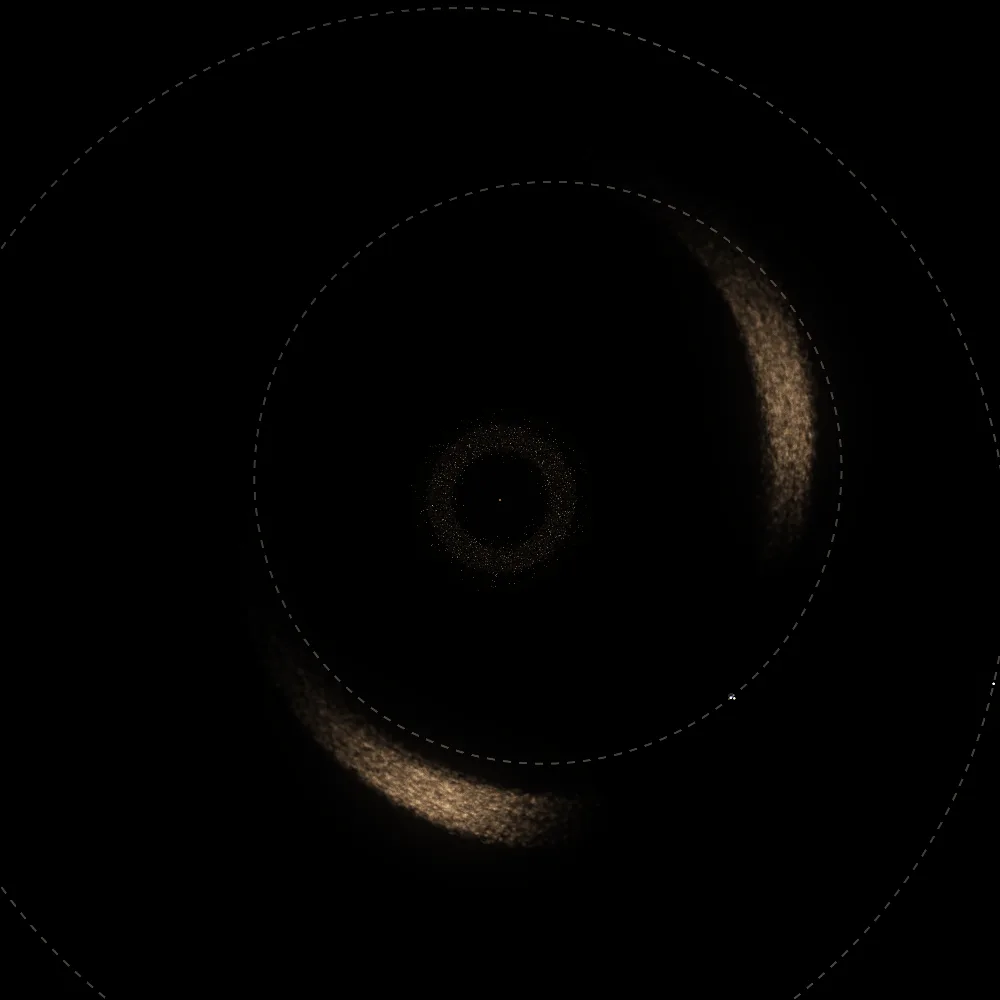
The clouds with their families: the same tadpoles as before, their grain the families’ streaks along the swing.
The next rock in hours
A short hop is now a short trip. The navigation computer used to fly even to a sibling a few thousand kilometers away on a long, lazy arc around the star, and the quickest it could manage was two and a half days, near or far. Now it also looks at quick hops of a few hours, and it meets the rock right where it passes instead of overshooting and coming back.
What a hop costs now depends on how far the other rock is and how soon you want to be there. From Galuromus A-53 on the starter ship, a sibling about 9,000 kilometers away is under 0.2 km/s if you arrive within a day, 0.85 within six hours, and an hour and a quarter away if you burn hard. One three times as far costs 0.7 km/s within a day. The slow, cheap way of a week or more is still there when nobody is in a hurry.
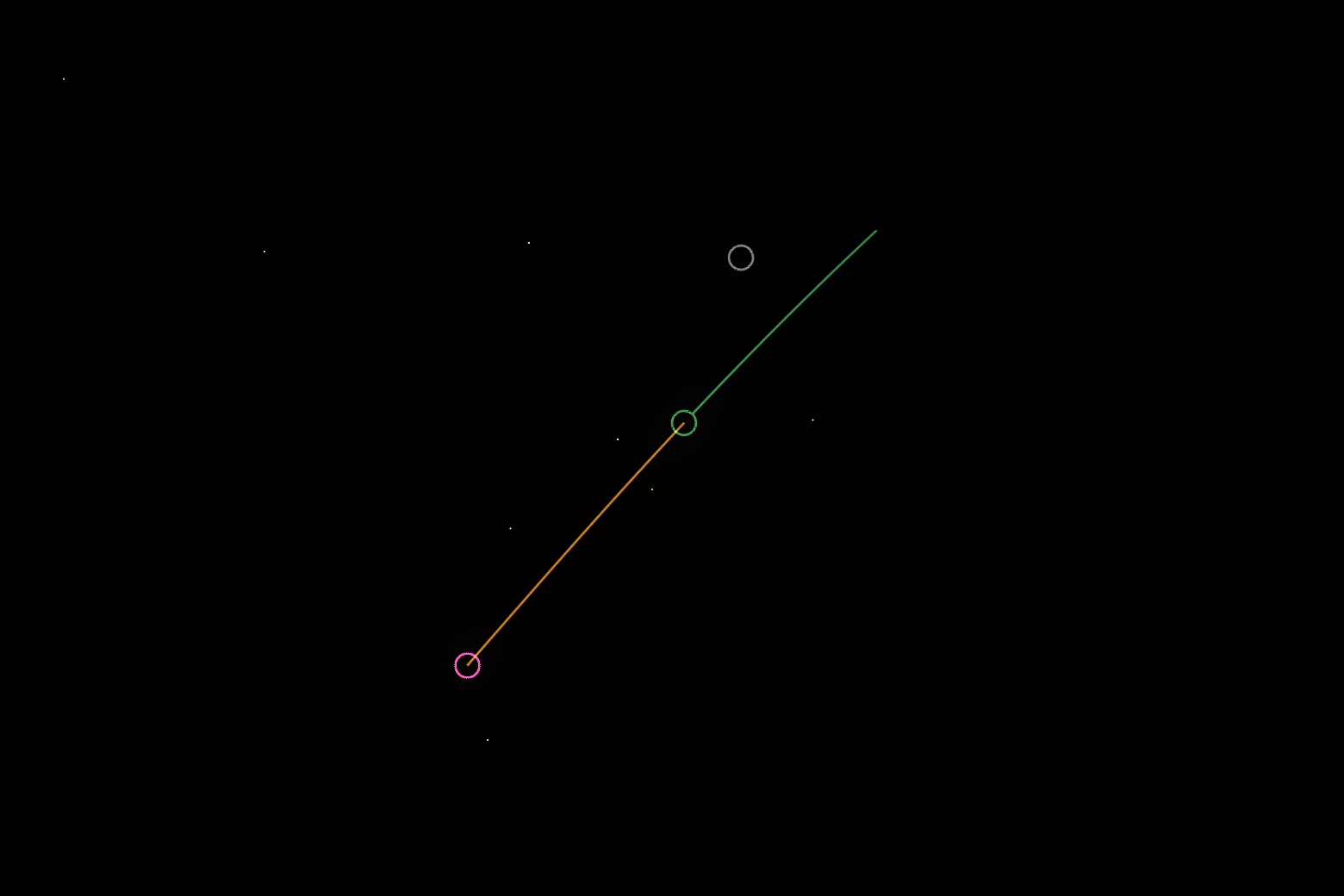
A hop of a day from Galuromus A-53 (gray) to a sibling 9,000 kilometers away (pink), seen riding along with the sibling. The ship is halfway, the way behind it in green and the rest of the course in orange.
Your cargo priced where you are
The Ship section shows what each material in your hold is worth. It used to take the prices of whichever market the game happened to hear about first, and with e’s station and the pilots’ own wheels selling too, that could be a market far from you. Now the worth is what the station you are docked at pays, and anywhere else what your home station at d pays.
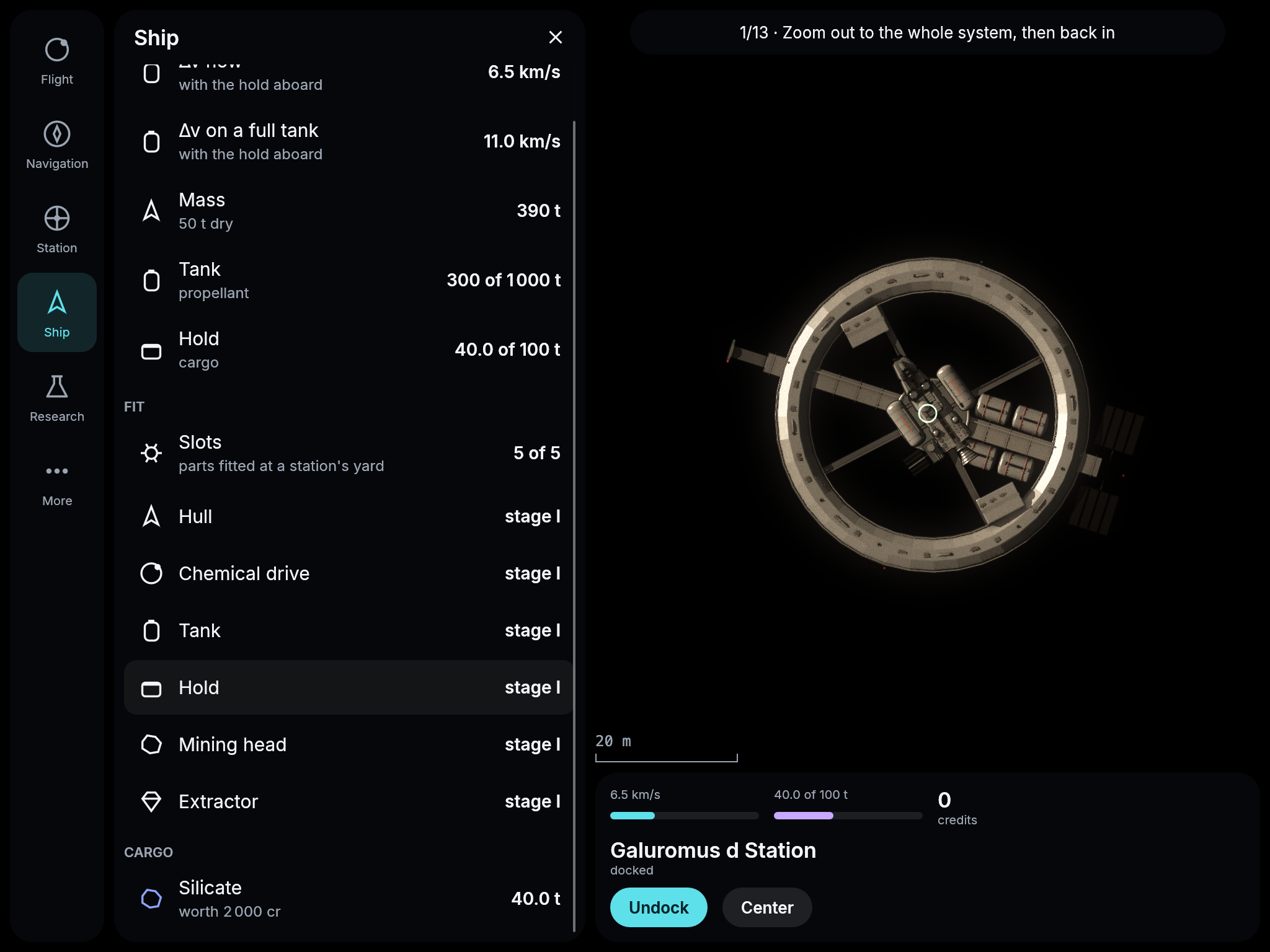
Forty tonnes of silicate at d’s station, worth 2 000 credits at its 50 a tonne.
A course line that holds still up close
Zoom in on your ship while it flies a plan and the amber course line used to shake from frame to frame, the closer the worse. The course itself was fine. Each stretch of it runs for thousands of kilometers, and drawn beside a ship twenty meters long the ends of that stretch lie billions of pixels off the screen, further than the graphics card can place a point exactly. Every small move of the camera rounded the line somewhere else. Now only the part of each stretch that crosses the screen is handed to the graphics card, so the line stays where the course puts it, however close you zoom.
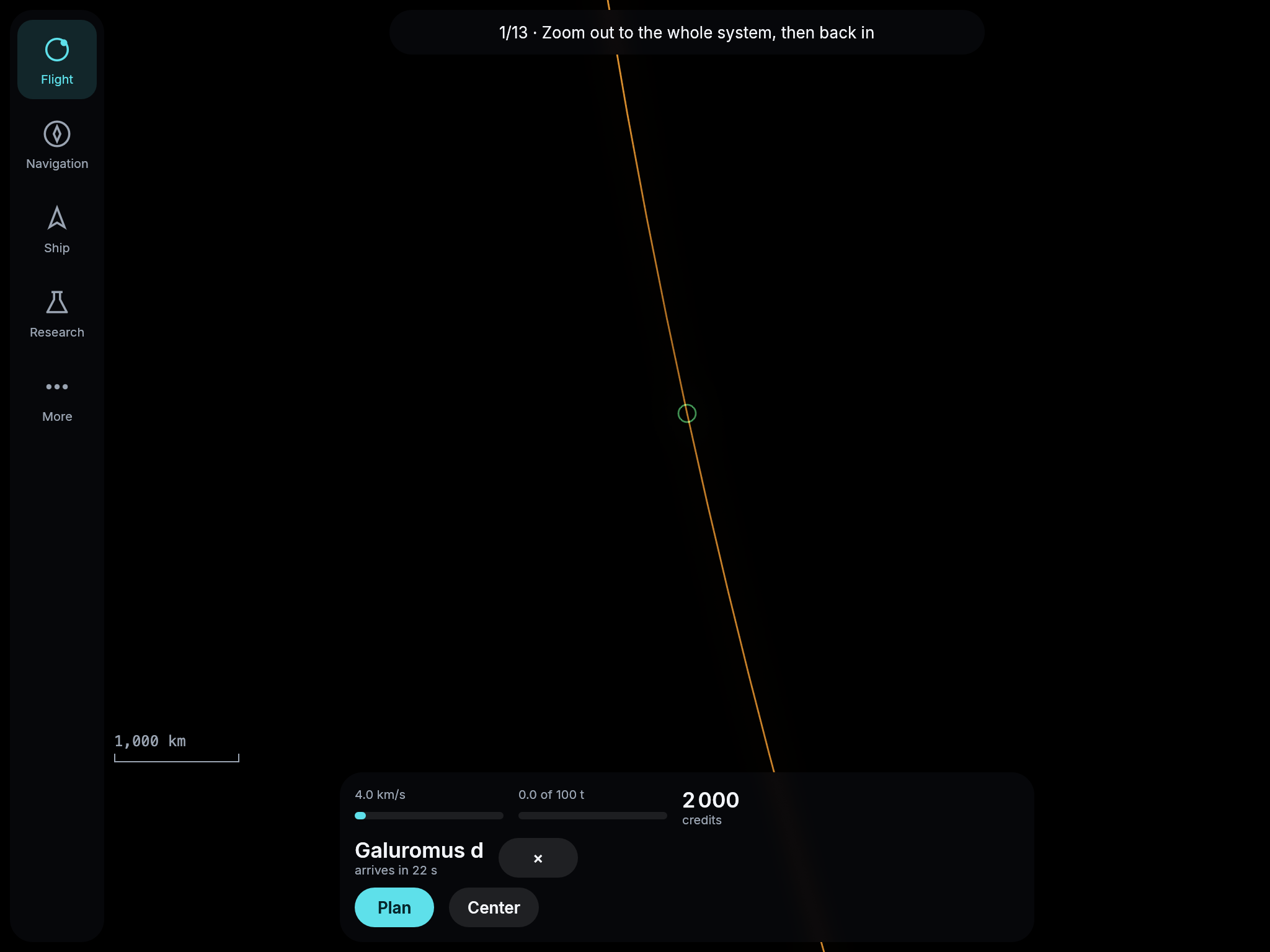
On the way back to Galuromus d, the course through the ship’s ring, drawn steady.
Drives you can see burning
A ship’s engines now light up while they burn. Every nozzle on a ship’s artwork throws a plume of light behind it: white-hot where it leaves the nozzle, the one part of a ship brighter than white, fading to orange as it goes and widening a little. The harder the drive burns, the longer and brighter the plume, and with the drive cold there is nothing. The color is that of a hydrogen-oxygen engine’s chamber, the start kit’s drive. A real plume of that kind is nearly invisible in space, so this is a deliberate liberty, taken so you can see a burn. Far out, where the ship is a speck, a burning ship is a brighter speck, and the plume never pops in or out as you zoom. The game will light the drives for the seconds of each maneuver.
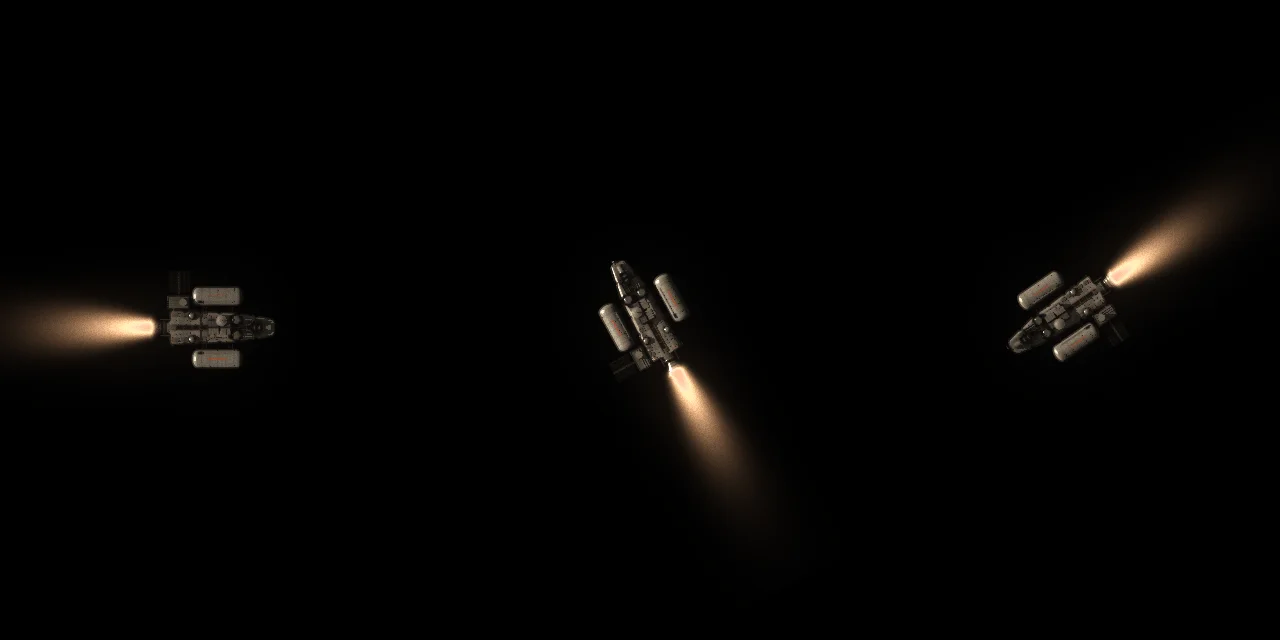
The start kit at full throttle, at three headings, drawn by the engine.
Galaxies sharp to their edge
Where a galaxy thins out toward its edge, it used to go soft: each point drawn there stood for many stars and was smeared over the gap to its neighbors, so the outer disk looked out of focus around a crisp middle. You called it out on the site’s galaxy picture, and it is gone. A point is now never wider than the points in the galaxy’s dense core, so the thin outskirts are fewer stars, each as sharp as the ones in the middle. How thin the disk is shows in how many stars there are, not in a haze. The light is the same, just gathered into sharper points. It shows on a Retina screen and on a phone; an ordinary desktop screen, with fewer pixels to spend, stays close to how it was so that a spiral keeps its full arms there, which is what you chose when shown both.

Oboromea’s outer disk at full size, before (left) and after (right), drawn by the engine.
A fusion drive from the first minute
Every ship now flies on a fusion drive. The start kit’s chemical drive was honest about what rockets cost, and that was the trouble: the way to the Trojan rocks was a long, slow arc that took the better part of an hour, and the tank barely got you there and back. The new drive throws the water in your tank out at 1 000 km/s, about two hundred times faster than the old one, so the same kind of tank now holds more than 1 200 km/s instead of 13. That is enough to stop coasting along arcs. The drive pushes the whole way and brakes the second half, and the navigation computer always plans the fastest way it finds: out to the rocks in six to seventeen minutes, the moon in about one.
The tank is smaller, 150 tonnes, and the scoop that gathers hydrogen from the star’s wind is part of every fusion drive from the start, so nobody can be stranded. The tutorial’s last steps now build Fusion drive II, which pushes twice as hard and is what Galuromus e asks for. Ships that already flew the old drives were refitted: a chemical drive became the fusion drive, a nuclear-thermal one Fusion drive II. The way home from the rocks is still an arc for now, and the tutorial and the market’s prices follow in the next steps.
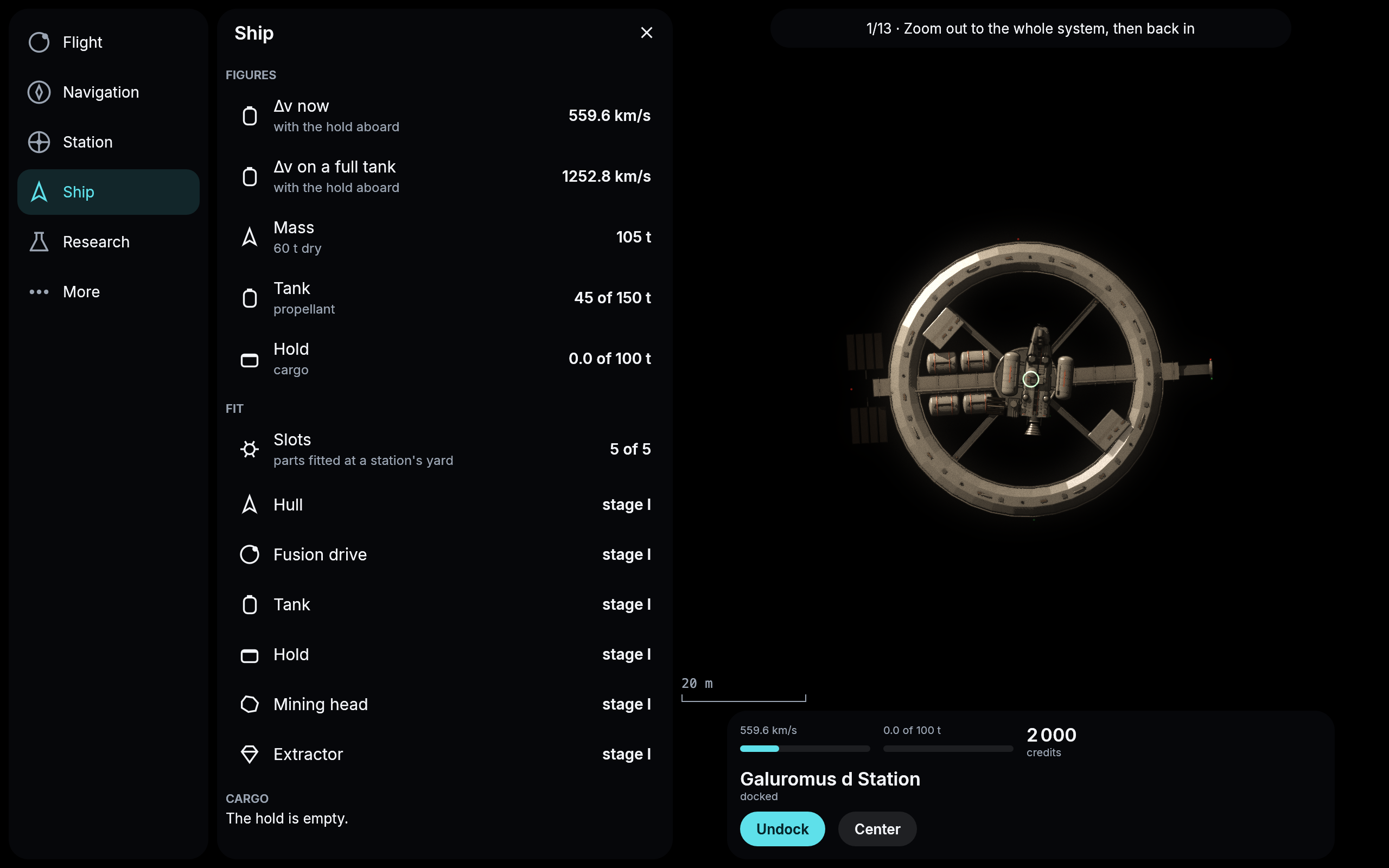
A new pilot’s start kit on the fusion drive, with the 45 tonnes it is given.
The tutorial’s trip, home soonest
With the fusion drive the tutorial’s trip to the rock was still chosen the old way: the route whose way home cost the least. When every way home is cheap, that was the wrong thing to save. It could keep your ship waiting beside the rock for most of an hour for a window that saved a few tonnes nobody needed. Now the server offers the trip that has you back at the station soonest, counting the wait before it leaves.
At the rock the ship stays at least four minutes. It mines a sample of a few tonnes while the extractor fills the tank again, then flies home by itself. Vault I is free during the tutorial now, like Drives I, so the sample doesn’t have to pay for it. Start Vault I at the rock and Drives I on the way home, and the tutorial moves on as soon as you have sold. A new ship now leaves the station with 15 tonnes, a tenth of its tank. That is enough for the moon and back many times, but not for the rocks, so the tutorial’s fill at the market still matters. The whole trip takes half an hour to an hour and a quarter today. It gets shorter once the navigation computer can fly a straight line out of a planet’s pull.
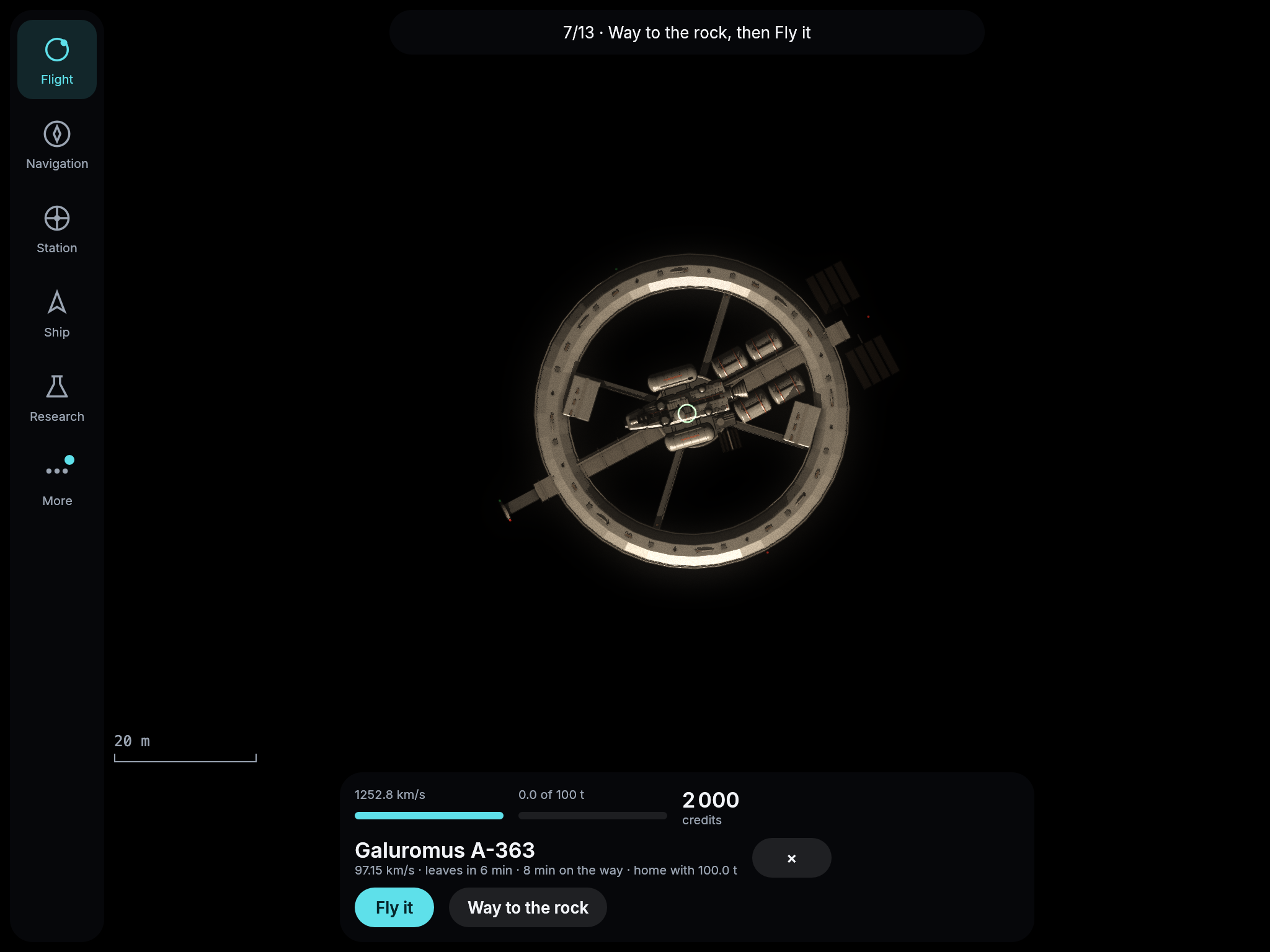
The trip the server offers: a start six minutes off, because from there the ship is home soonest.
Propellant worth paying for
The fusion drive burns so little that the station’s propellant had become free in all but name. A trip to the rocks and home burns 23 to 77 tonnes, and at 2 credits a tonne that was less than a single tonne of metal brings. Propellant and water at Galuromus d’s station now cost 20 credits a tonne, ten times as much, and propellant at Galuromus e 30. A full trip’s propellant is again a real share of what the hold sells for, from a tenth to a third, where with the old drive it was more than half. Water from a wet rock now sells for 20 credits a tonne too, so it is worth carrying home. The daily free fill still fills the whole tank, now worth 3 000 credits, and the 2 000 credits every pilot starts with buy 100 tonnes, more than the longest trip burns.
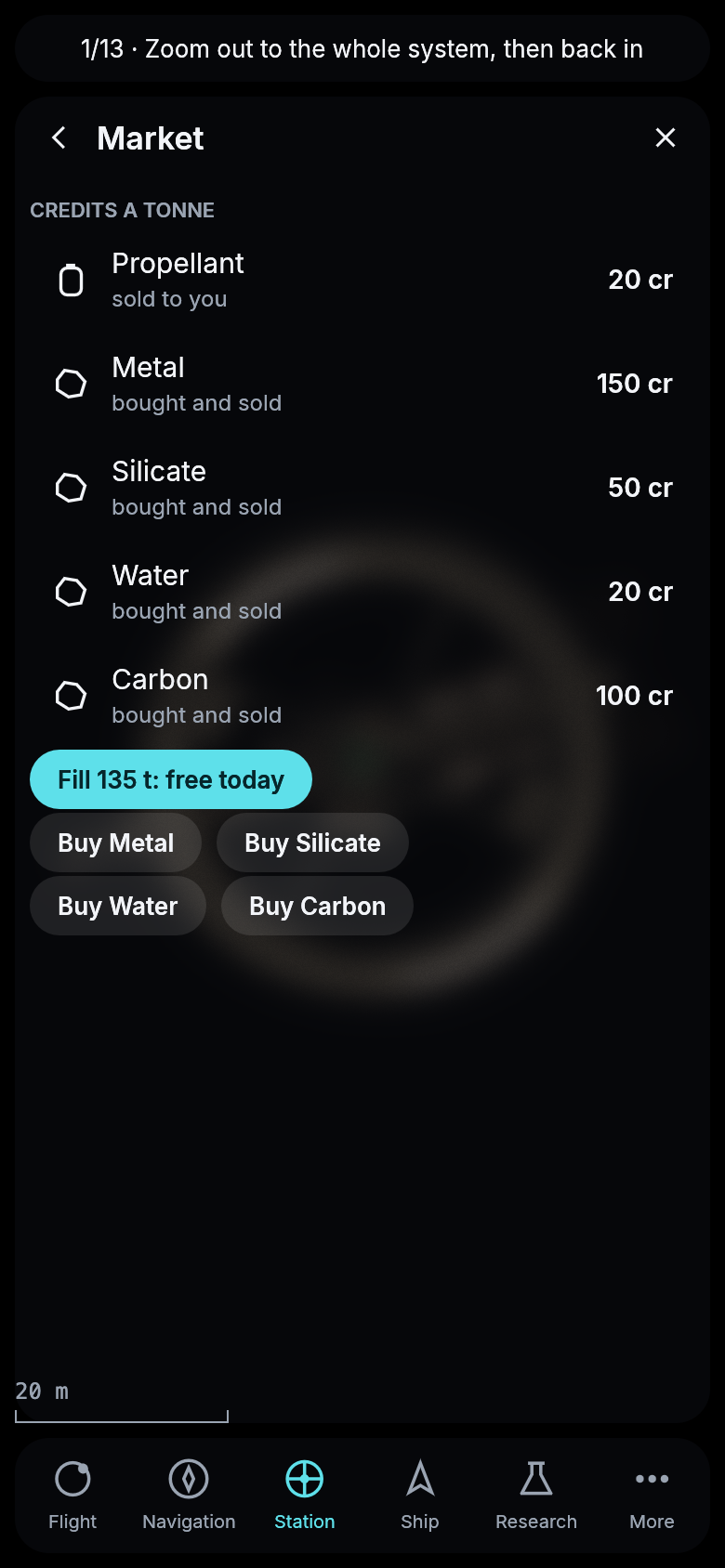
Galuromus d’s market with the new prices for propellant and water.