Two more steps for the fusion drive
Fusion drives come in two more stages, a ship of yours can fetch what your mine fills, and a plan offers the fastest and the cheapest way side by side. Steering jets now fire where you can see them, and a flight can be called off before it leaves.
Two more steps for the fusion drive
Every ship already flies on a fusion drive, and Drives I doubles its thrust. Until today that was the end of the drive branch. Now two more steps follow it in the research tree.
Drives II takes an hour and opens the blueprint of Fusion drive III. It pushes as hard as Fusion drive II, but its exhaust leaves at 1 500 km/s instead of 1 000. The same tank then holds about 1 860 km/s instead of 1 250, and a trip to the rocks and back burns a third less propellant.
Drives III opens Fusion drive IV, which pushes with half a g, two and a half times as hard as before, so every burn is that much shorter. It is the first research that takes six hours. You start it, fly or log off, and the ship finishes it on its own.
Both drives are built at the yard like Fusion drive II. Each is a tonne heavier than the step before, and both keep the scoop that refills the tank from the star’s wind.
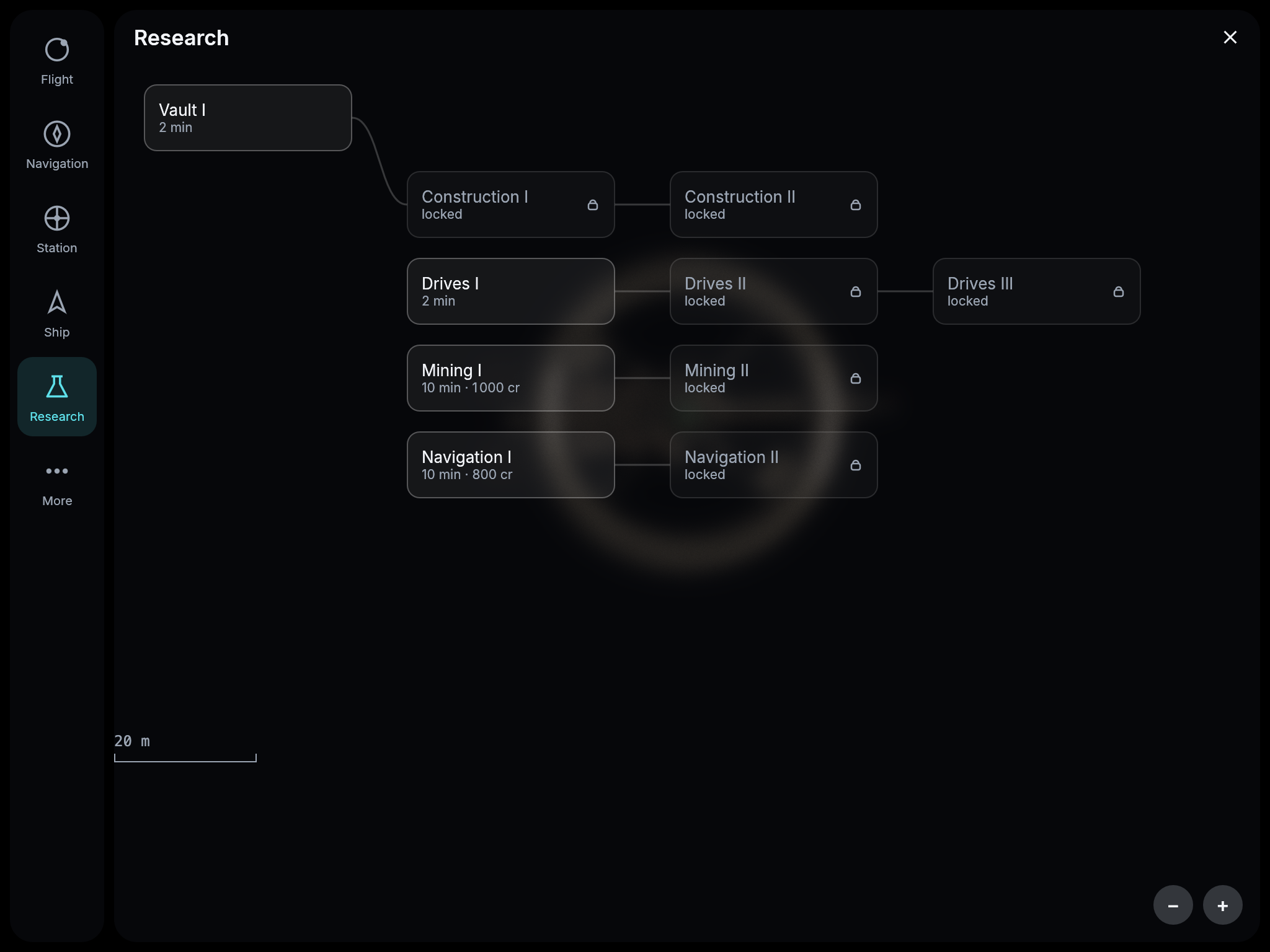
The tree at the start. Drives II and III wait behind Drives I, and Drives III opens a fourth column.
The rocks behind Galuromus c can be found
Every giant pulls two clouds of rocks along its orbit, one sixty degrees ahead of it and one sixty degrees behind. At Galuromus c both were always drawn, but only the one ahead could be found. A tap in the cloud behind, or a search for a rock there, came back empty up to seventy degrees behind the planet, so the cloud behind was never among the rocks the game offered.
The cause was in deciding which cloud a place belongs to. Each cloud was given the same reach to both sides of its point, as long toward the planet as away from it. On c’s stretched orbit the cloud ahead reached past the planet and over the other cloud’s point, and the first cloud that claimed a place kept it. A cloud now reaches only as far toward its planet as its rocks actually swing. Where the two still overlap on an eccentric orbit, the place goes to the cloud whose point is nearer.
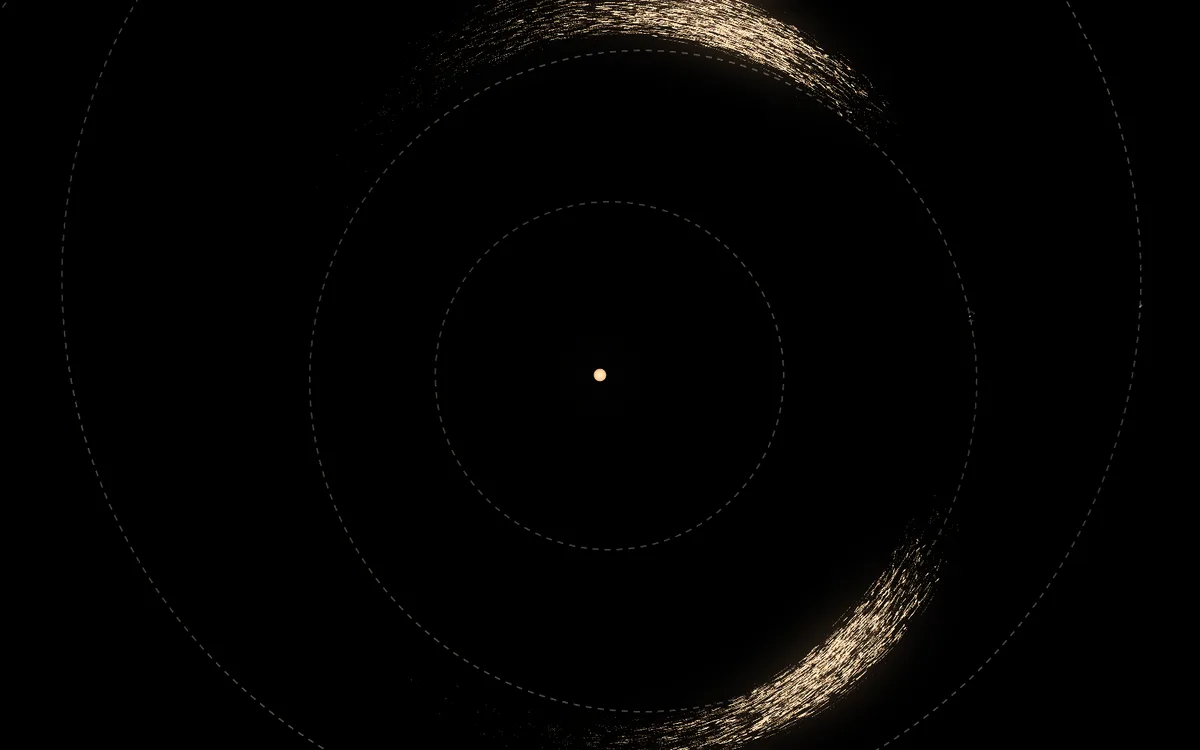
Galuromus c’s two clouds: both are drawn as before, and now both can be tapped.
A ship that fetches from your mine
Any of your ships can now work as a freighter. Dock it at a station, open Ship, and pick one of your mines under Freighter. The ship fills its tank from the water in your vault, flies to the mine, waits until the mine holds a load worth the trip, and brings it back. At the station it unloads into the vault, fills up again and starts the next round. It keeps going while you fly your other ship or are offline.
A freighter only leaves when it has the propellant to get home again, so it never gets stuck at a rock. If the vault runs short of water, or has no room for the load, the ship stays docked and the log says why. Stop at the station ends the loop after the round it is on. On the start ship a round to the rocks behind Galuromus c took about a quarter of an hour.
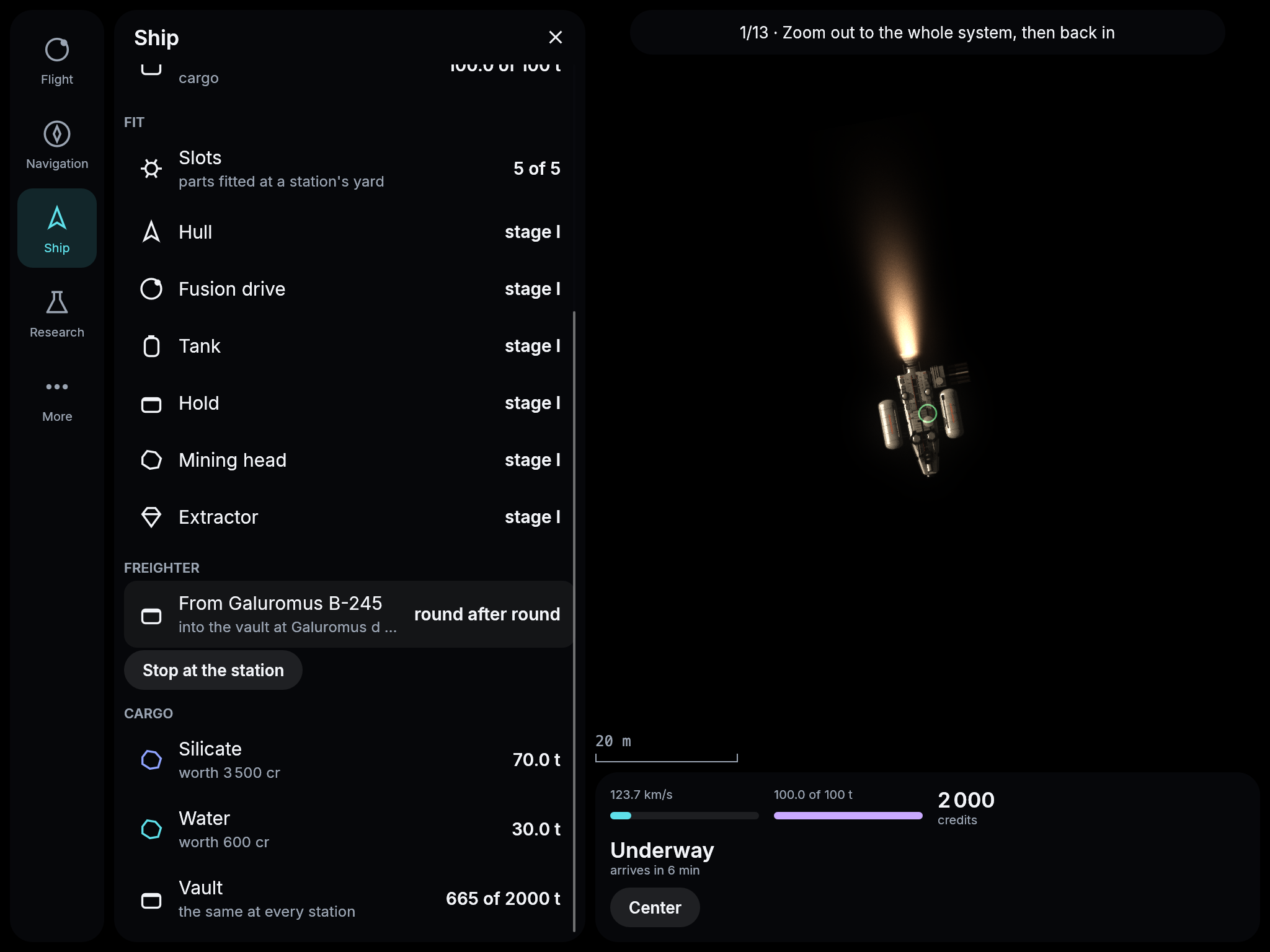
The start ship on its way home from its mine with a full hold.
How fast you are going
The card now shows your speed all the time, beside the tank and the hold. It is measured against the body you are near: the planet or moon you go round, the rock you wait beside, and on the way the body your course is drawn around, so a flight to a moon is measured against its planet and a flight between planets against the sun. Under the speed the card says what your drives are doing: off, speeding you up, or braking. On a phone the speed has a line of its own under the bars.
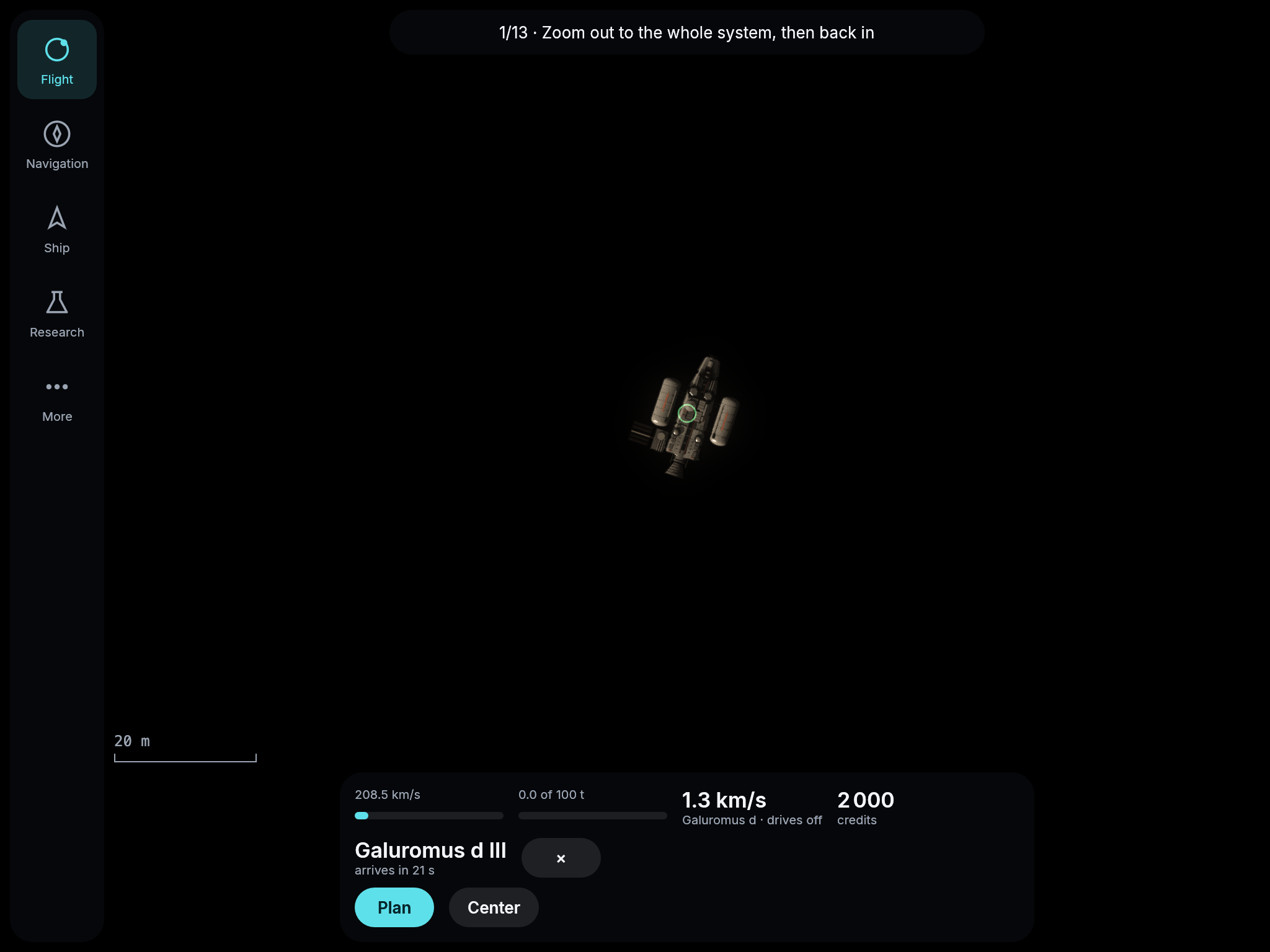
Coasting home from the moon at 1.3 km/s, drives off.
The fastest way or the cheapest
Until now Plan always gave you the fastest route, a straight burn that eats a large part of the tank. Now it asks for two routes and you choose. The fastest comes first, usually within seconds. The cheapest follows a little later, because the computer has to search the arcs that leave within the next hour. When the two differ, the card shows both with their cost and time, and you press Fastest or Cheapest.
The difference is large. To a rock in the clouds behind Galuromus c the cheapest way costs about 12 km/s, a quarter to a thirtieth of the fastest, and arrives half an hour to an hour later. For a short hop like the moon both come out the same, and the card shows one offer as before.
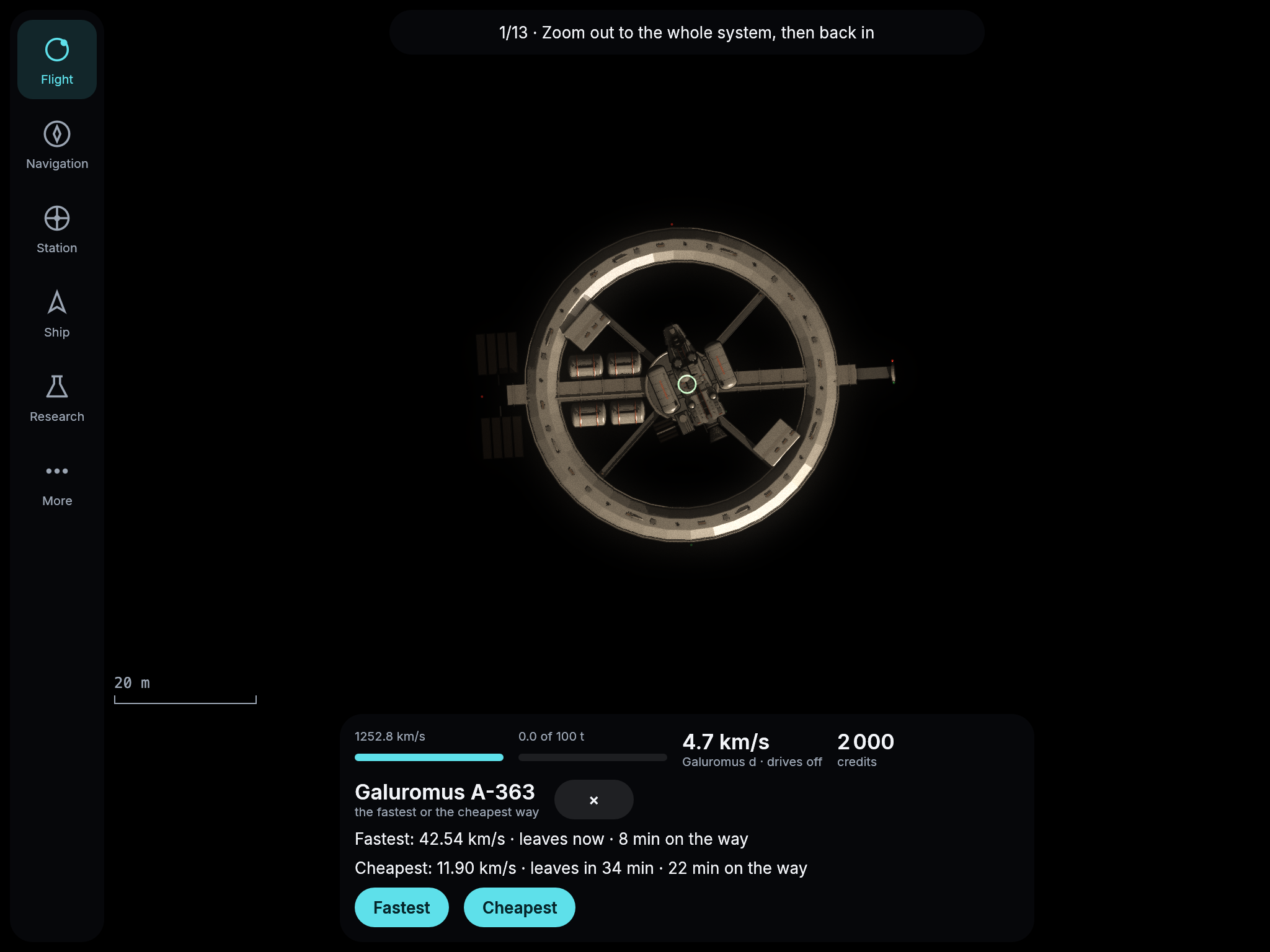
Two ways to the same rock, one fast and one cheap.
Freighters get the same choice. Under Freighter in the Ship section you pick Cheapest or Fastest before you pick the mine. On the cheapest way a round burns a few tonnes of water, so a mine on a wet rock pays for its own freighter. On the fastest way it burns a hundred tonnes and more, and the vault runs dry after a handful of rounds.
Steering jets you can see
A ship turns with small steering jets, eight of them by default, two to either side and four along its length. Since this morning the engine can plan those turns before every burn. Now it also draws them. Every jet that fires puffs a short, wide cone of white exhaust, lit by the sun the way a real thruster’s exhaust is seen, and only the jets that actually fire light up. A ship starting a turn to the right shows a puff at the bow on its left side and one at the stern on its right, and when it stops the turn the two opposite jets fire.
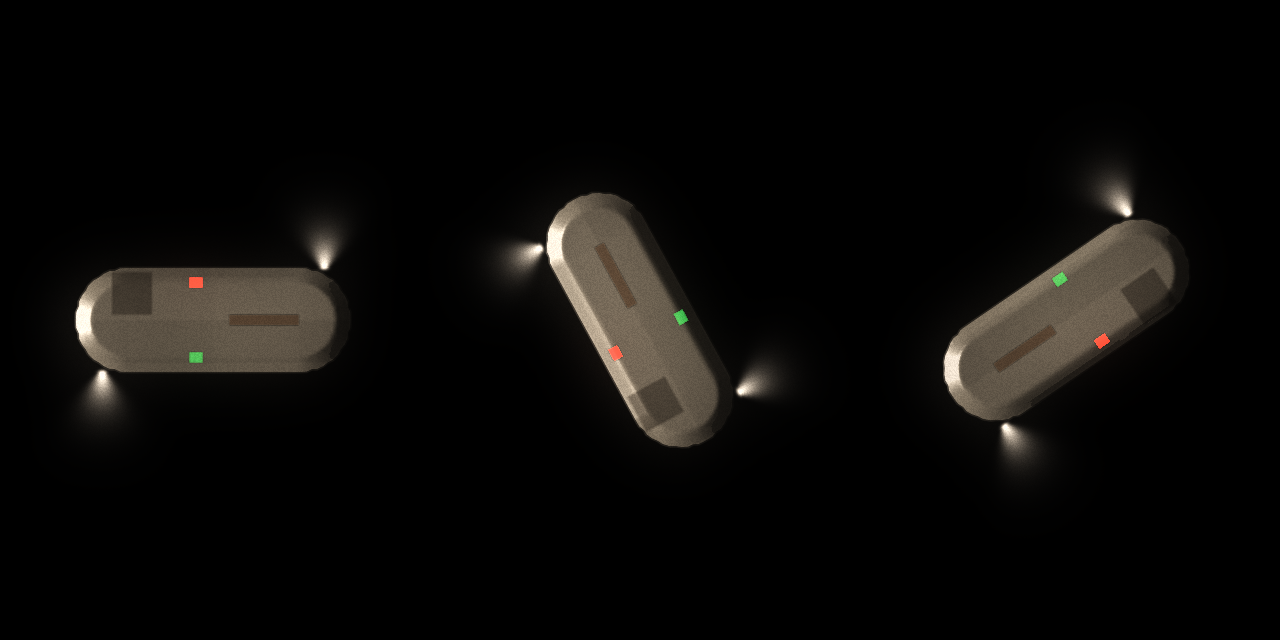
The engine’s test hull turning to the right, its bow jet and its stern jet firing.
The jets also do real work now. When a ship meets a station or a rock, the main engine matches its speed, and the steering jets close the last few kilometers, pushing the ship sideways, forward or back without turning it, the way real spacecraft dock. Before, the big engine had to turn the whole ship around for every small correction, and some approaches to a station never settled at all. Now every route the engine is tested on reaches its station, at the same cost as before.
The game’s own ships get their jets marked next, so that the ship you fly shows them too.
Names on the system map that make room for each other
The system map in Navigation used to put every name in the same spot: a planet’s letter up and to the right of it, a station’s name to its right. When two things stood close together, their names ran over each other. On a phone, “Galuromus e Station” ran across planet b’s letter, and the station at d covered f’s. Now every name looks at the spots around its body, beside it, above or below it, or slid along an edge, and takes the first one where it covers no other name and no other body, crossing as few orbits as it can. A name is never hidden to make room. You need it to find the body.
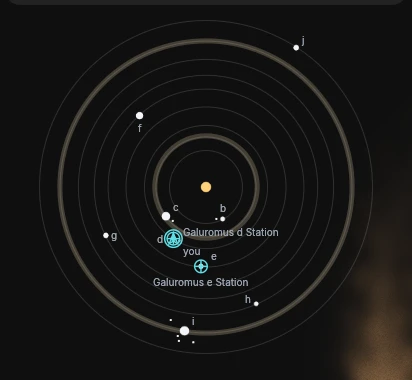
Galuromus with the ship and a station at d, and a station at e, under the long names that used to cover the planets’ letters. Every name now has a spot of its own.
Steering jets on your ship
The ships you fly now carry their steering jets. Every hull has four small blocks of them, two at the bow ahead of the tanks and two at the stern, and each block has one jet pointing out to the side and one pointing along the ship. That makes eight on every ship, the same eight the engine uses to turn a ship and to close the last few kilometers to a station or a rock.
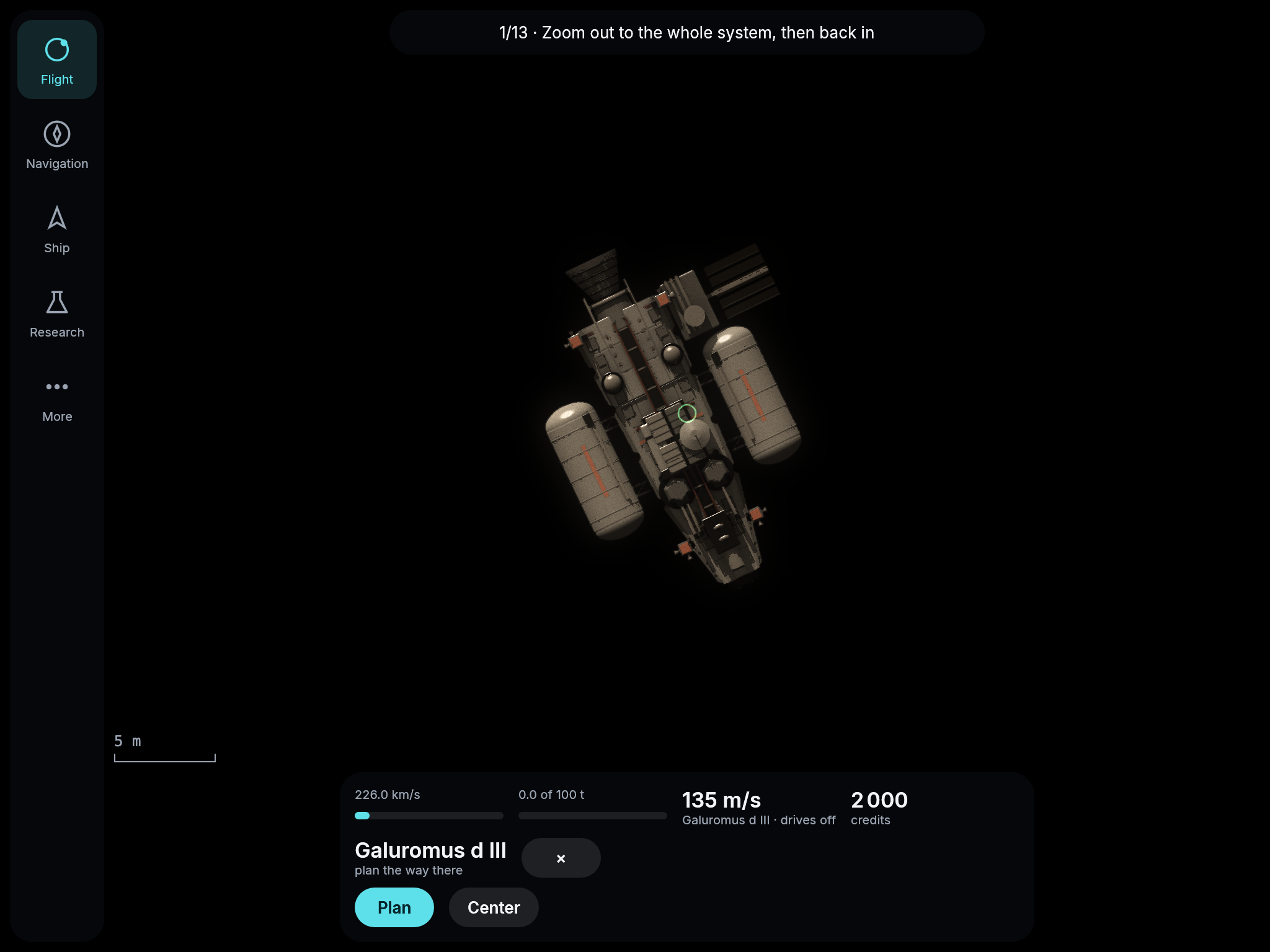
The start ship with its four blocks of steering jets, two at the bow and two at the stern.
They do not fire in the game yet. The ship turning on them before every burn comes next, once working out which way a ship points on a fast route takes the engine a moment rather than several seconds.
The map’s names stay off an open page
The map’s own writing, the names of planets and stars and the scale bar in the corner, used to be drawn on top of everything. With a page open on a phone, the scale bar could end up inside the sheet, at its bottom left, and a planet’s name could sit across the sheet or the panel beside the map. Now the scale bar and the clock stand above a sheet however far it has risen and beside a panel, and a name that would land on the glass is left out. When a page covers the whole map, as Research does, the scale bar waits until it closes.
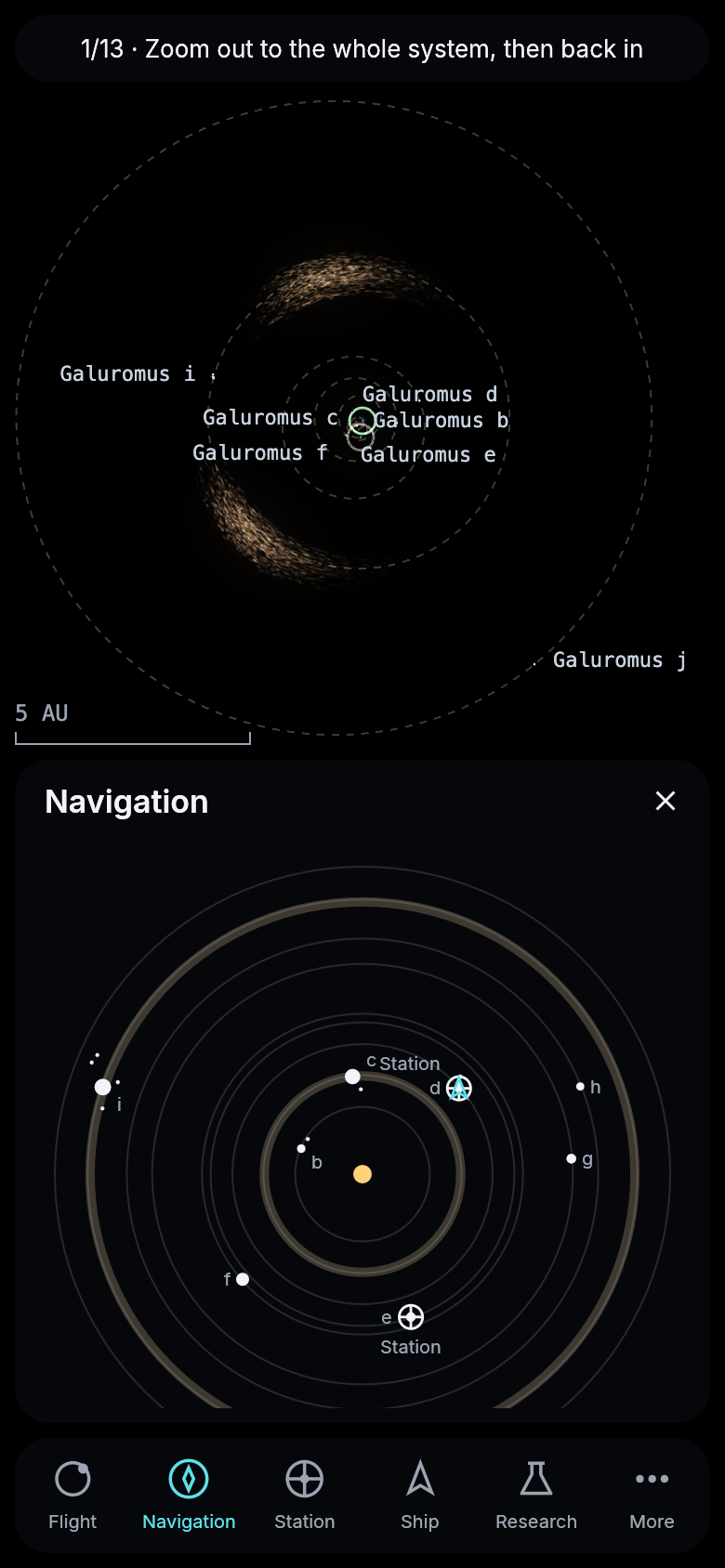
Galuromus at 5 AU a scale bar, with Navigation open. The names and the scale bar stop at the sheet’s edge.
One name for Galuromus d’s moon
The map called Galuromus d’s moon “Galuromus d I”, and the card and the Navigation list called the same moon “Galuromus d III”. The map had it right: a moon is numbered by its place around its own planet, as Jupiter IV is Jupiter’s fourth moon. The card counted every moon in the system, so the two moons of the planets closer to the sun came first. Now every place in the game calls it Galuromus d I.
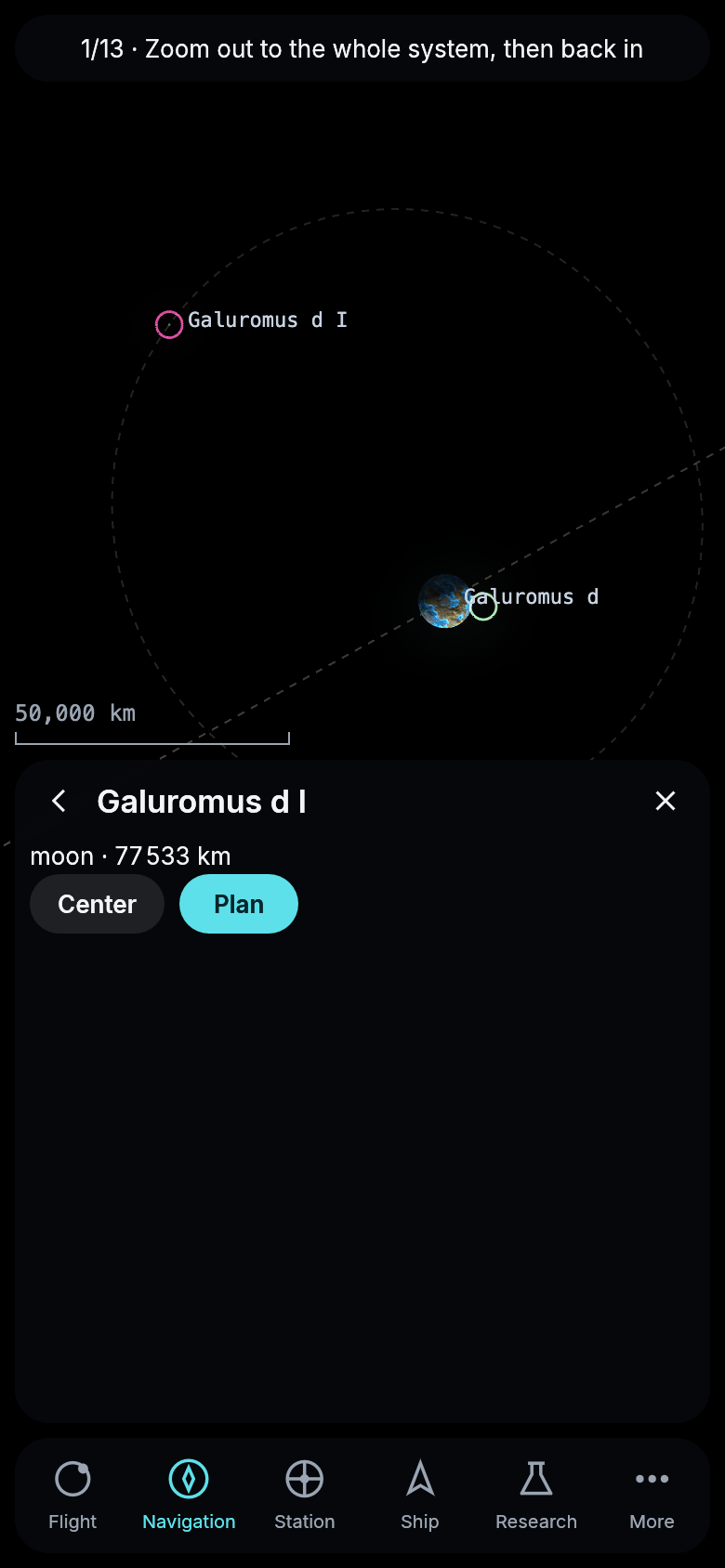
Galuromus d’s moon, with the map and the page giving the same name.
Buttons that answer while Plan works
Plan asks the server for two routes, the fastest and the cheapest, and working them out takes from a few seconds to most of a minute. Until now everything else you pressed in that time waited behind them: dock, sell, buy propellant or start a research, and nothing happened until both routes were back. Now the server works the routes out on the side, both at once, and answers every other press straight away. The cheapest route also comes back sooner, because it no longer waits for the fastest to finish. If you ask again for the same ship before an answer has come, the old question is dropped, so the card never fills with a route to a place you have since changed your mind about.
There is no picture of this one: what changed is that nothing waits.
Calling off a flight before it leaves
A cheap route often waits for the right moment to leave, sometimes for an hour or more. Until today the card only said when the ship would arrive, and once you had pressed Fly it you were committed. You asked that the wait be shown, and that a flight can still be called off while it waits.
Now the card counts down to the departure with leaves in … and only then to the arrival. Beside it is Cancel. Press it and the flight is off. The ship stays where it was waiting, back at the station if it left from one, and the propellant the flight would have burned is in the tank again.
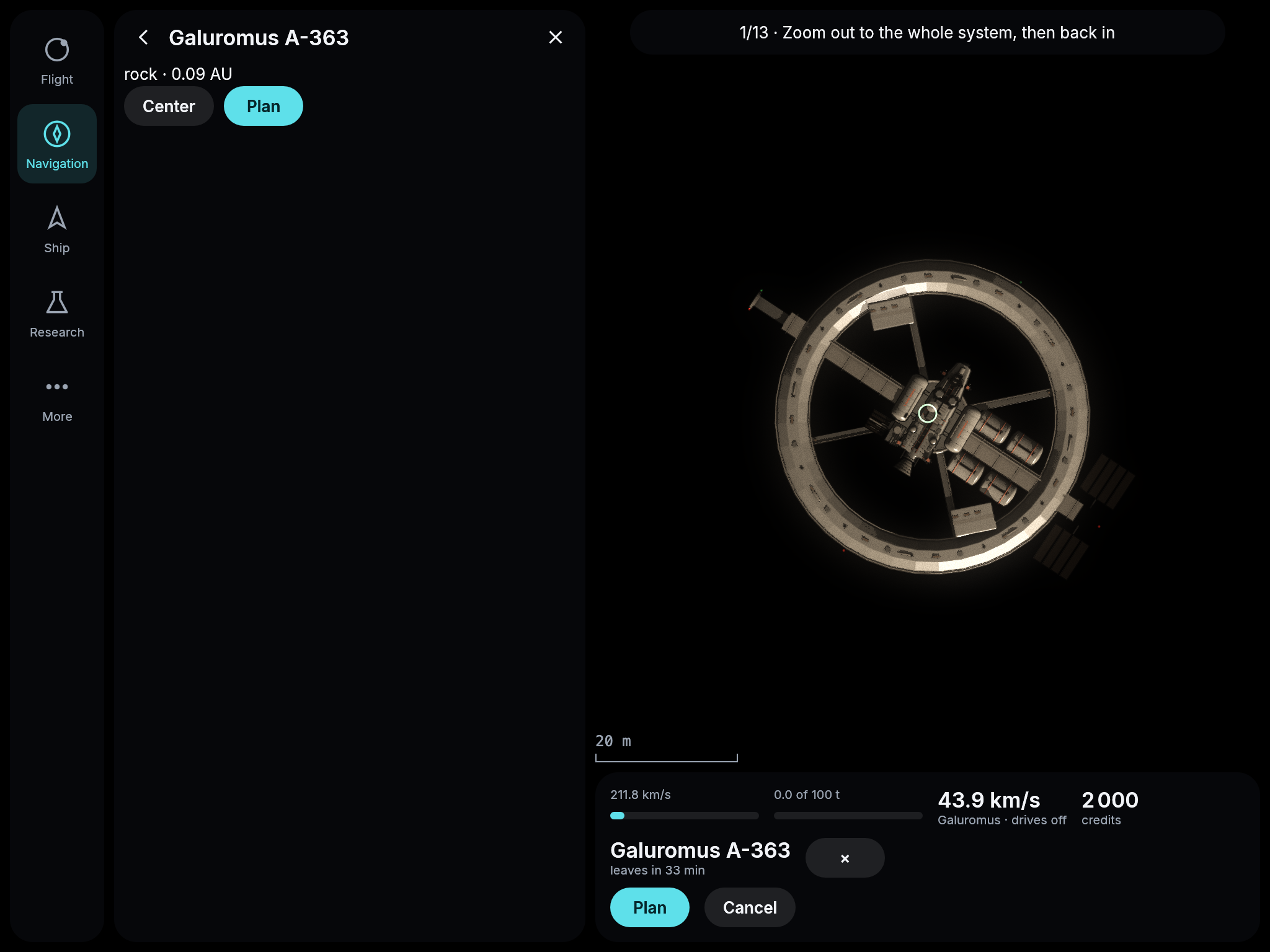
The cheapest way to a rock waits 33 minutes at the station. Until then Cancel calls it off.
Once the first burn has started there is nothing left to cancel, and you plan a new course from where you are, as before. Calling off a flight halfway, so that the ship just drifts on its arc, comes later. It needs the engine to fly a ship that has no plan at all.