Names, a tutorial that leads, a cockpit for the thumb and fusion flames
The first pilot to reach a star, a planet, a moon or a rock may now name it for everyone and for good, and the tutorial leads, opening the bar's sections as you need them and ending with shooting practice at Maren Range. The cockpit is easier to use on a phone, with a card that shows only what matters, buttons that say what they do, a lit one that is always the tutorial's next step, a map whose names no longer overlap and sizes made for a thumb. Ships that reach a station now stay beside it to dock, burn with the long blue-white jet of a fusion drive, climb out of a world's air on a turn that costs a sixth less and fly from the rock under Aquilon Station up to the station.
Name what you reach first
Reach a star, a planet, a moon or a rock before anyone else, and you may name it. Its page tells you how long you have, a real day, and gives you a field for the name and a button. From then on every pilot sees your name on the map, on the body’s page and on every card, and it stays for good. Let the day pass and the next pilot to arrive gets the chance.
A name is 3 to 24 Latin letters, accents, spaces, hyphens and apostrophes included. No two bodies share one, and names with rude words are turned away. The planets and moons of the start system keep the names they already have.
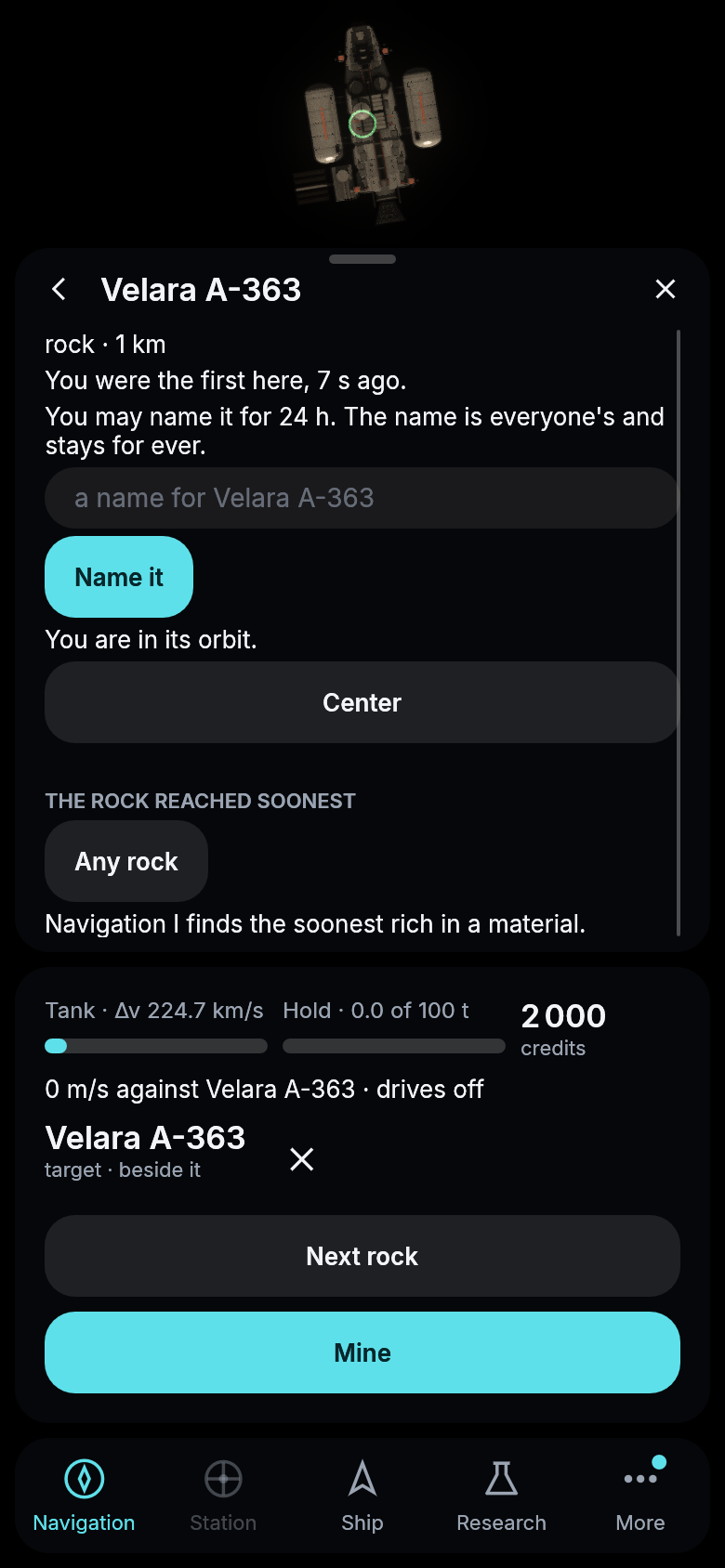
Beside a rock nobody had reached before.
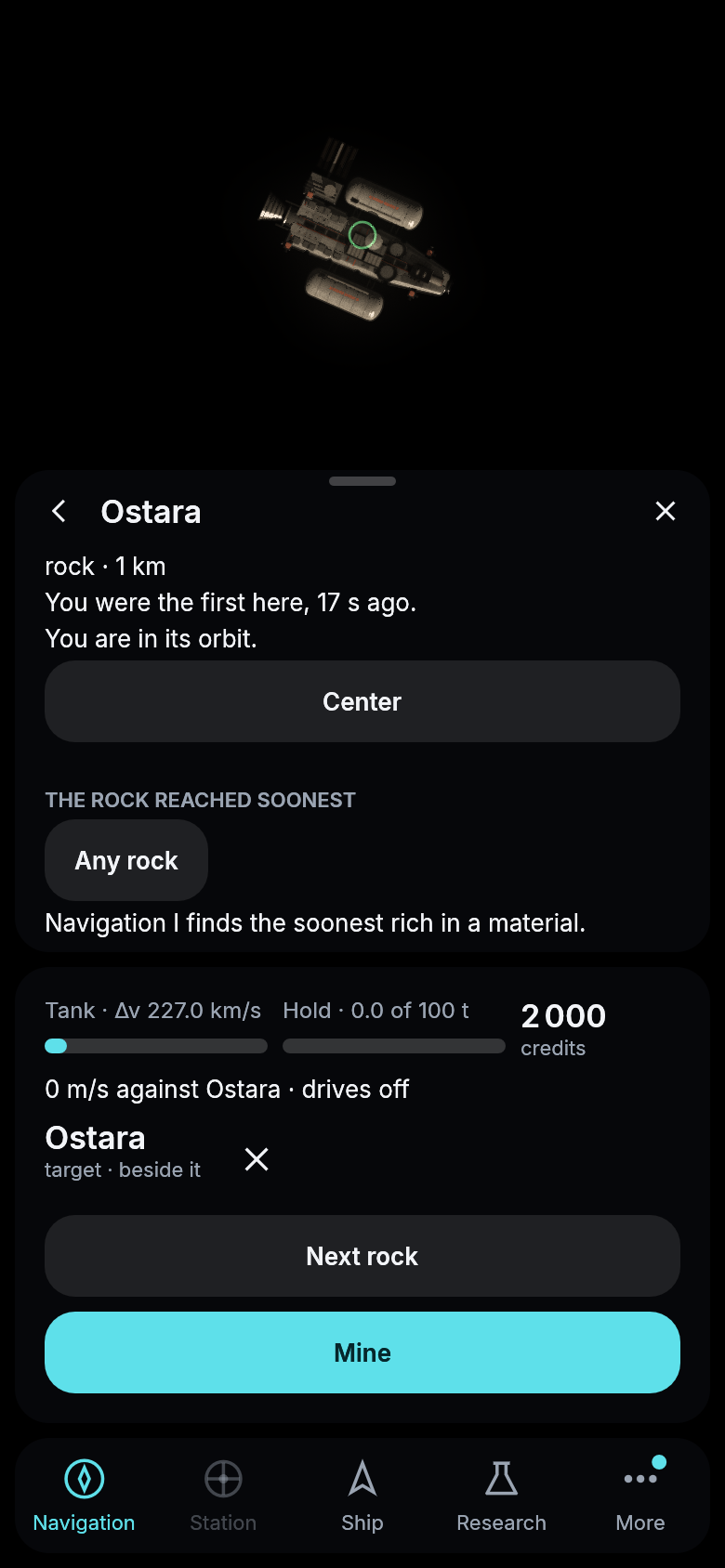
The same rock, named Ostara, drawn by the game against a local server.
A card that shows what matters
The card at the bottom always shows your tank and your credits. The hold now only appears while something is aboard, while you mine or while you are docked at a market, so it no longer takes room on every trip. While your drive burns, the line with your speed also says how hard it pushes, in g. And while your weapons are armed, the card shows what a fight needs, your shield and hull once you have been hit, when your guns and launchers can fire again, and how fast you close on the ship you last fired at.
The place you are at or flying to now stands on the card as a title in large type, and the market opens with your credits as its one big figure. The log gives each entry the whole width and says how long ago below it, so a sale shows what it brought instead of breaking off after the first digit. With nothing targeted, the card names where the ship is, beside a station, beside a rock and whether it mines there, or in a body’s orbit, where it only said No target before.
Find a rock now offers the soonest rock you reach within 2.5 km/s first, so a short hop never eats the tank you need to get home. Where spending more would get you somewhere sooner, Fly the fastest sits beside it.
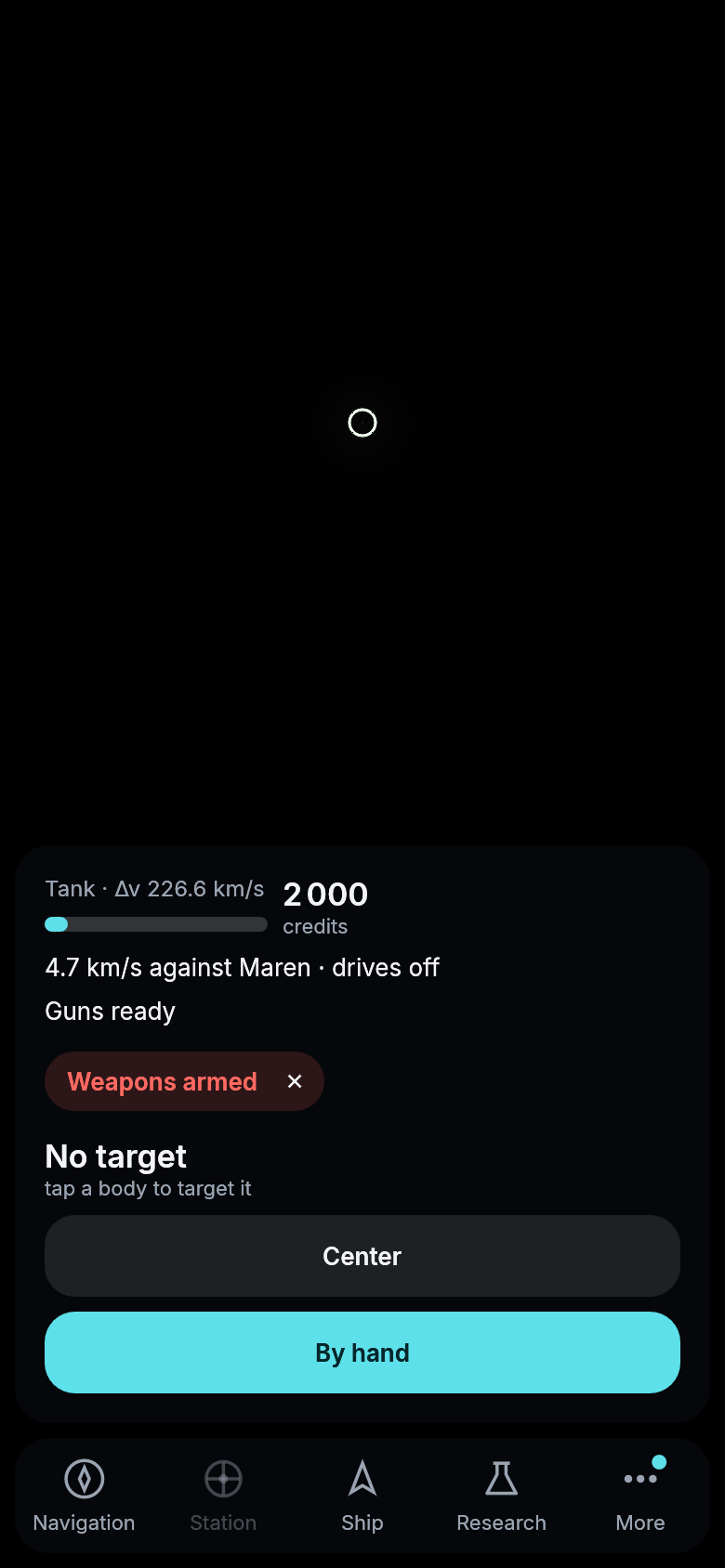
An armed start kit with nothing aboard, drawn by the game against a local server.
A map you can read
Navigation’s map of the system had become a knot of words around Maren, where the planet, its station, the shooting range and a “Wreck” for every ship that broke up nearby all printed over each other. Now a station or a wreck at a planet stands there as a small icon beside the planet’s name, and the list below the map still names each. A station out among the rocks keeps its name on the map, and so does whatever you have made your target. A station still being built now says so on its page, with how many of its crates are there.
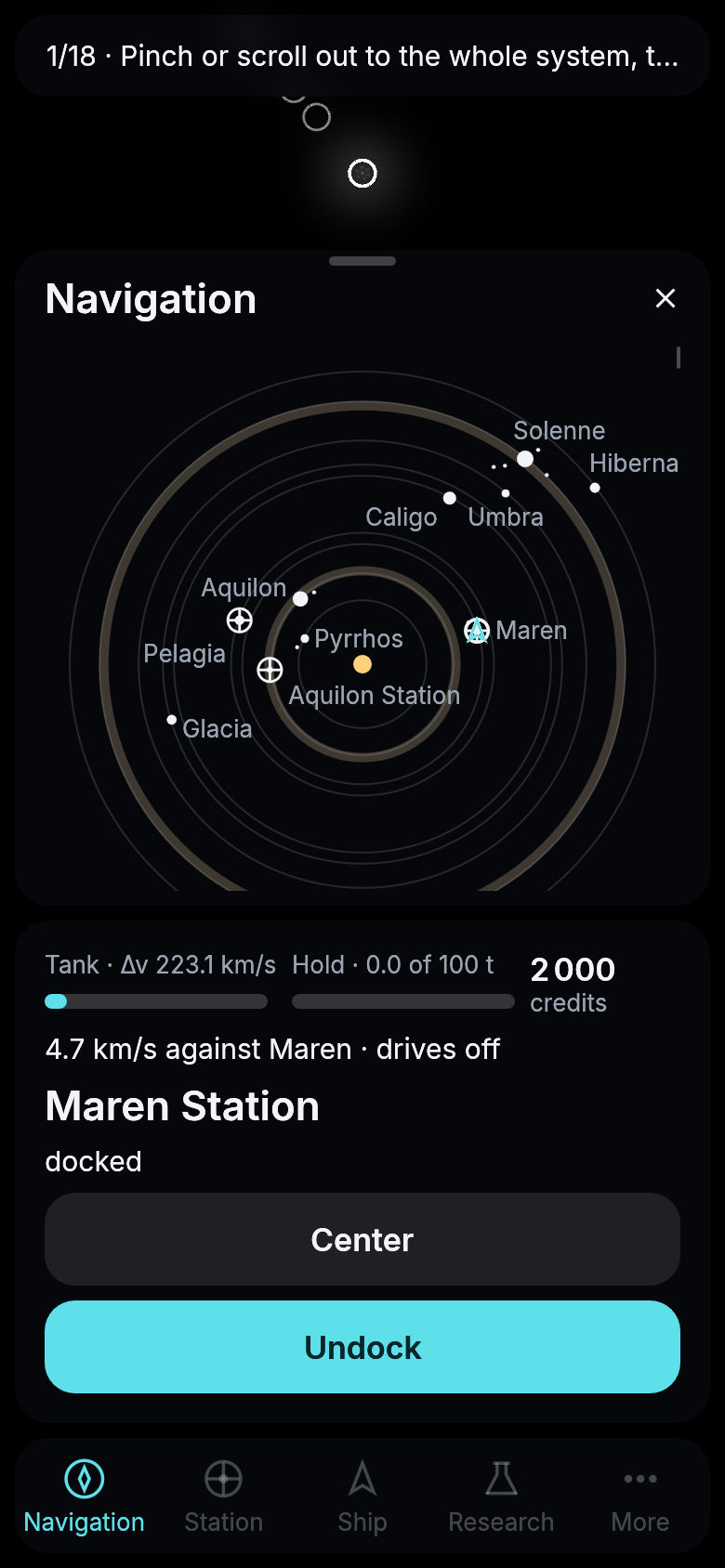
The start system’s map, drawn by the game against a local server.
Buttons that say what they do
Every button now says what it does in a verb or two, such as Find a rock, Fly by hand or Offer it here, and where it costs something the cost follows the word, as on Sell · up to 2 738 cr. When the navigation computer offers two ways, only one button lights up. Fly the cheapest is the lit one, with Fly the fastest quiet beside it, so the tank is never spent by the button that merely stood out. A page no longer repeats the card’s lit button either, nor its own name under its title, and a half sheet that lights a button of its own leaves the card below unlit, so only one ever stands out.
A hail from another pilot used to wait behind a small dot on More. Now it stands on the card until you have read it, and a tap opens the talk.
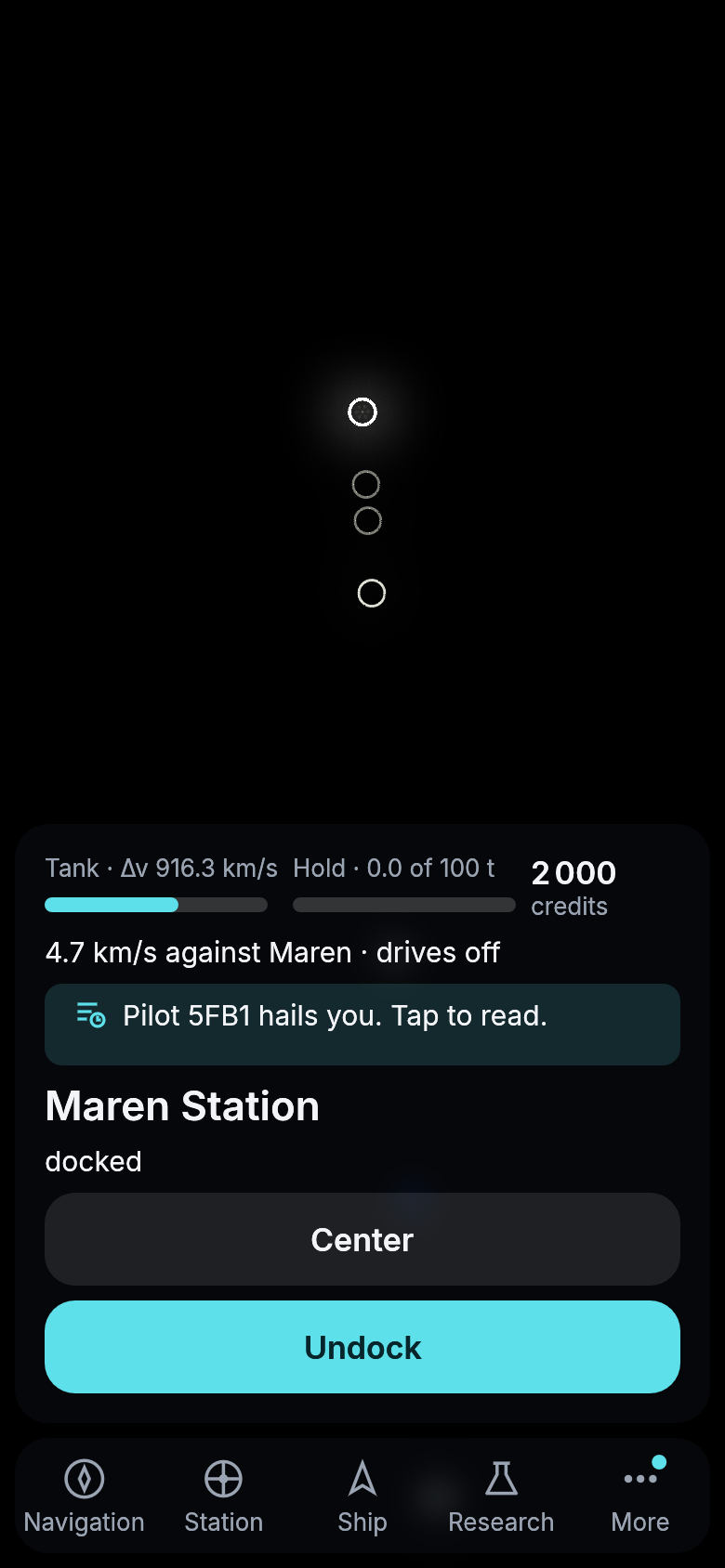
A hail waiting on the card, drawn by the game against a local server.
A tutorial that leads
The tutorial used to be a line at the top that you could follow or not, with every section of the bar open from the first second. Now the sections it does not need yet are faint and do not open: Station and More come with the market, Research with your first research, and Ship with the better drive. Navigation is always open, since every step needs a target. And nobody can fire on your ship until the tutorial is done.
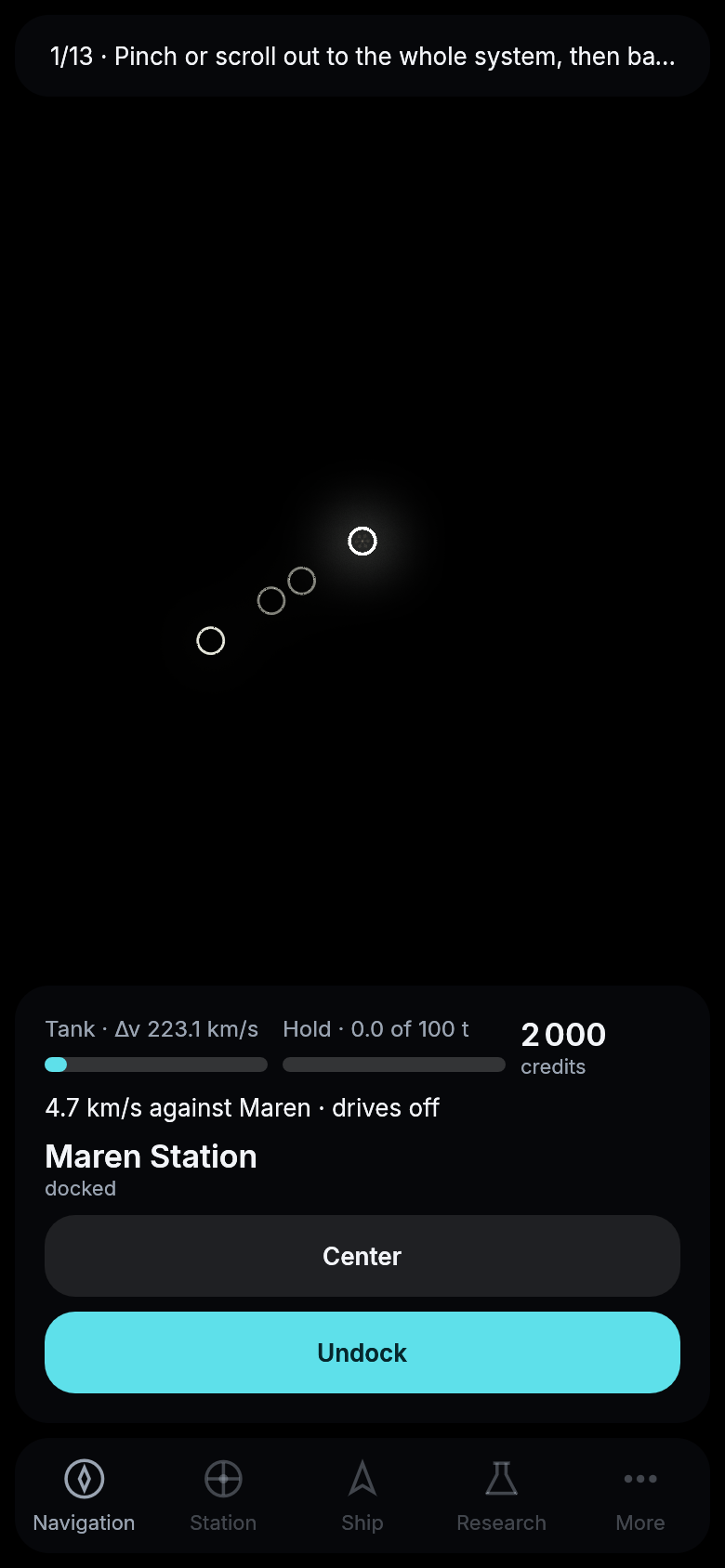
A new pilot’s first screen, drawn by the game against a local server.
The tutorial also ends with shooting practice now. After the better drive you research Weapons I and build a Railgun I, both free, fit it, fly to Maren Range, arm your weapons and hit one of the target drones. The first hit finishes the tutorial and opens the rest of the game. Pilots who had already finished it are not sent back.
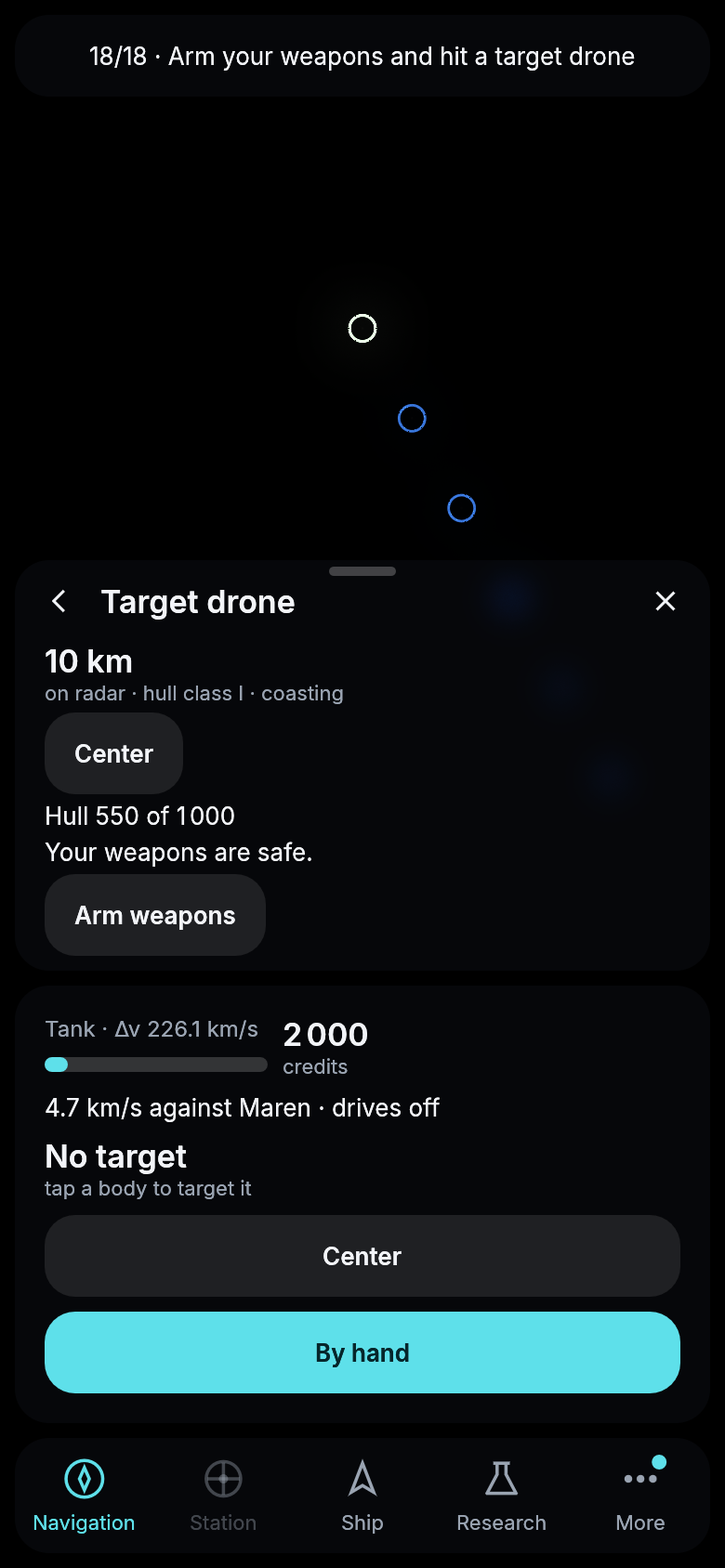
The practice’s last step at Maren Range.
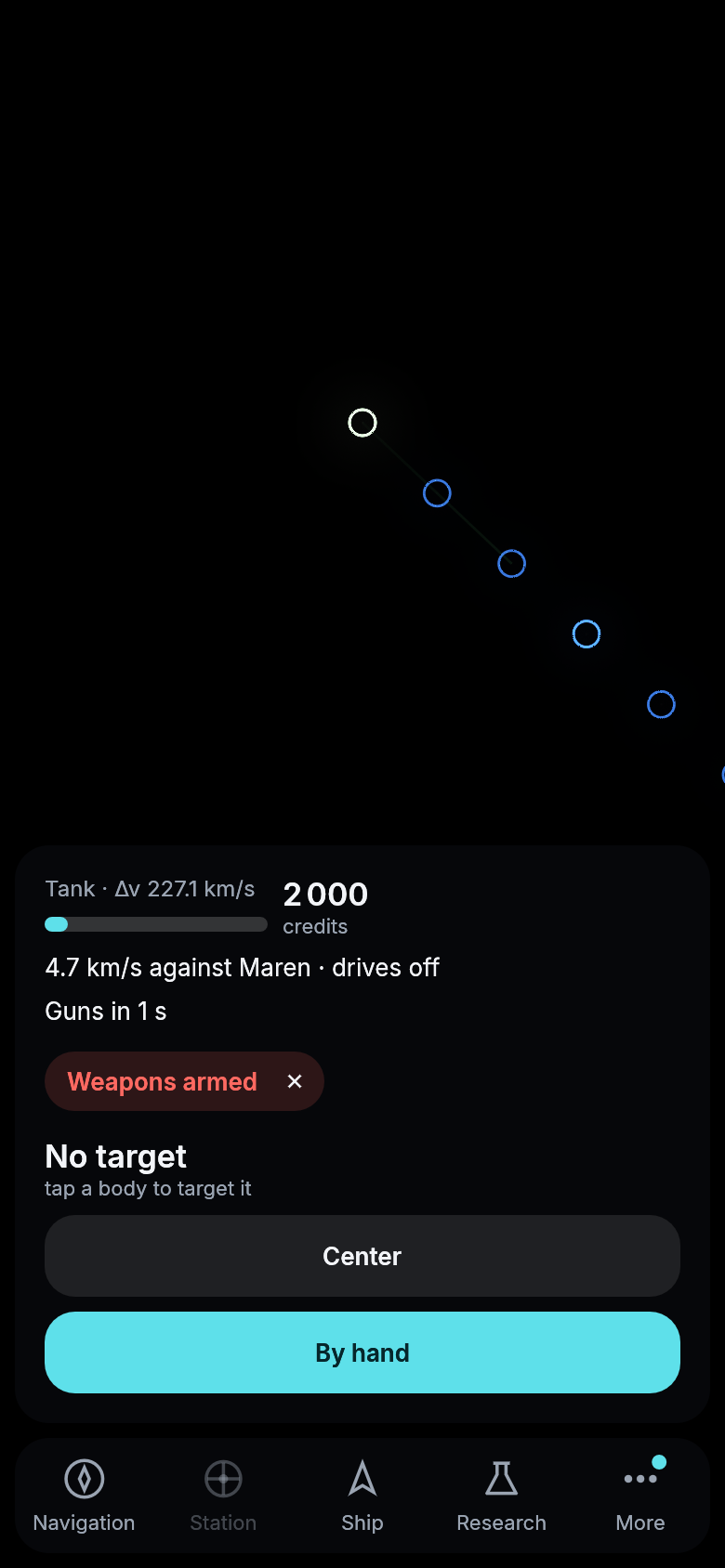
After the first hit, drawn by the game against a local server.
A new pilot goes through the whole of it. If you finished it once and then start over, the card offers to skip it.
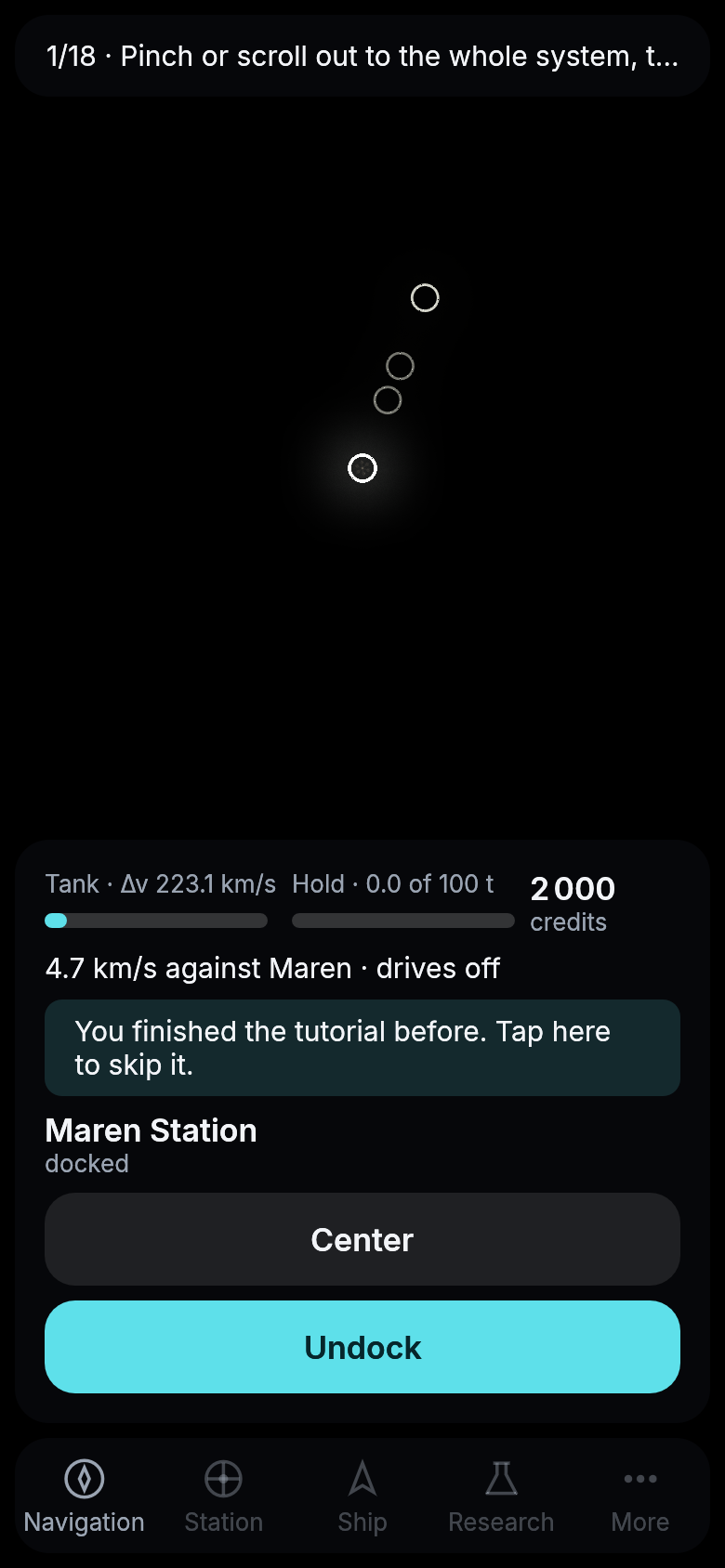
After starting over, drawn by the game against a local server.
The tutorial, walked through
A walk through the whole tutorial against a local server, all eighteen steps as a new pilot takes them, turned up a handful of snags, and each is fixed.
The worst was at home. A ship flown back to its station arrived a hundred meters beside it and then drifted off, out of docking reach within half a minute, so Dock vanished while you read the card. A ship that arrives beside a station now stays there, going round with it, until you dock.
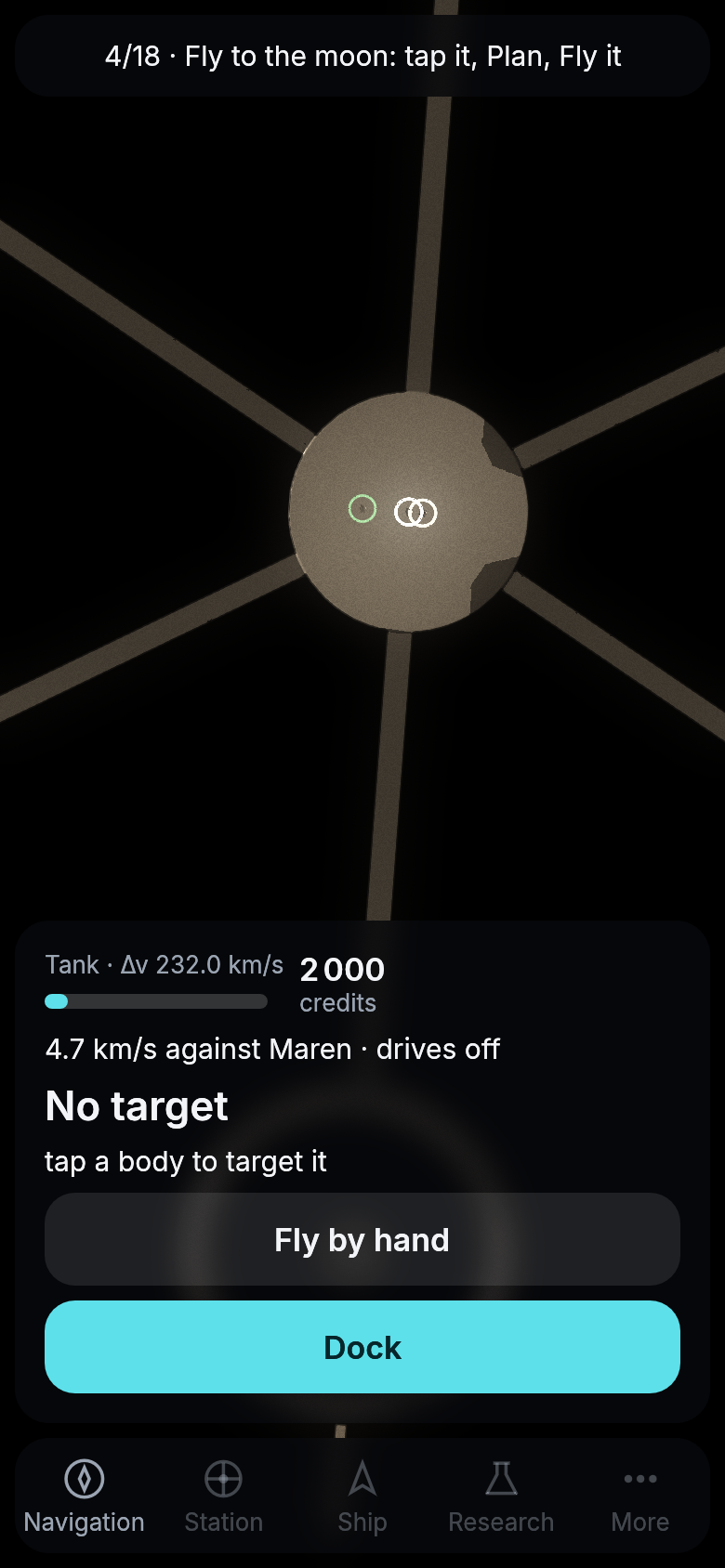
Still beside the station after arriving, drawn by the game against a local server.
The rest were about the lit button, which too often led away from the step. Now it is always the step’s. Docked, it finds the rock, opens the market, the research to start, the blueprint to build or the yard where the new part is fitted, and once that page is open the button on it is the lit one, Sell the hold when the sample is sold and Fit for the part just built. At the range it aims at the nearest drone, whose page lights Arm weapons and then Fire. At the steps done on the map, a zoom or a tap, nothing is lit at all. At the step that only shows what the way to the rock costs, nothing lights up to fly it. Tapping the moon after that shows the moon and Plan, not the rock’s ways still lit, and the moon’s way is one offer with Fly it again rather than two identical lines. In orbit with nothing else to do, Plan home is lit, not Fly by hand.
Two more came up on the way. When the fastest way has left by the time you press it, the server plans again and may pick the round through another rock, and the card now follows your ship there instead of offering to plan back to the first. A railgun built from the blueprint Railgun I is called Railgun I in the yard too. And when the last drone is hit, a notice on the card says the tutorial is done, where its line used to just go.
Walking the loops after the tutorial turned up two more. A route to one of the tutorial’s rocks no longer sends a pilot who has finished it to another rock and home again after four minutes, as the tutorial’s round does. And a ship that mines beside a rock can still unload a mine’s crates there or collect from its mine, where both were refused without a word while it mined. Beside a mine still being assembled, the card says when it will be ready instead of offering a Collect that did nothing, and the hold’s bar counts the crates a ship carries. With the hold full beside a rock, the card lights Plan home instead of a Mine that would do nothing, and the log names the station you flew home to and the rock you left crates at. And Collect at your mine no longer drops your connection to the server, which it did every time.
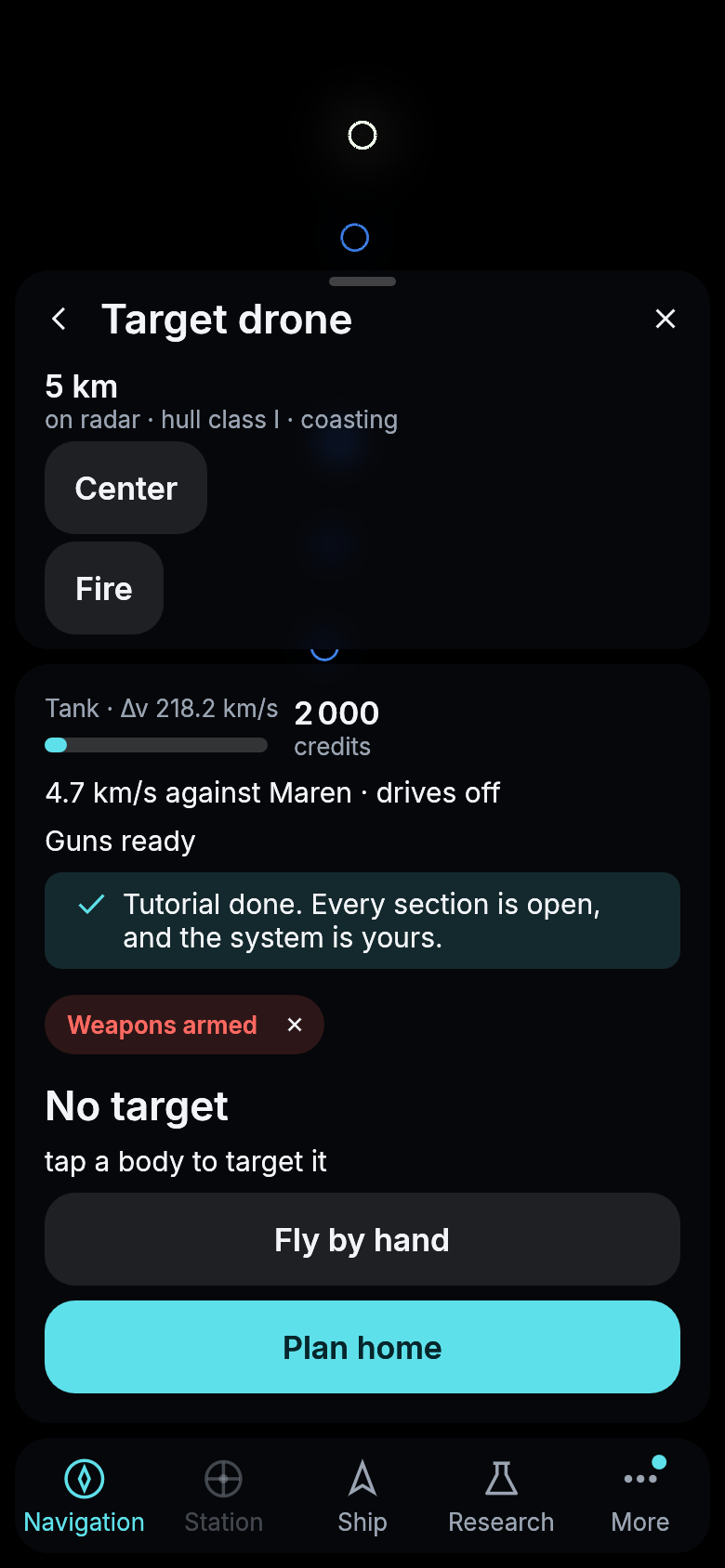
The tutorial’s end at Maren Range, drawn by the game against a local server.
Words and buttons sized for a thumb
Every word in the cockpit now takes one of five sizes, picked by what it is for. Labels are the smallest at 13 points, where some were 11 before. Lines you read are 15, buttons and the rows you tap are 17, the name of a place is 22, and the one number a page is about can be 28. Buttons are 50 points tall, so the action of the moment is easy to hit with a thumb.
The card can now carry the name of where you are, or where you are going, as a title of its own, and a page can open with one big figure, like your credits at a market.
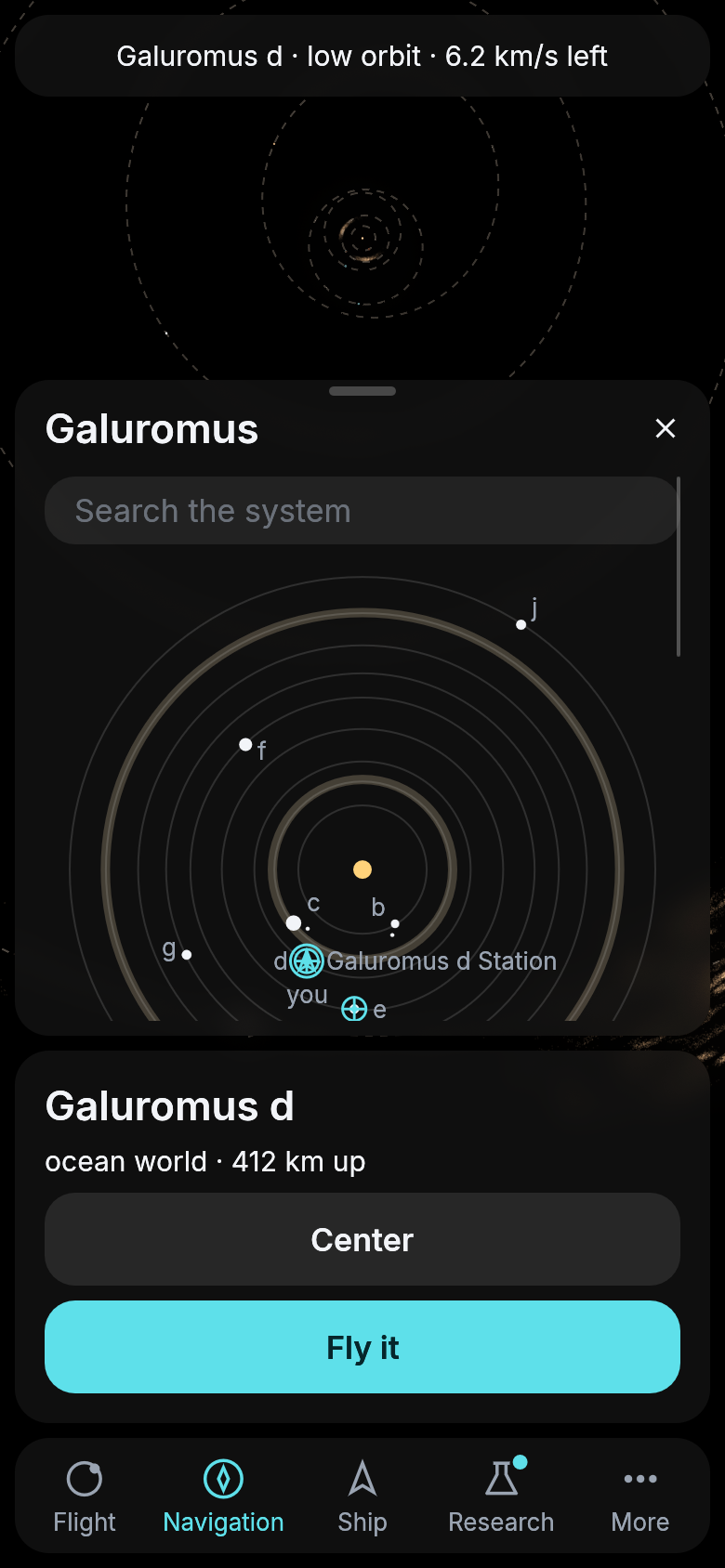
The engine’s own cockpit example on a phone, with Navigation open over Galuromus.
Pull a page up to the full height, the Market or Research, and the card below it no longer shrinks to its figures alone. The main button stays under them, so you can undock or fly without closing the page first. The quieter buttons wait until the page comes down again.
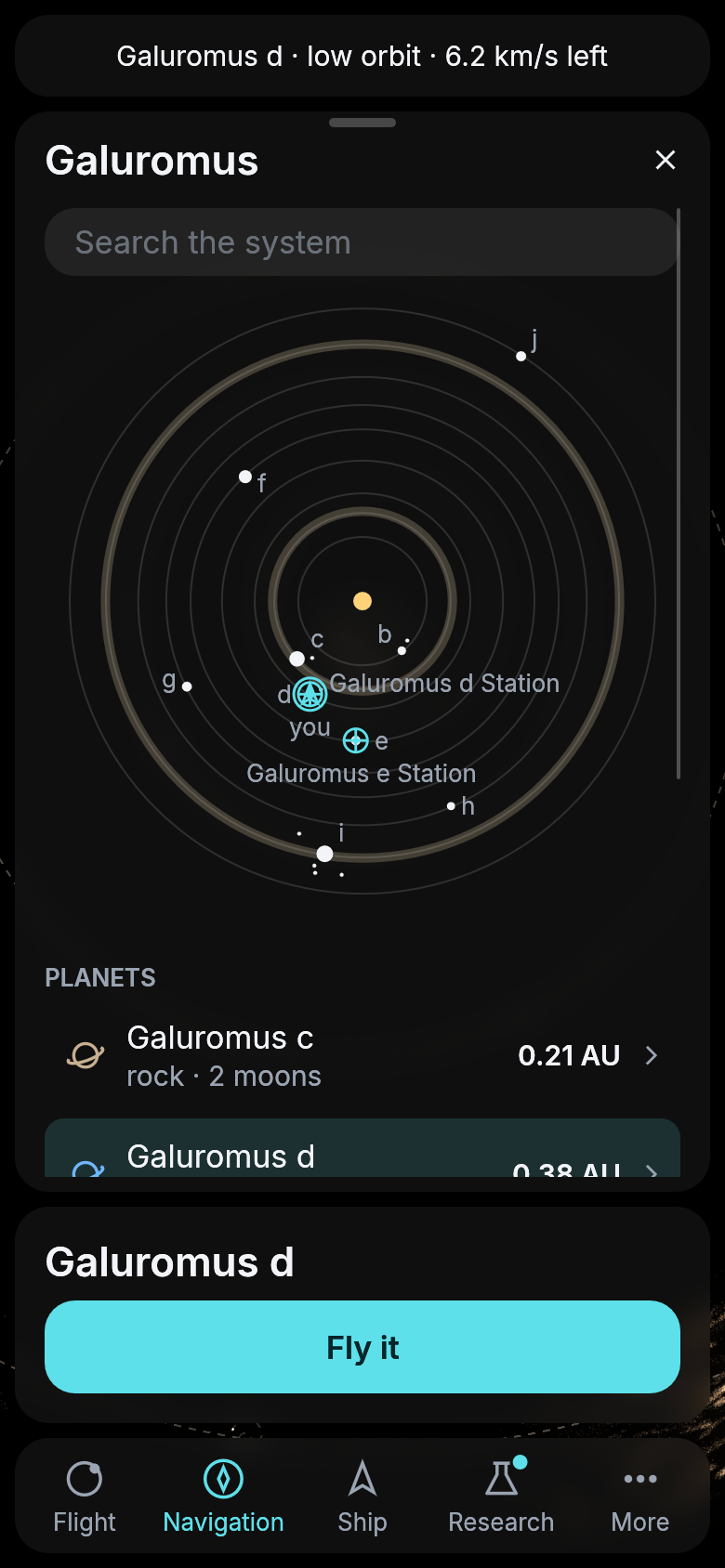
The engine’s own cockpit example on a phone, its page pulled up to the full height.
Fusion flames
Every ship in the game flies on a fusion drive that throws hydrogen out at a thousand kilometers a second, but its exhaust was still drawn as a chemical rocket’s short orange flame. Now a burning drive trails a long, narrow jet, white where it leaves the nozzle and blue where it thins. That is the color hot, thin hydrogen plasma gives off, about the color of a star of 11 000 K. Ease off the throttle and the jet shrinks to a short blue flame.
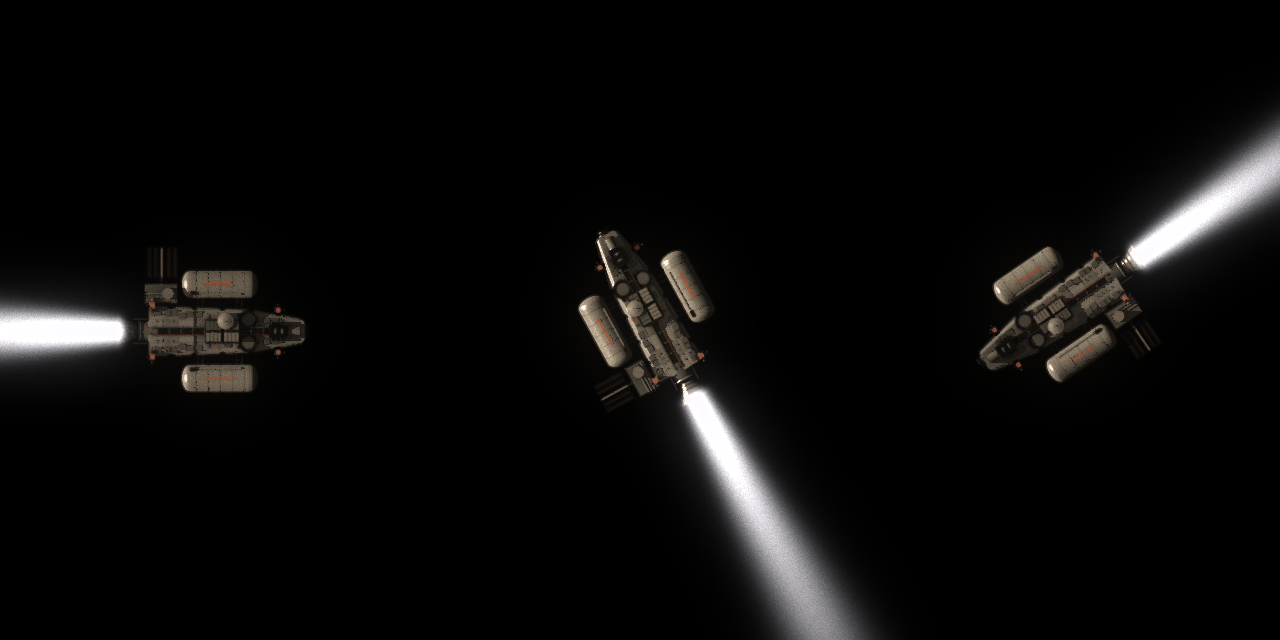
Start kits at full throttle, drawn offscreen by the engine with the game’s own artwork.
Takeoffs that lean over
Lifting off from a world with air used to go straight up until the air thinned, then turn sharply along the ground. Now a ship leans over as it climbs, the way a real rocket does. It rises slowly where the air is thick, as fast as the air lets it, and tips toward the horizon as the air thins. Leaving Maren’s ground for an orbit at one g now takes about 10.3 km/s where it took 12.4, and the climb from Solenne’s third moon 4.2 km/s where it took 4.9. Takeoffs from moons without air are a little cheaper too.
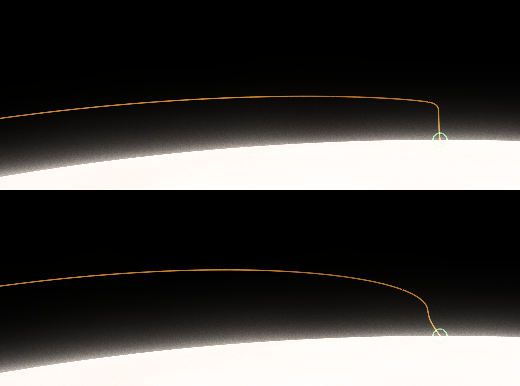
The way up from Solenne’s third moon before (top) and now (bottom), drawn offscreen by the engine.
From a rock to the station above it
Aquilon Station hangs 20 km over a rock of Aquilon’s leading cloud. A pilot who had flown to that rock found no way from there up to the station, and one docked at the station found none down to the rock below. Now the ship pushes off toward it, coasts and brakes alongside, in about a quarter of an hour and for some 44 m/s on the start kit, either way. The same holds for any rock and any place that goes round it.
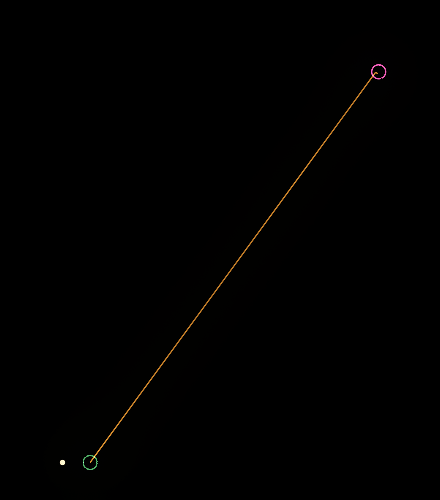
The way from a kilometer off a rock of Aquilon’s leading cloud to a place 20 km over it, drawn offscreen by the engine.