A new home and a better first hour
The game moved to Elor and started its world afresh, and the first hour of play was gone over from the first tap to the first pirate. Ships now show what they carry, markers have shapes of their own, and the navigation computer learned to land on almost every world of Elor.
Home in Elor
The old start system, Galuromus, kept no giant planet once the universe was made more realistic, and without a giant there are no Trojan rocks to mine. So the game moved to Elor, a large system with everything a new pilot needs. You now start at Maren Station over Elor c. Its moon Lunet goes round it backward, and the rocks you mine sit in the two Trojan clouds of the ice giant Aquilon. Pelagia Station hangs over the neighbor planet. The names the game gave its places went with them. The bodies with no role took names of their own, Glacia, Hiberna, Favilla, Talis and Corin. The first gate now leads to Briar, four and a half light-years away, and the second to Corar A, the nearest black hole at 26 light-years.
Later the same day the Trojan clouds became more realistic as well. A giant on a stretched orbit can’t hold on to its Trojans, so now only a giant on an orbit like Jupiter’s keeps both clouds whole. A more eccentric one keeps thinner clouds, and one past an eccentricity of 0.35 keeps none, which is a quarter of all giants. Aquilon’s clouds were thinned and their rocks are new. A mine or a ship left beside a rock that is gone would have had nothing to stand on, so the user chose to start the world afresh. Every pilot comes back as a new guest with a start kit at Maren Station, and the authority’s traders and miners start again around Aquilon Station’s new rock.
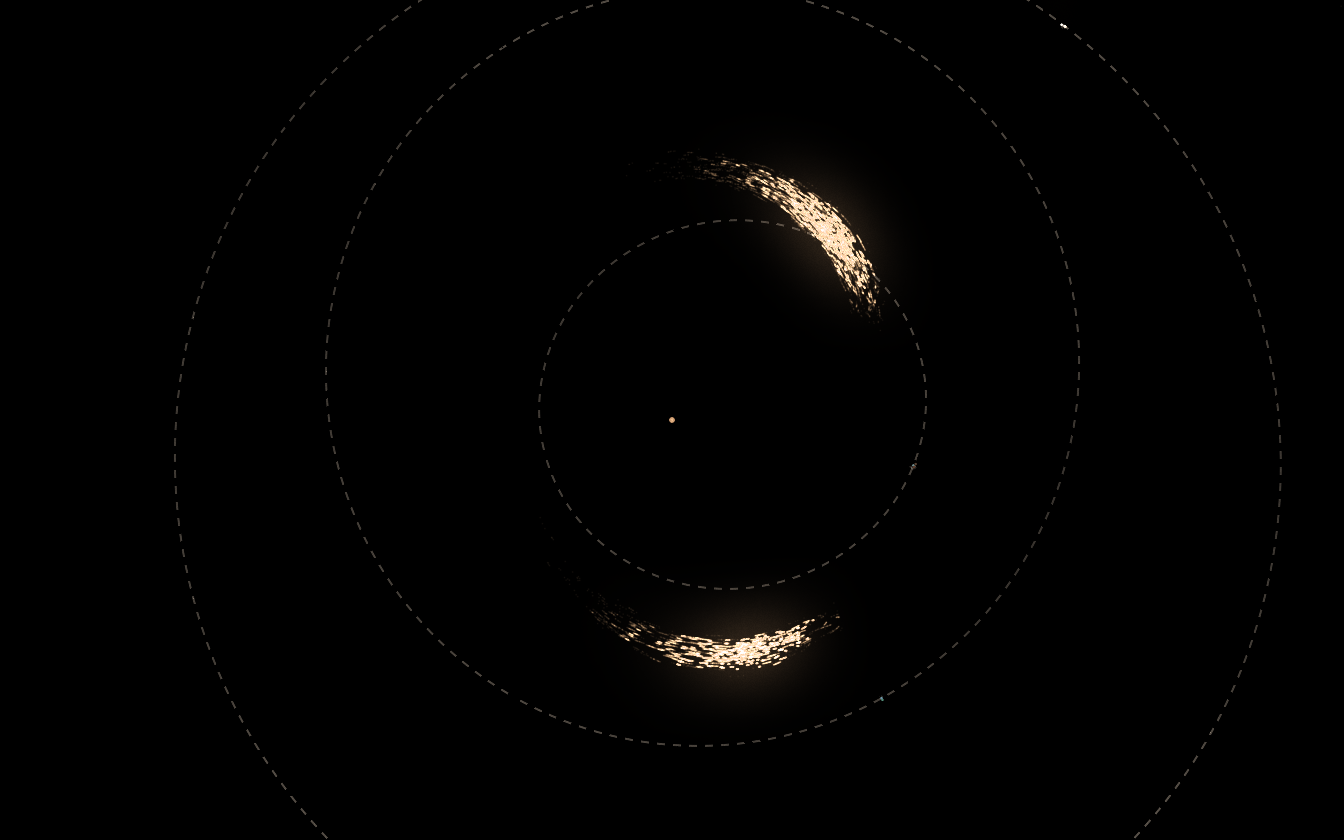
Aquilon’s leading and trailing clouds about the star Velara, drawn by the engine from the game’s seed. This is where the first rocks are mined.
The first hour, gone over
The user went through the first hour of play as a new player would, and every finding was fixed the same day.
- The arrow keys and the space bar no longer fly the ship the moment it undocks. The arrows move the map, as dragging does, and the keys fly only after you press Fly by hand.
- A tap on a ship or a station opens its page, where you can show it on the map, hail its pilot or plan a way to it. Tapping a moon makes it your target and leaves the view where it was. A tap on empty sky drops the target, as the guide always said.
- When the link to the server drops, the card says so and offers nothing to press until it is back. Before, presses were kept and sent all at once, so a Buy pressed twice bought twice.
- No wait goes on forever. A route the server turns down says why and what to try instead, the card gives up after half a minute without an answer, and the first launch says “Connecting…” from the start.
- When two routes are offered, the lines and the buttons stand in the same order, and new buttons wait half a second before they can be pressed.
- A faint section of the bar says why it doesn’t open yet, and the view says when it has reached the system’s edge or the closest zoom.
- Center is a round button at the map’s right edge, always in the same place.
- Every line of the tutorial fits on a phone.
- The words are clearer. A “no” says what helps, the tank’s warning says how much of the tank a route spends, each research says what it gives, and a route says how long the scoop needs to give its fuel back.
- In the browser, everything the cockpit shows can be read by a screen reader, and a new line such as a refusal is announced as it appears.
When a pirate demands half your hold, the card now belongs to the demand. It says how many tonnes the pirate wants and how long you have, lights Hand it over as the safe choice, and offers Arm and fight only if your ship carries a weapon.
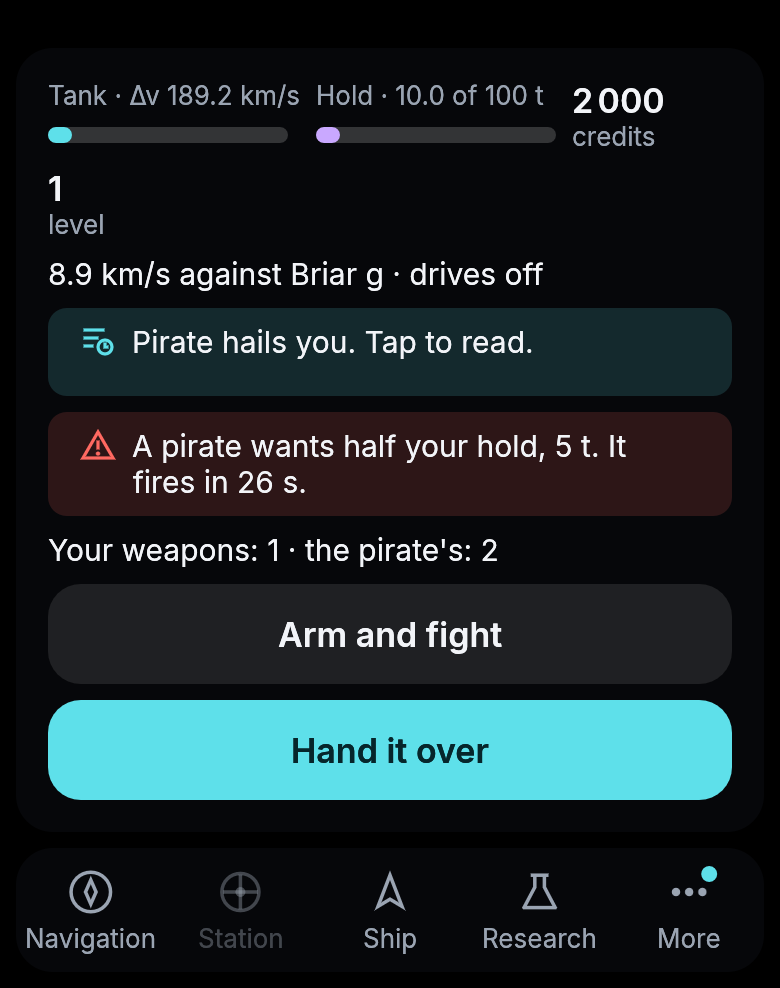
The card while a pirate’s demand stands, from the game run against a local server.
Flying by hand, and a shape for every marker
The round buttons for flying by hand now say what they do, “Turn”, “Turn” and “Burn”, and the stick says “Jets”. Let go of a turn and the ship stops turning, its small jets firing the other way until it holds still. Before, it spun on until you caught it by eye.
Markers on the map used to be rings told apart by color alone, and about one man in twelve can’t tell those colors apart. Now the ship you fly is a green arrow that points where its bow does. Another pilot’s ship is a white diamond, the authority’s ships and stations a blue square with a dot, and your target sits in four magenta corner brackets. A planned course carries small chevrons in the direction it will be flown. The user chose the shapes.
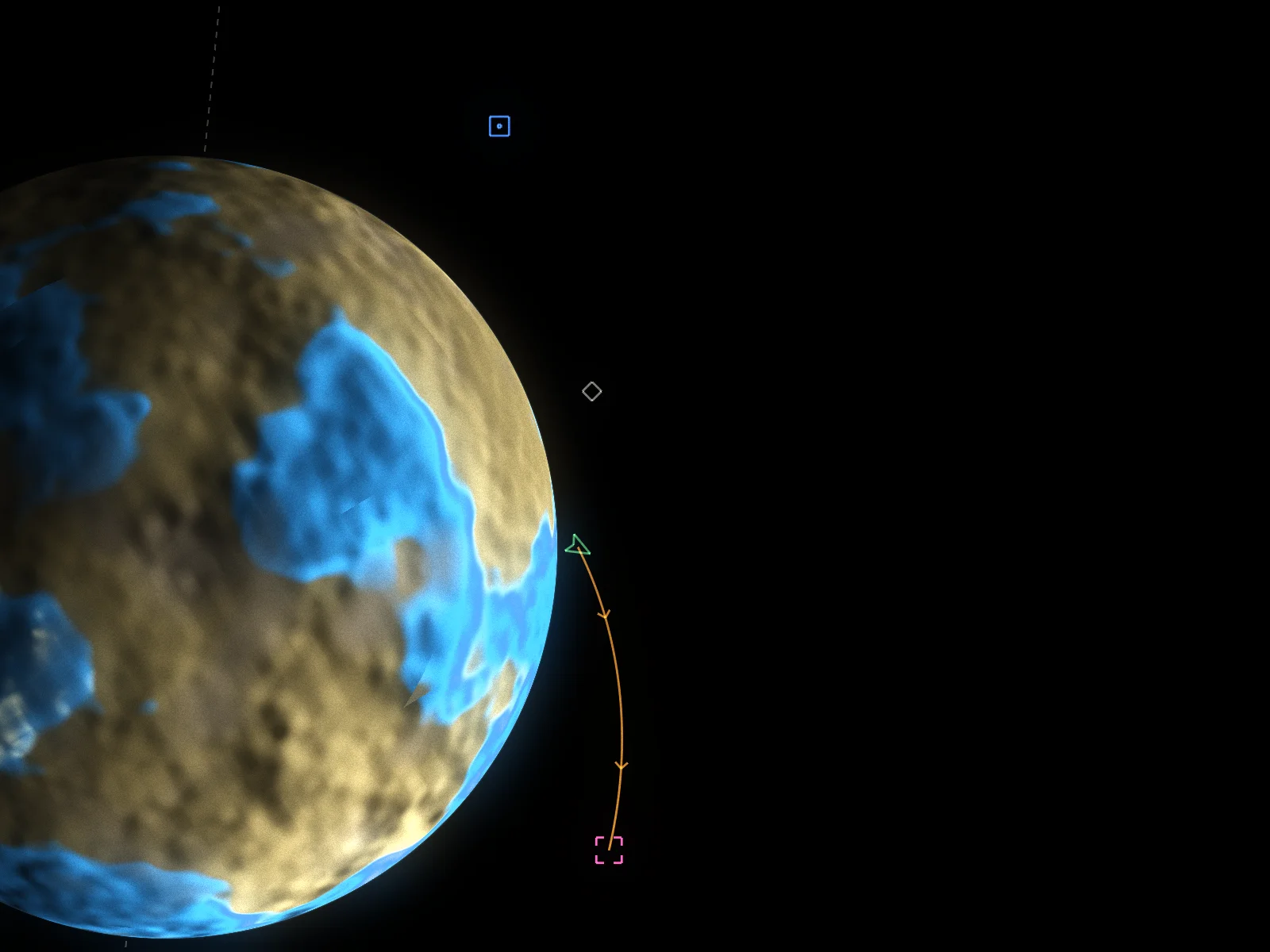
The markers as the engine draws them over Elor c, without the game’s panels.
Ships that show what they carry
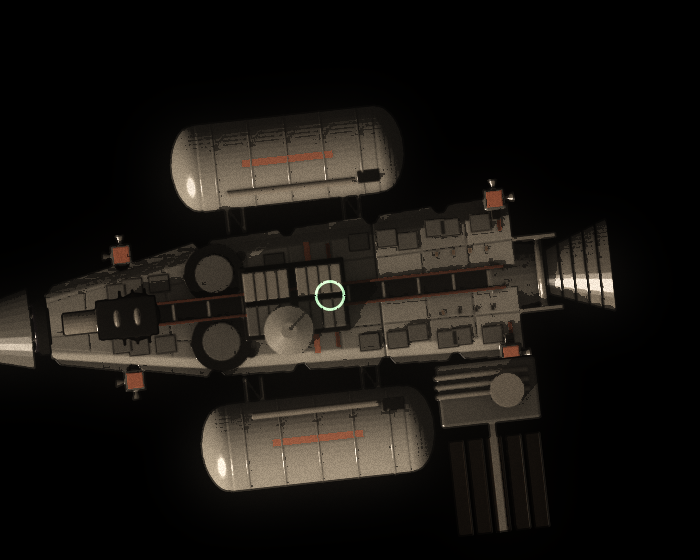
A ship used to show a mining laser, a tractor beam and an extractor whatever it carried. Now each of these is a part of its own on the hull. The laser and its tractor sit at the bow only while a mining head is fitted, the extractor’s radiators only with an extractor, and a skimmer for helium-3 shows as a wide intake where the head would be.
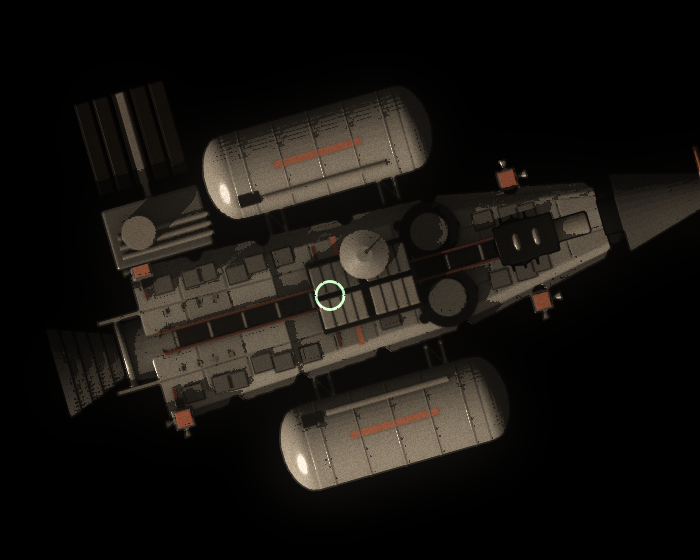
The start kit with its mining head and extractor, drawn by the engine.
The same ship with a skimmer in the mining head’s place.
Pirates used to wear the same orange as the authority’s miners. They now fly a short, stepped hull with its holds as pods at the flanks, in dull metal with rust red stripes, so you can tell a pirate at a glance.

A pirate beside one of the authority’s traders and one of its miners.
Factions value their own work
Standing with the four factions used to rise only by trading at their stations. Now each one also rewards what it lives from. Aquilon Extraction raises you when you collect from your mine in Aquilon’s clouds, the Pelagia Exchange for every delivery your freighter makes, and the Survey Corps for a first and for a chart you sell. Trading still counts, and all of it together is at most ten a day with each faction.
The navigation computer
Most of the engine’s work went into the navigation computer.
- It can land on every planet and moon of Elor except the giant b. It now measures a descent over the ground beneath the ship and holds against every pull there. A landing on Lunet costs 854 m/s where it cost 1 363.
- A ship on the smallest moons lifts off again, and a ship that asks for a place further round its own orbit flies a phasing orbit as real crews do. Half a turn ahead costs under a kilometer a second.
- Home from a moon close to its planet costs half the fuel, home from a rock with a full hold is always offered, and the authority’s heavy miners find their way back to Aquilon Station in seconds.
- The fastest way to Aquilon’s trailing cloud is found in about a second, and a ship with too little fuel hears so at once instead of waiting forty minutes.
- A ship with a modest drive takes the straight burn where it arrives first, from Elor c to d in 10.7 days instead of 14.3, and a way through an asteroid belt plans in half the time.