Trojan asteroids, explained
A Trojan is a small body that shares a planet's orbit. It circles the star in step with the planet, about sixty degrees ahead of it or sixty degrees behind. At these two places, the Lagrange points L4 and L5, the pull of the star and the pull of the planet combine in a way that keeps the rock from drifting off for billions of years.
The five Lagrange points
Around a star and a planet on a circular orbit there are five places where a small body can keep its position relative to both. Three of them lie on the line through the star and the planet. L1 is between them, L2 is beyond the planet and L3 is on the far side of the star. All three are unstable, so a small nudge is enough to make a body drift away. Spacecraft parked at L1 and L2 have to fire their thrusters now and then to stay there.
L4 and L5 are different. Each of them forms an equilateral triangle with the star and the planet. L4 is sixty degrees ahead of the planet on its orbit and L5 is sixty degrees behind. Joseph-Louis Lagrange found them in 1772.
Why Trojans stay
At L4 and L5 there is no pit that holds a rock in place. In terms of potential energy the points are actually hilltops. What keeps a rock there is the Coriolis force of the rotating frame. As the rock starts to slide away, its motion is bent around the point, so it circles L4 or L5 instead of leaving. Seen from the planet, a Trojan swings slowly around its point on a long, curved path called a tadpole orbit. A rock that swings wider loops around both points on a horseshoe orbit.
This only works if the planet is light enough compared with its star, at less than about one twenty-fifth of the star's mass. Every planet in the Solar System is far below that. Jupiter has about a thousandth of the Sun's mass.
Which planets have them
| Jupiter | More than 13,000 are known. The first, 588 Achilles, was found by Max Wolf in 1906. There are probably about as many as in the main belt. |
|---|---|
| Neptune | Dozens are known, and in total there are likely more than Jupiter has. |
| Mars | A handful, most of them at L5. |
| Earth | Two found so far, 2010 TK7 and 2020 XL5. |
| Saturn's moons | Tethys and Dione share their orbits with small Trojan moons. |
Jupiter's Trojans are named after the heroes of the Trojan War, with the Greek camp at L4 ahead of the planet and the Trojan camp at L5 behind it. They are dark, reflecting only about seven percent of sunlight, and reddish. They are primitive bodies that are thought to have kept the ice and organic matter of the early Solar System. NASA's Lucy probe, launched in 2021, will fly past several of them from 2027 on.
How the main belt between Mars and Jupiter compares with the one in The Expanse is on the page about Belters and the real asteroid belt.
Trojan asteroids in Supergalactic
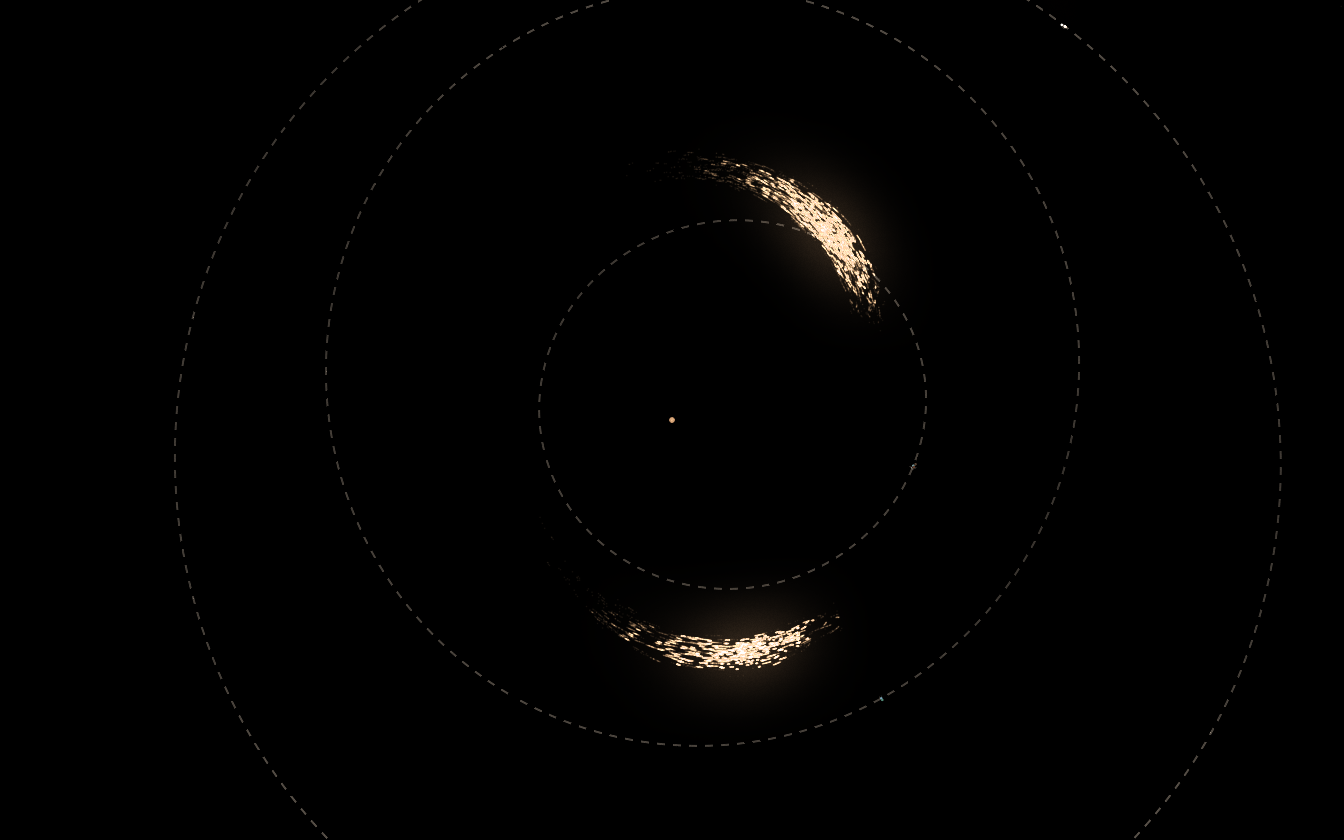
In Supergalactic every giant planet, gas or ice, has two Trojan clouds at L4 and L5 that move with it. As with Jupiter's, the rocks are dark, reflecting seven percent of the light, and primitive. Those of Aquilon, the giant next to the start planet, are a quarter to a third water. Every rock is a separate body with its own mass, shape and address, and it is the same for every pilot.
There is one thing the game leaves out on purpose. Its rocks do not swing around their points. A cloud in which every rock follows its own tadpole orbit looks the same as a cloud of rocks that stay still, so the game simply draws the cloud.
Where every pilot's first rock is
The water in Aquilon's Trojans is why the start kit flies there first. Next to a rock, its extractor refines the ice into propellant, so the rock pays for the flight home. The way out is a transfer between orbits that costs 10 to 12 km/s, and whatever the hold brings back is sold at the station. The whole loop is described on the page about the space mining game.