Mining and the market
Mining is how a pilot earns money. The first rocks are in the two Trojan clouds of Aquilon, the giant next to your start planet. They are dark, primitive rocks, and a quarter to a third of each one is water.
At the rock
Your ship mines with a mining laser that cuts the rock and a tractor beam that pulls the pieces into the hold. Next to a rock, two things happen at the same time.
- The head fills the hold with the rock’s mix of silicate, water, carbon and metal, at about a tonne a minute, as far as the hold has room.
- The extractor bakes the ice out of the rock and refines it into propellant, which fills the tank.
Next to a rock the card offers Mine. Mining goes on until the tank holds enough for the way home, and the bars in the card rise as it goes; Mine leaves the card until it is done, and the line under the rock’s name says mining. Once the hold is full, the card says so and lights Plan home, where the hold is sold. While it mines, the laser’s lens at your ship’s bow glows red, and a thin red beam reaches from it to the spot on the rock’s surface it cuts. Every rock spins, and your ship stays over the spot it arrived above, going round with the rock and turning with it so that its bow, where the laser sits, keeps facing that spot. Every rock is shared, so what you take is gone from that rock for every other pilot.
The next rock
When a rock is mined out, or you are done with it, Find a rock on the card asks your navigation computer for the rock your ship reaches soonest from where it is. That is the one with the shortest trip, which is not always the closest. The search looks at the rocks within 30 000 km, so it only works next to a rock, among its neighbors in the same cloud. The answer becomes your target, and its way is on the card, ready to fly. The way offered first is the soonest rock your ship reaches within 2.5 km/s, Fly within 2.5 km/s on its button, so that a short hop does not eat the tank you need to get home. Where spending more would get you to a rock sooner, Fly the fastest is offered beside it.
After the research Navigation I you can also search by what a rock holds. Open the rock you are next to in Navigation, and under The rock reached soonest pick water, metal, silicate or carbon. You get the soonest rock that is at least a third that material. Water is what your extractor turns into propellant, and metal is what building needs most.
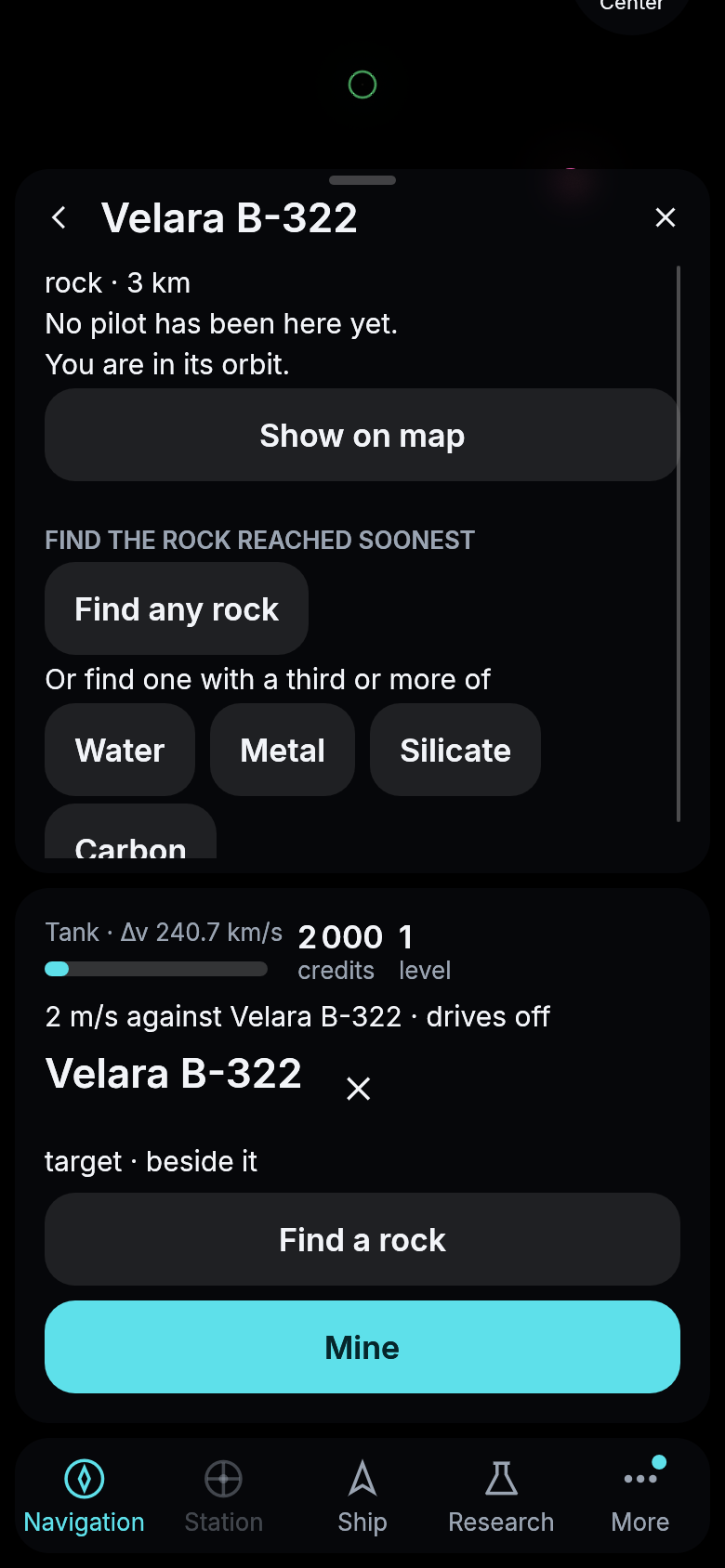
The trip the tutorial sends you on
The tutorial’s rock is a wet one in one of Aquilon’s two clouds, the one nearest the middle of its cloud at the time. The rocks of a cloud swing back and forth about its middle, so every few minutes it may be another rock; one you picked a little earlier still counts.
The route to the tutorial’s rock comes with the way home already planned. Of all the routes, the server offers the one that has you home soonest, counting the wait before it leaves. The card says when it leaves, usually within a few minutes. Fly it and the ship does the whole trip by itself. That is the tutorial’s round. Once you have finished the tutorial, a route to these rocks is a route like any other, and the ship stays at the rock until you send it on.
- At the rock it stays at least four minutes. It mines a sample of 4 t or more while the extractor fills the tank again, and stops filling the hold at what the way home can carry.
- It leaves when the way home starts.
- At Maren it plans the route to the station.
- Next to the station it docks.
The stay is a good time for research, Vault I at the rock and Drives I on the way home. Vault I is free in the tutorial and Drives I costs 500 credits of your start money, so the sample doesn’t have to pay for either. The trip takes a quarter of an hour to twenty minutes of real time. You can put the phone away and find your ship at the station when you come back.
The market
The market’s page, like every page where you spend something, shows your credits, the free room in your hold and your Δv at its top.
When you are docked, the Station section lists what the station does, its market and any charts offered there. Undock is on the card. Your vault is under More and the yard under Ship, as they are yours and your ship’s.
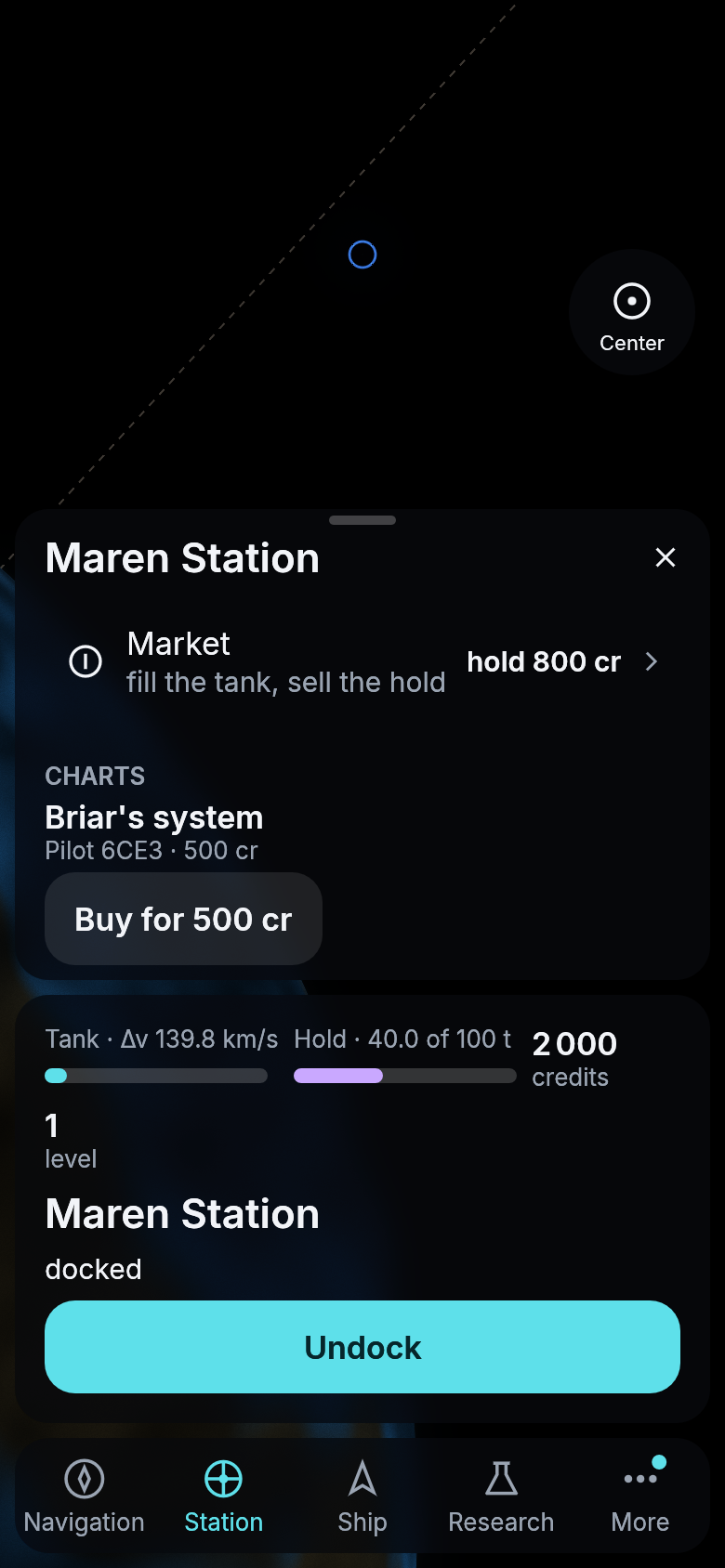
Maren’s station. Each row leads to its detail.
Market opens the prices and the buttons to trade. Research runs aboard your ship, so it is in its own section of the bar.
There is a second station at Pelagia, the next planet out. Its market pays more than Maren’s for silicate, carbon, metal and water, and asks more for propellant, so a hold can be worth the longer trip. You can only fly there with Fusion drive I (see the yard). With the drive your ship starts with, Plan says so instead of offering a way.
A third station, Aquilon Station, sits in the leading cloud of rocks ahead of Aquilon, going round one of its larger rocks. It is the miners’ station. Its market pays little for ore, a fifth of what Maren Station pays, and sells water and propellant as cheaply as Maren does, so you can fill your tank right next to the rocks. Navigation lists it by its distance, as a station at its rock.
A fourth station, Briar Station, is through the gate at Briar. It goes round the gas giant Briar c, below the gate’s end there. Its market pays for ore what Maren Station pays, so a hold you could not sell well at a crowded Maren still sells in full there. It is short of water and pays five times what Maren does for it, and sells propellant as cheaply as Maren.
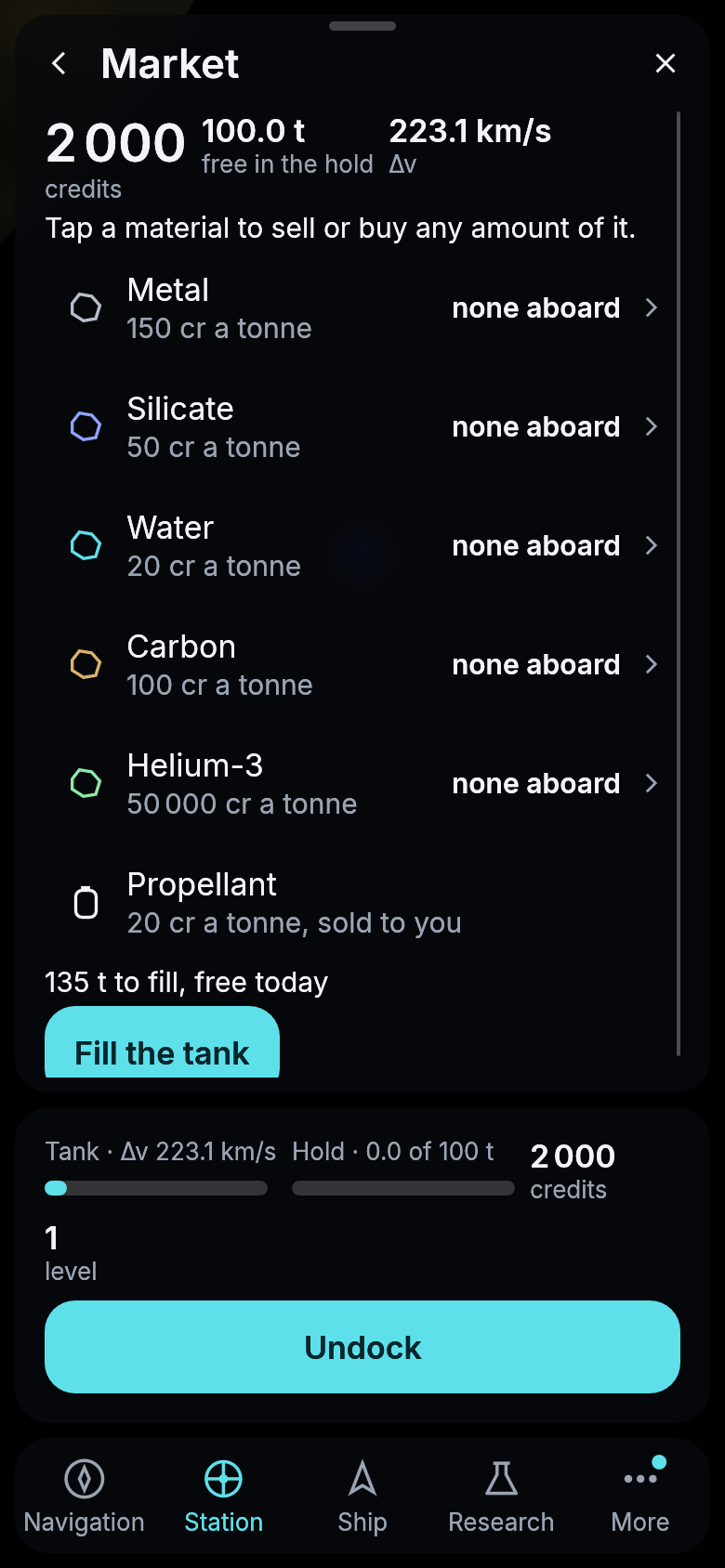
Maren’s station market, with what it pays and asks per tonne and today’s free fill.
- Fill the tank tops up your tank. While the tutorial runs every fill is free, and after it the first fill of each day (by UTC). Otherwise you pay the station’s price for propellant. The line above the buttons says how much it takes and what it costs.
- Sell the hold sells everything in your hold at the station’s prices, once you have said Sell the hold again to the question it asks, the red button there; Keep it keeps it.
- Tap a material to sell or buy any amount of it. Each row shows what a tonne fetches and how much of it is aboard. Its page starts at all you have aboard, ready to sell. Drag the slider to any amount of it, press ¼ or ½ for a share or All for all of it, change the tonnes by one with − and +, or type them. Sell then sells that amount, and Buy buys it, up to what fits in the hold; the lines above them say what each brings or costs and what your Δv will be after it, since cargo makes the ship heavier. The stock holds what other pilots and you have sold, so you can buy back your own hold.
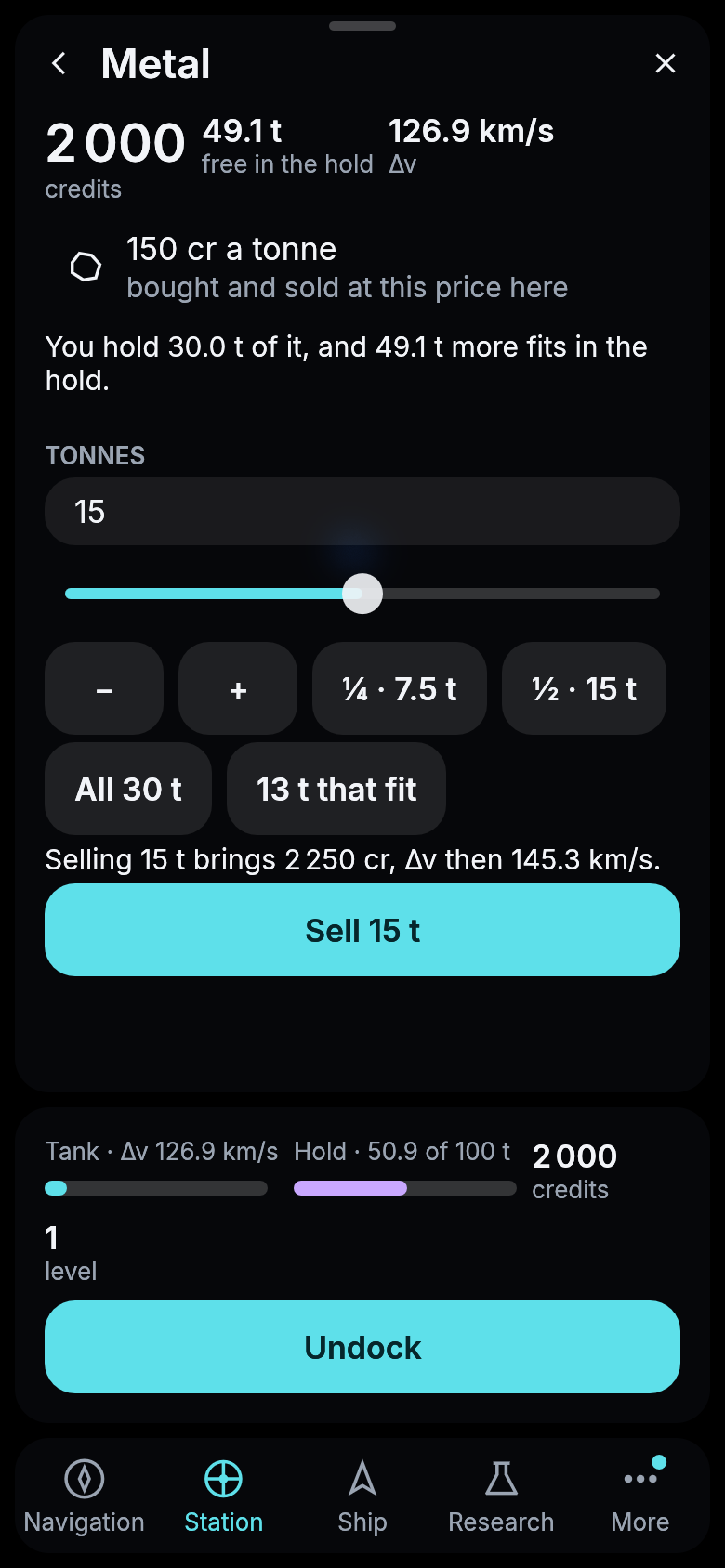
Selling half of the metal aboard.
| A tonne of | At Maren’s station, at rest |
|---|---|
| propellant | 20 credits |
| water | 20 credits |
| silicate | 50 credits |
| carbon | 100 credits |
| metal | 150 credits |
Prices move
A market’s prices follow its stock. Everything sold there is added to the stock, so the more of a material arrives, the less the station pays for it. A trip’s 30 tonnes of silicate lowers its price from 50 to 49, and a thousand tonnes lower it to 35. What you buy is taken from the stock in the same way. Left alone, a stock returns to its usual level, halfway in about five and a half hours and nearly all the way in a day, and the prices follow. A sale is always paid at the prices the station showed you, and only the next sale gets the new prices. A purchase is paid at the price the stock has after it, a little more than the one shown, so a hold sold and bought back never earns you anything.
You are not the only one trading. The Charter’s traders fly between Maren Station, Pelagia Station and Aquilon Station, and through the gate to Briar Station, and they buy and sell at the same markets as you. Its miners work mines of their own in both of Aquilon’s clouds and sell what they bring at Aquilon Station. Your map shows them within ten million kilometers of your ships, so from Maren you see Maren’s traders but not Aquilon’s miners, until you fly out there. You can tell them from other pilots’ ships by their hulls and by their blue rings on the map. The traders are long and pale with blue stripes, their holds in a row or in pods along the hull, and the miners are ochre with orange markings, their tanks gathered at the stern. A trader leaves on its own departure, one every five minutes on each route, and takes a way that arrives within three quarters of an hour unless that costs more than three times the cheapest way. Then it waits at its station until the planets line up. At each station they sell what they brought and buy whatever the other station pays at least twice as much for, so their trade moves the prices just as yours does. Mostly that is water for Pelagia and ore from Aquilon Station, so those prices come closer while they deliver and drift apart again when they stop.
Every pilot starts with 2 000 credits, enough for 100 tonnes of propellant, more than the longest trip to a rock and home burns.
Contracts
The Charter’s stations pay you to carry goods for them. Docked at one of them, open Station and then Contracts. Each contract says what it carries, where to, how many tonnes and what it pays on delivery.
A hauling contract takes a material to another of the Charter’s stations, the one whose price there is furthest above the price here. At Maren Station that is usually 50 tonnes of water for Pelagia. When you press Take, the station loads the goods into your hold and keeps a deposit, which is what they cost here. You need the room in the hold and the credits for the deposit, and the page says so when you are short of either. Dock at the other station and the card offers Deliver. You get the deposit back and the reward on top. The reward is what the same goods would earn you by trading, and a quarter more. With prices at their usual level, Maren’s water comes with a deposit of 1 000 credits and 5 000 for delivering it.
A supply contract asks you to bring 20 tonnes of what the station is shortest of, back to the same station. It costs nothing to take, and pays a quarter more than selling the same tonnes there would. Mine them or buy them anywhere, then dock and press Deliver.
The figures stay as they were when you took the contract, whatever the prices do meanwhile. There is no deadline. Since you paid the deposit, the goods are yours, so if your plans change you can sell them like any other cargo and the contract stays open. You can take each contract once a day, and the stations offer them again after midnight UTC. Every delivery also gives you experience, one point for every hundred credits of reward.
What the hold costs you
Cargo is mass, and mass costs propellant. With an empty hold the full tank gives 1 253 km/s, and with 100 tonnes aboard it gives 661 km/s. Mining stops at what the way home can carry, so your ship never mines so much that it cannot get back.
Helium-3
Two of Velara’s giants, Aquilon next to your start planet and Solenne further out, have helium-3 in their air, about three parts in a hundred thousand. Once you have researched Sensors III, a giant’s page in Navigation says how much.
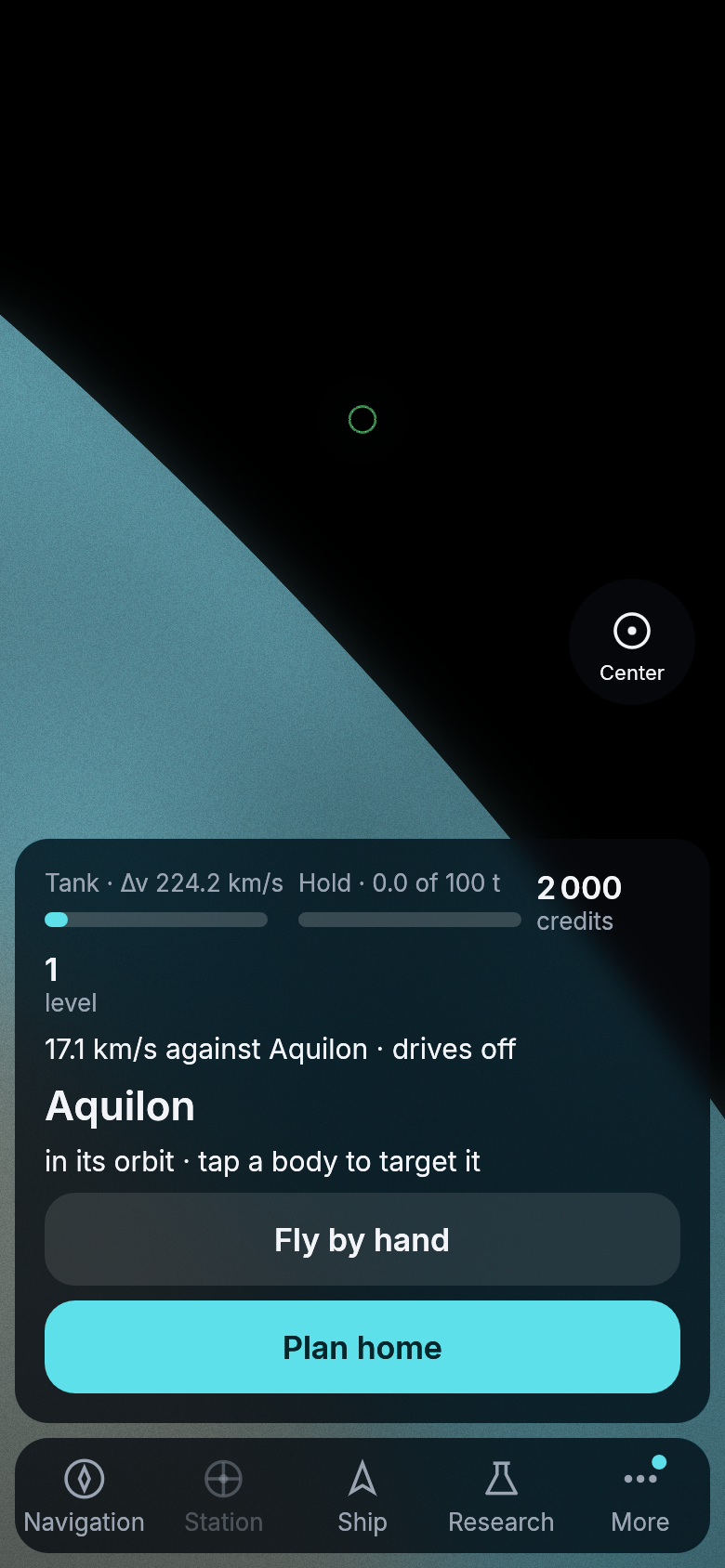
To skim it you need Mining III, which needs Mining II and Sensors III, and a Skimmer I from the Yard, fitted where the mining head was. Fly to the giant. In its orbit, the card offers Down to skim: a plan to an orbit 1 000 km over its clouds. Coming down that low takes a push of about a sixth of a g. Fusion drive I has it even with a full tank; the drive your ship starts with has it only once the tank is down to about a third. Once you are there, press Skim.
The skimmer takes a fifth of a tonne of helium-3 an hour and keeps up to a tonne of it cold, so it is full after five hours. You can leave it skimming while you are away. Every station of the Charter’s buys helium-3 at 50 000 credits a tonne.
Next: Research