Research
Every limit in Supergalactic can be raised through research, such as a bigger vault, a better drive, a faster mining head or plans further ahead. Research happens aboard your ship, wherever it is, docked, in orbit or on the way somewhere, while you do something else or nothing at all.
The tree
The Research section is drawn as a tree. Each branch (Construction, Drives, Mining, Navigation, Sensors, Weapons, Defense and Comms) has a row, each tier has a column, and a line runs from each research to the one it requires. Each node shows whether the research is done, running (with a ring showing its progress), open with its time and credits, or locked.
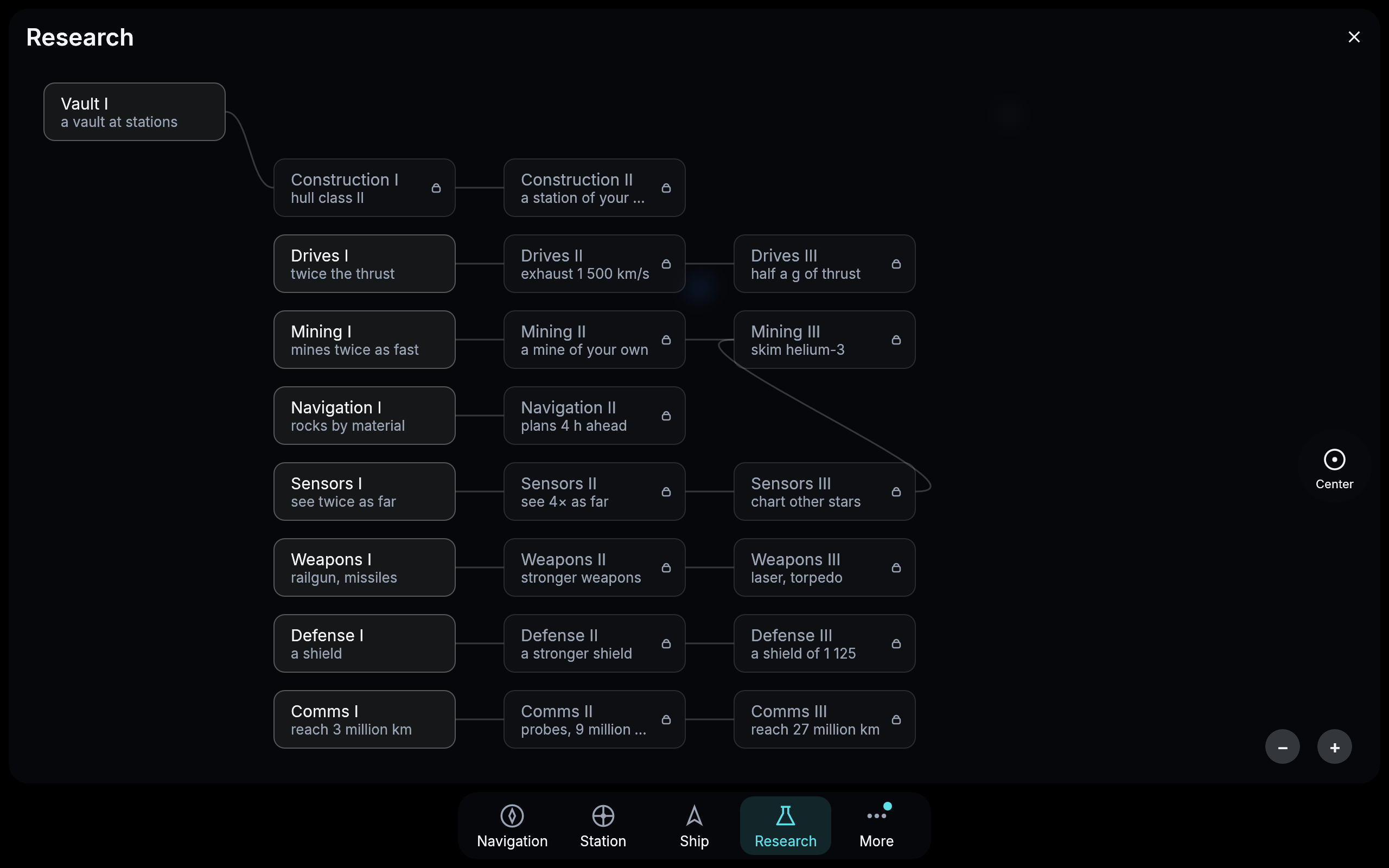
The tree at the start. Vault I comes first, then the first tier, and the later tiers and Construction wait for what comes before them. On a computer the tree fills the whole screen. On a phone the same research is a list, one branch under the other, which you scroll by dragging it.
A locked research says in the tree what it comes after. Tap a research to see what it unlocks and costs. At the top of its page are your credits, the free room in your hold and your Δv. Each cost says whether you have enough, and if not, how much is short; a research you cannot start yet says what to do about it. A locked one says what it needs first, with a button that takes you there, and See opens the blueprint a research unlocks. Docked at a station with a market, Buy the rest buys the materials a research lacks in one press, when your credits pay for them and the research.
- Credits are paid when the research starts.
- Materials come from the hold of the ship you fly. These are silicate, carbon and later metal, the same things the rocks give you. While you are docked, whatever the hold lacks comes from your vault. Away from a station only the hold counts.
- Time runs on the ship’s clock. The first research takes two minutes, a tier-1 research ten and a tier-2 research an hour. Drives III, the first of tier 3, takes six hours. It keeps running while you are away.
In a research’s detail, Research starts it if nothing else is running and your purse and hold (and, docked, your vault) can pay. Otherwise the detail says what is missing. Only one research runs at a time. The section shows how long it has left, and its icon in the bar shows a dot while it runs. When it is done, what it unlocks is offered next.
What there is to research
| Research | Takes | Costs | Unlocks |
|---|---|---|---|
| Vault I | 2 min | 10 t silicate (free in the tutorial) | a vault of 100 t that you can reach from every station |
| Drives I | 10 min | 1 500 credits, 20 t silicate, 10 t carbon (500 credits, or free with less, and 2 min in the tutorial) | the blueprint of Fusion drive I, twice the thrust |
| Mining I | 10 min | 500 credits, 15 t silicate, 5 t carbon | the blueprints of Mining head I and Extractor I, twice as fast |
| Navigation I | 10 min | 800 credits, 10 t silicate | plans up to two hours ahead, and finds the nearest rock rich in a material |
| Sensors I | 10 min | 800 credits, 10 t silicate | the blueprints of Radar I, which sees other ships twice as far, and Telescope I, which lets you zoom out further |
| Weapons I | 10 min | 800 credits, 10 t silicate | the blueprints of Railgun I, Launcher I and Point defense I (see fighting) |
| Defense I | 10 min | 800 credits, 10 t silicate | the blueprint of Shield I, 500 points |
| Comms I | 10 min | 800 credits, 10 t silicate | your radios reach 3 million km (see in reach and out of reach) |
| Construction I | 10 min | 1 500 credits, 20 t silicate, 10 t carbon | hull class II’s blueprint, the vault 500 t |
| Mining II | 1 h | 5 000 credits, 40 t silicate, 20 t carbon, 5 t metal | the mine’s blueprint, and Mining head II and Extractor II, four times as fast |
| Navigation II | 1 h | 3 000 credits, 20 t silicate, 5 t metal | plans up to four hours ahead |
| Sensors II | 1 h | 3 000 credits, 20 t silicate, 5 t metal | the blueprints of Radar II, which sees other ships four times as far, and Telescope II, out to the nearest stars |
| Weapons II | 1 h | 3 000 credits, 20 t silicate, 5 t metal | the blueprints of Railgun II, Launcher II and Point defense II |
| Defense II | 1 h | 3 000 credits, 20 t silicate, 5 t metal | the blueprint of Shield II, 750 points |
| Comms II | 1 h | 3 000 credits, 20 t silicate, 5 t metal | your radios reach 9 million km, and the yard builds probe bays |
| Construction II | 1 h | 6 000 credits, 60 t silicate, 30 t carbon, 10 t metal | the station core’s blueprint, the vault 2 000 t |
| Drives II | 1 h | 5 000 credits, 40 t silicate, 20 t carbon, 5 t metal | the blueprint of Fusion drive II, half again the exhaust speed |
| Drives III | 6 h | 15 000 credits, 100 t silicate, 40 t carbon, 20 t metal | the blueprint of Fusion drive III, half a g |
| Sensors III | 6 h | 15 000 credits, 100 t silicate, 40 t carbon, 20 t metal | the blueprint of Telescope III, which charts another star’s system |
| Weapons III | 6 h | 15 000 credits, 100 t silicate, 40 t carbon, 20 t metal | the blueprints of Railgun III, Launcher III, Point defense III, Laser I and Torpedo tube I |
| Mining III | 6 h | 15 000 credits, 100 t silicate, 40 t carbon, 20 t metal | the blueprint of Skimmer I, which takes helium-3 out of a giant’s air |
| Defense III | 6 h | 15 000 credits, 100 t silicate, 40 t carbon, 20 t metal | the blueprint of Shield III, 1 125 points |
| Comms III | 6 h | 15 000 credits, 100 t silicate, 40 t carbon, 20 t metal | your radios reach 27 million km |
Construction I needs Vault I first, Mining III needs Sensors III as well as Mining II, and every other research of the second or third tier needs the one before it in its branch. Sensors III also shows how much helium-3 a giant’s air holds, on its page in Navigation.
Your ship’s start drive already reaches the whole system, so the drive research mostly buys time and cost. Drives I and III make every burn shorter, and Drives II makes each tonne of propellant go half as far again, so a round costs a third less and a full tank reaches further.
Not built yet
Research is the first step toward building your own things. The vault is already there, and Construction I and II make it larger. The faster mining heads and extractors are built at the yard, as are the better fusion drives, hull class II, the mines and your own station.
Next: The yard